Lawmakers push road relocation, hard-structure implementation after NC 12 washout
By Miles Layton
BUXTON – State legislators and Dare County officials told residents Friday that another storm will likely wash out NC 12 again, and that the fastest help is to move the road west and loosen the state’s ban on hard erosion-control structures.
OMG — NC DOT photo shows the damage from the nor’easter. Friday, I drove past the rubble from the section of the “old” NC 12 road that got busted up and placed in the berm. The highway was repaired within three days – that’s amazing!


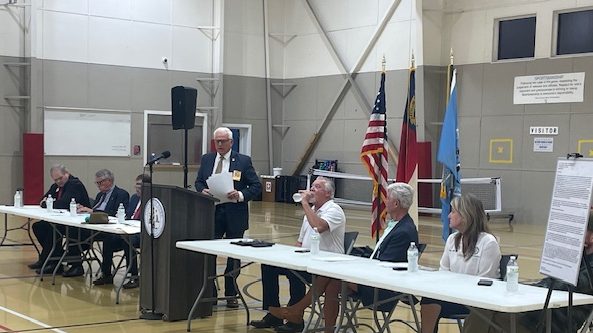
Sen. Jerry Tillett organized the panel to hear from the public and to discuss short-term fixes for the highway south of Pea Island. The panel included Sens. Michael Lazzara and Norman Sanderson, Rep. Keith Kidwell, and Dare County Commissioners Mary Ellon Ballance, Ervin Bateman, Carson Creef and Steve House, the board’s vice chair.
Tillett came prepared, informed and ready — leadership. And being a retired judge, Tillett’s voice boomed across the crowded bleachers at the Fessenden Center. The Senator and other elected leaders listened to what the public had to say, fired up the troops to send a message to Raleigh — we need help!
“We can talk about this, we can study this, we can hire some more consultants, or we can do something,” Tillett said.
There will be a separate story about the meeting’s public comments section.
Tillett said time matters.
“Another storm is inevitable, and it will wash out that road again,” he said.
A few takeaways:
Over the past 10 years or so, repairs to sections of NC 12 have cost $17.2 million!? Yes.
During that period, the road experienced 60 closures and restrictions, totaling about 467 days of traffic impact.
Speaking of road closures, Captain Ryan Albaugh of the Avon Fire Department shared this story.
“This issue is important to me on many different levels, including keeping an emergency corridor open, which is very important. I don’t know if many of you know, but during the tropical storm, we LifeFlighted a woman who was in labor. The flight crew was over their hours, and they’re heroes for doing that, because it’s something they don’t normally do. But because of the road conditions, they had to do what they had to do.”
Prayer is always a good place to start
Sanderson opened the meeting with a prayer. He asked for “a solution that all of us can abide with and live with, and that it solves the problem.”
Tillett said the meeting came in the wake of “somewhat of a crisis” in which access to the island was destroyed. He said another washout is likely.
“Four issues generally have to be dealt with: geography, money, government regulations, and time,” Tillett said.
He said the late-September storm was a nor’easter, not a tropical system. “This weekend’s event was a nor’easter, not a tropical storm or a hurricane,” Tillett said. He said such storms come several times a year and that the ocean and sound sit only a few feet from the road. What residents saw this fall, he said, will likely repeat itself.
Tillett said he wanted the event to do two things. First, he said, it should give residents a chance to be heard. Second, it should focus on a quicker, more durable fix until a permanent one is in place. He also said government bureaucracies too often use regulation to obstruct.
Subscribe — it’s free!

A road closed for days
Lazzara, who chairs the Senate’s oversight committee for the N.C. Department of Transportation, walked the audience through the timeline.
NCDOT closed NC 12 to all traffic around 5 a.m. Sept. 24, he said. An emergency ferry route began two days later, on Sept. 26. Crews reopened the road to traffic in one direction on Sept. 29. By Saturday, Oct. 3, NC 12 was open to two-way traffic again, nearly 24 hours ahead of the original schedule, Lazzara said.
He acknowledged that residents felt information came too slowly during the closure. He said he had explained the department’s reasoning to Tillett. Storm surge was still high, he said, and crews could not get to the damage to judge what came next.
“We do not put information out until we are 100% sure of the information that we put out,” Lazzara said.
Tillett thanked the N.C. Ferry Division and road crews for their work in emergency conditions. He said the emergency ferry could not carry the volume of people and goods that the road normally does. The washout, he said, left hundreds of island families stranded.

What the road has cost
Ballance told the crowd the state has spent roughly $15.4 million maintaining the corridor over about 10 years. The latest storm brought that figure to about $17.2 million, she said. During that period, the road experienced 60 closures and restrictions, totaling about 467 days of traffic impact.
She said the lowered roadway is now more exposed. Dunes that once washed over and protected the road will not last long, he said. Sandbag repairs and replacements could add another $1 million every five years, Ballance said, reciting NCDOT data. Moving the road back from the ocean would cost between $6 million and $9 million, she said.
Tillett said the cost goes beyond maintenance. Each washout, he said, also triggers an emergency response and leaves the island’s residents and visitors cut off. Even with relocation, he said, the risk of losing access does not go away.
A statement from Sen. Bob Brinson was read aloud by Tillett. It said NCDOT has spent $17 million on routine maintenance on NC 12 in Dare County since 2010 and $51 million more on storm repairs. It also said Dare County has $82.2 million in shoreline management efforts planned for 2026, and that beach nourishment is not lasting as long as it once did.
House gave the audience some history. He said a task force, that included about 20 people, filed a report in 2023. The National Park Service and U.S. Fish and Wildlife Service asked NCDOT to move the road, he said, a request that was denied.
He said the state has a fund for beach nourishment, but has not distributed any funds. He also said the county’s dredge could place sand only at certain sites due to how it operates. A federal permit’s environmental conditions, not money or time, stopped the most recent project, he said.
NCDOT, not the county, owns or maintains any roads.
Moving the road
Tillett said the road should be repaired first, and then moved west to put distance between it and the water. He called relocation a stopgap, not a cure. He said the cost is about $5 million and the work could be done fairly quickly.
Lazzara put the figure at about $7 million. He said that is hard to square with the amount already spent.
“We’ve spent $17 million already, but we can’t invest $7 million,” Lazzara said. “So a lot of things a government does sometimes just doesn’t make any sense.”
He said NCDOT is working with the Federal Highway Administration on emergency funding. He added that the department is working with environmental agencies on a temporary reroute that would “buy a little time.”
Lazzara said the project has not yet been scored in the state’s transportation priority system. He said NC 12 is only now being moved onto the step where it can be considered. Environmental issues and money both complicate the road, he said.
A bridge is far off
Lazzara said a bridge to replace the exposed stretch of NC 12 is not on the horizon.
“To build bridges, you’re looking at $500 million to $750 million,” he said. “I don’t see that happening anytime soon.”
He said NCDOT has a budget of about $5.8 billion for 81,000 miles of state-maintained roads, second in the nation behind Texas. Roughly $2.6 billion of that goes to new construction across the state, he said. He said the gas tax was capped years ago, and that more efficient and electric vehicles mean it no longer brings in what it once did. Costs have also outrun revenue since the pandemic.
“What we used to get for a dollar, we’re now getting about 30 cents, 40 cents,” Lazzara said.
He pointed to the proposed Wilmington bridge as an example. Estimated project costs started at about $380 million, he said, and now stands at $1.2 billion, even with about $200 million in federal money.
He said an elevated road, not a full bridge, might be within reach. “If we can get that down to $200 million versus a $700 million bridge, then maybe that’s more attainable,” he said.
But he warned that the state could not pay for it alone. He said NC 12 would not qualify for tolling.
“North Carolina, in its current format, we will not have the revenue for a single project of $200 million without tolling,” Lazzara said. “It won’t happen, and this doesn’t qualify for tolling, so it couldn’t even be tolled.”
He urged residents to contact their federal representatives and said federal help has changed the outlook for other major bridge projects in the state.
“I’m an honest person, so I like to sort of be transparent,” he said. “What I will commit to all of you, as long as I’m in this title, is that we will continue to work on long-term solutions.”

The hard-structure debate
Tillett and Kidwell both pressed for lifting North Carolina’s ban on permanent hard erosion-control structures such as seawalls. Brinson filed Senate Bill 1009 this session, with Lazzara and Sen. Bobby Hanig, who Tillett recently replaced, as primary sponsors. It would direct the Coastal Resources Commission to regulate such structures by rule rather than ban them by statute. In his statement, Brinson said the bill does not waive the permitting process.
“Coastal constituents are demanding that local, state, and federal governments act to protect their communities and beaches,” Brinson said in the statement.
Brinson said the bill is not a proposal to let every property owner build a seawall. What it asks, he said, is whether modern, site-specific options exist that could protect homes, roads, utilities and public beaches without causing unacceptable harm.
Tillett said the state stands alone.
“We are the only state in the nation to have an inexorable, complete ban on hard structures up and down the coast,” he said.
Other states have addressed intense, short-term storm damage with some form of hard protection, he said, and the road is better protected as a result.
Sanderson said he signed on to the bill as a supporter. “I’ve signed on to the hard structure deal because I think that in some cases, as in Oregon Inlet, they work if they’re put in the right place and they’re constructed the right way,” Sanderson said.
Kidwell said he worked with Brinson on the bill. He said the ban was a poor idea from the start and should be revisited. He also said he does not want the pendulum to swing too far.
“Now I’m not thinking we need to cut down everything, tear up sand dunes, and kill turtles,” Kidwell said. “You’re not going to beat nature. You have to work with it.”

Money from Raleigh and Washington
Sanderson, who chairs the Senate Agriculture Committee, said the state budget is limited. Education accounts for about 65 percent of it, he said, leaving less for roads and local infrastructure.
“We can’t spend money that we don’t have,” Sanderson said.
He said lawmakers must balance the budget every year, and that the legislature has cut taxes rather than raised them in his time in Raleigh. He said he wanted to hear from residents because part of the answer might be in the room.
He said Dare is not the only county affected when NC 12 washes out. Tourism traffic bound for neighboring Ocracoke Island depends on NC 12 and the ferries, he said, and a loss would hurt Hyde County as well. Tourism is among the state’s top economic drivers, he said.
Kidwell said the answer is ultimately financial and federal. He said Dare County is one of about five donor counties, meaning it sends more money to Raleigh than it receives.
“There’s only one solution, and that’s money,” Kidwell said of building a solution. “It will take federal dollars.”
He said residents should contact U.S. Sen. Ted Budd and the district’s congressional representative.
Kidwell said his time in office is nearly up. “I have 83 days left that I’ll be serving,” he said. “I will do what I can in those 83 days to make sure we at least get the temporary solution to this problem.”
The General Assembly is not expected to return to Raleigh until after the November election, he said.
Kidwell also pointed to the ferry docks, where he said parking lots and shoreline are eroding. He said losing a dock during the same storm as a road closure is a real possibility. He said the problems need to be fixed before the first of the year.
What residents can do
Tillett closed the evening by urging residents to take two concrete steps. He said they should call their county leaders and legislators about eliminating the ban on hard structures in specific locations, at least under emergency conditions, and about funding and carrying out the road’s relocation.
He said the tourism the road supports is worth the effort. He said the island generates about $38 million in revenue, a figure he said does not capture all its economic effect.
Tillett’s quotes bear repeating.
“We can talk about this, we can study this, we can hire some more consultants, or we can do something,” Tillett said.
He said time matters. “Another storm is inevitable, and it will wash out that road again,” Tillett said. He added that leadership in Raleigh will change in January.


Let us know what you think by leaving a comment. Comments are subject to approval.