By Miles Layton
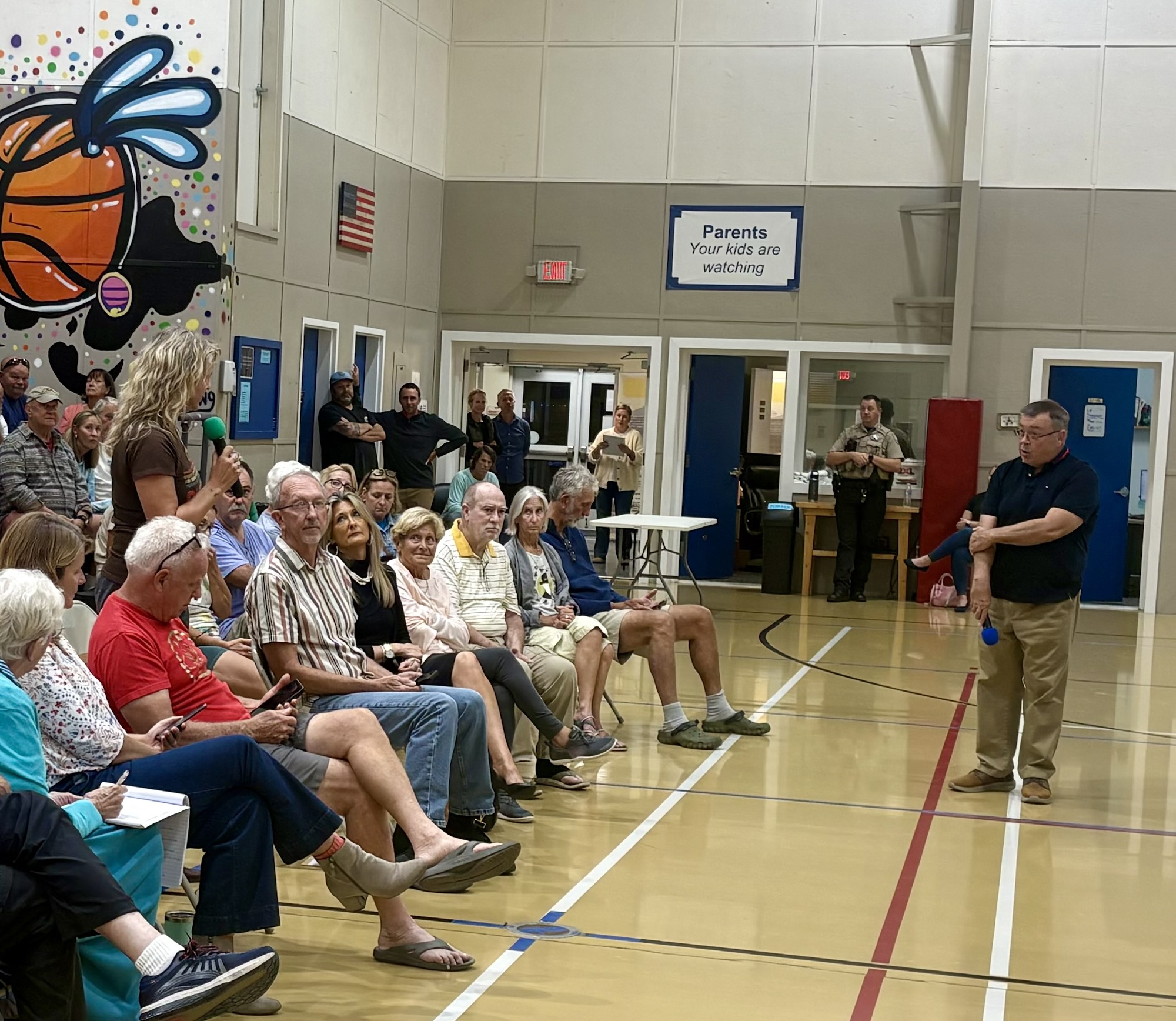
BUXTON – After state lawmakers finished laying out options for NC 12 on Friday, residents took the microphone to press them for action. They spoke about bridges, federal money, hard structures and the plain fact of getting people off the island in an emergency.
About a dozen speakers addressed the panel at the Fessenden Center. Most offered ideas. A few expressed doubt that anyone in Raleigh would listen.
Bev Boswell said she had been doing her own homework. She told the panel she had come prepared with a speech, but lawmakers had already covered most of it.
“I did find three federal grants,” Boswell said. She said she plans to bring them to U.S. Sen. Ted Budd and Rep. Greg Murphy.
She said it will take cooperation at every level. “It’s got to be all three of us, or we won’t get anything done for this bridge,” Boswell said.
She thanked the panel for handling public money carefully. “I want to thank you for being good stewards with our money,” she said.
Justin LeBlanc, executive director of the Ocracoke Access Alliance, said the road is not only a concern for Hatteras Island. Most visitors to Ocracoke arrive by way of NC 12, he said, and residents use it to reach medical appointments.
“The NC12 issues and challenges that you face are our challenges as well,” LeBlanc said.
LeBlanc offered one suggestion. Any fix near Pea Island, short-term or long-term, will require relocating the Pea Island National Wildlife Refuge visitor center, he said.
“We can’t build a road where that visitor center is,” LeBlanc said. He said the building is a U.S. Fish and Wildlife Service facility on National Park Service land and should be paid for by the federal government.
“Let’s get that wildlife center visitor center moved so that we have choices to make about the road,” he said.
Sen. Jerry Tillett said talks are underway with both agencies. “There are ongoing conversations,” Tillett said. He said representatives of the two agencies had earlier committed to attend the meeting.
Jeannette Vorce argued that funding exists if officials look for it. She said Dare County ranks fourth among North Carolina counties in the money it sends to the state.
“Dare County is number four on the list for giving funds to North Carolina,” Vorce said.
She also pointed to federal spending at Cape Hatteras National Seashore, which she put at $202 million. She said she knows how transportation budgets work because she used to work for the N.C. Department of Transportation.
“There’s ways not to move the buckets, but to reallocate the money,” Vorce said.
Ryan Albaugh, captain of the Avon Fire Department, said he has also built roads for a living. He told the panel he has spent nine years watching how the road, dunes and beach interact.
Albaugh repeated the account he had given earlier that evening about the medical flight for a woman in labor during the storm.
“This issue is important to me on many different levels, including keeping an emergency corridor open, which is very important,” he said. “I don’t know if many of you know, but during the tropical storm, we LifeFlighted a woman who was in labor. The flight crew was over their hours, and they’re heroes for doing that, because it’s something they don’t normally do. But because of the road conditions, they had to do what they had to do.”
Arbaugh then turned to what he thinks should happen next.
“We need to move the road far west,” Albaugh said. He said the road should skip the visitor center altogether.
He said the dunes should be left alone. “Let the dunes do their own thing,” Albaugh said.
He said he has seen two places where the beach has rebuilt itself without help, at the new inlet and near the Jug Handle Bridge. Sand collects there, he said, because there are no dunes.
Aida Havel questioned whether the advice to call legislators would do any good. She said Dare County Board of Commissioners Chairman Bob Woodard wrote to all 170 state senators and representatives in November 2025.
The letter asked for three things, Havel said. It sought money for the state beach nourishment fund, long-term strategies for NC 12 and a second look at the ban on hardened structures.
Havel said Boyle reported this past Monday that only one senator and one representative had acknowledged it.
“If the chair of our county commissioners couldn’t get the response from 168 of our elected representatives, do we stand a chance?” Havel asked.
She then put the question to the panel. “I am asking each of you tonight to commit to supporting what we requested,” Havel said.
Natalie Kavanagh arrived straight from her son’s marching band performance at a soccer field. She said she is a “bridge mom,” a reference to the mothers who campaigned for replacement of the Bonner Bridge and later bridge projects.
She said the state backed away from one proposal, a 17-mile bridge priced at $1.1 billion, because it would never be funded. Officials turned to a series of smaller projects at trouble spots instead, she said.
Kavanagh said Pea Island is deteriorating faster than planners expected. She said she has seen drawings and plans for a bridge there.
“I realize that $200 million is a hefty price tag. But we need to have it done,” Kavanagh said.
Kavanagh said the mothers who wrote letters earlier were asking legislators and NCDOT to keep their families safe. “I hope you will remember that when it is time to vote on these things, and let us know how we can help,” she said.
Brett Barley said he was nervous at the microphone but encouraged by the meeting. He said Pea Island’s problems are not new.
“I would say the meeting went a little different than I expected. It was pretty encouraging,” Barley said.
Barley said the delay has raised the bill. The state’s habit of pumping sand because it is cheaper in the short run has caught up with it, he said.
“When we keep kicking the can down the road, then it’s going to cost more,” Barley said.
He said the road runs through a wildlife refuge and a national park, America’s first national seashore. He said federal money should be available.
Barley’s main concern was emergency access. He said emergency responders and visitors were handed “an absolute mess” during the closure. He said there is no emergency route known to all the agencies involved.
“We need to have emergency routes that are secondary,” Barley said. He said they could be basic four-by-four tracks on land west of the road.
The tone shifted late in the evening when Marcie Shoemaker challenged the panel’s argument that money is short.
“I want to say that I think it’s a little bit disingenuous for you guys to all sit up here and say there’s no funding, that they won’t fund this line item, when the Republicans have had a supermajority in this state for 15-plus years. These men are asking us to find the money for this, to talk about this, and to come up with solutions. Well, they’re the ones up there in Raleigh. They have been there for 15-plus years with a supermajority.”
As Shoemaker spoke, a man near her looked down at the floor, put his hand over his face to rub his temples as he shook his head, while other members of the crowd sighed and looked away, before someone cut Shoemaker off: “Please keep the partisan politics out of the this.”
Another person added, “We’re seeking solutions.”
Let us know what you think by leaving a comment. Comments are subject to approval.