By Miles Layton
ELIZABETH CITY — A couple of texts came in asking me to check out Monday’s Elizabeth City Council meeting.
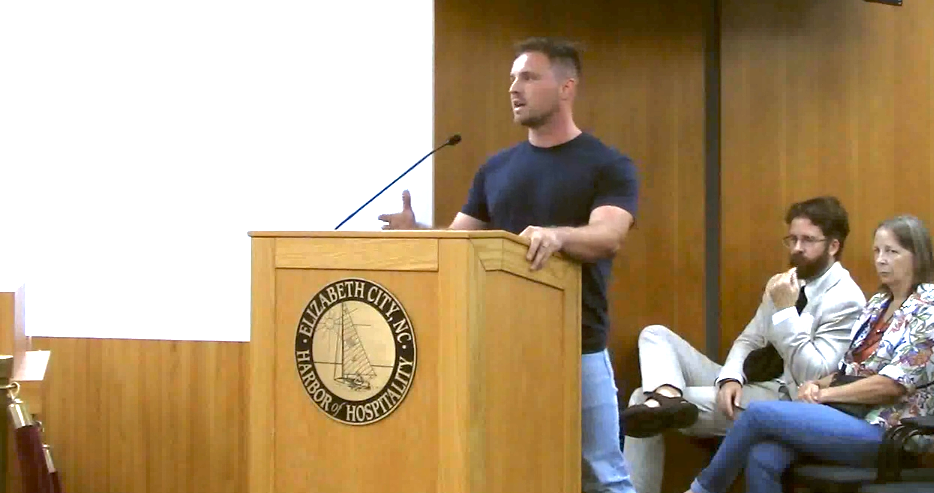
That heads-up did not disappoint because a parade of residents took to the podium during the public comment portion of the meeting to warn that the city’s rapid growth is outpacing its infrastructure, straining its finances and, some argued, threatening to erase the small-town character that drew many of them here in the first place.
Five speakers in particular — David Long, Katie Canning, Rachael Surface, Conrad Mollenkopf and Ginger Feliciano — offered starkly different angles on the same underlying concern: that Elizabeth City is changing fast, and the council needs a plan for what comes with that change.
More council news will appear in another story — subscribe, it’s free!
David Long, who told the council he lives outside the city and county line, said he served 12 years in the Army before returning to build a farm, continuing work his grandfather had started before him.
Long said his family’s roots in the region run deep; he described himself as an eleventh-generation North Carolinian whose sixth great-grandfather is buried near a downtown pawn shop. He also referenced a recent local news article that he said had stuck with him, posing the question of “whether the people who built the city” are “being left behind” by its growth.
Long framed his remarks as an after-action report, borrowing military terminology to lay out what he called the goods and the bads of the city’s direction. On the positive side, he pointed to the revitalization of downtown Elizabeth City, recalling it as rundown when he was a kid, with the Carolina Theater as one of the few draws still open.
“The downtown area is growing,” he said. “You’re getting local shops in, it’s becoming beautiful again.” He praised the restoration of historic buildings and the redevelopment of the cotton mill, saying the city should continue following that model for other historic homes.
But Long said he worries the city is approving new development too quickly, risking what sets it apart from other coastal communities.
“We are recklessly approving new developments,” he said. “We are barreling into becoming just like Hampton Roads, a faceless metropolitan area.” He argued that residents of larger, less distinct cities often struggle to describe what their own community is known for. “It’s because they lost their culture,” he said. “The culture has died.”
Long pointed to the recent story of Carl Witten, whose neighbors were honored earlier in the same meeting for rescuing him and his wife from a house fire, as an example of what he doesn’t want the city to lose — more on that story later.
“That showed me small-town community,” Long said. “And that’s what I want to continue to see. I don’t want to see our culture die here.”
Speaking of Long, he’s featured in this story — click here — he’s a leader of a rural resistance to save Northeast NC’s farmland and culture.

Katie Canning spoke about the city’s finances, referencing bond financing figures tied to millions needed to pay for infrastructure projects. She said she understood that growth requires new water, electrical and road infrastructure, but pressed the council on what she called the human side of the equation.
“What kind of community are we building alongside of all this housing?” she asked. “Where are the living wage jobs? Where are the additional services and activities for our children and teenagers?”
Canning was careful to frame her comments as a call for planning rather than an objection to growth itself.
“I’m not asking Elizabeth City to stop growing,” she said. “I’m asking us to look at the whole picture as we invest millions in the physical infrastructure of Elizabeth City. We also need to think about our human infrastructure.”
Speaking of Canning, she made a passionate speech — click here — last week at the Camden County Commission meeting.

Rachael Surface took a different approach, framing her concerns around the city’s historic character. She opened by invoking a lesson she said residents learned as children.
“I want to remind you of something we learned in our school days, and that is: be yourself,” she told the council. “The value of Elizabeth City does not lie in turning us into Chesapeake or some other nearby city. Our value lies in the preservation of the buildings, houses and natural landscape that represent the heritage that we hold dear in this community.” She pointed to other North Carolina towns — New Bern, Southport, Edenton, Hillsborough and Mount Airy among them — that she said had successfully built their identities around historic preservation, adding that visitors are “hungry for authenticity” even as land and history disappear rapidly across the state.
Surface described a recent First Ward meeting where a list of roughly a dozen buildings faced possible demolition, some of them what she called “beautiful, irreplaceable historical homes.” She recounted an exchange from that meeting that troubled her. “A woman said, ‘These are historical buildings. You can’t just tear them down,’” Surface said. “And some people there actually laughed. Someone said, ‘Oh yes we can.’” Surface said she regretted not learning the name of the woman who raised the objection, calling her “a voice of reason in the room.”
Surface argued that the city’s identity is bound up in figures and stories that predate its current growth boom.
“Elizabeth City has a story to tell that is all its own,” she said. “But the approvals you’re making are destroying it.” She invoked several names tied to local history — Betsy Tooley, Peter Moore of Elizabeth City State University, Hattie Harney, Flora Robinson and Nellie Cropsey among them — and highlighted the city’s connection to Nelson Davis, a Union soldier she identified as Harriet Tubman’s husband. “Look him up,” she told the council. She closed on a lighter note, saying she supports a proposed hot cocoa walk downtown but argued the city’s real identity runs through a different local product.
“Everyone knows that Elizabeth City was raised on Orang-Aid from Comstock’s,” she said. “If we’re anything, we’re the Orangeade capital of the world. We could draw money and profit from what we already have, and who we already are, instead of trying to be somebody else.”

Conrad Mollenkopf said he hadn’t prepared formal remarks but wanted to build on points raised by earlier speakers. “I want to echo some of the same things that the people were talking about growth here,” he said. “Growth is necessary, but I think it plays to the character that people are trying to retain in the city here. And that’s important.” Drawing on his work touring properties “from the mountains to the water,” he framed Elizabeth City’s affordability as increasingly rare. “This is the last small coastal community of its type on the entire Atlantic seaboard, almost, that’s still affordable,” he said. He agreed that growth is inevitable but urged the council to weigh its effect on residents of different ages and backgrounds. “We really need to look at the quality of life of the people that we’re doing here,” he said. “And that quality of life varies depending on who you are, whether you are twelve, twenty or sixty.”
Mollenkopf also raised infrastructure concerns, pointing specifically to strain on the region’s water supply. “Things like the Yorktown aquifer is being challenged already,” he said. “We’re downstream of that aquifer, so you’ll be addressing that soon in years to come.” He cited figures suggesting a significant share of the area’s population doesn’t work locally, noting that “sixty percent of the people that live in Pasquotank County don’t work here” and that “twenty five percent of the people that live in Elizabeth City commute to Virginia to work.” He argued that trend risks producing a community of residents less invested in local civic life.
Mollenkopf closed by pointing to what he called the root of the city’s growth pressures: voluntary annexation tied to individual land sales. “A farmer is selling his land, so that’s the first problem,” he said. “And then the developer is asking for annexation, and that’s an easy yes, because we’re looking at dollar values, we’re looking at progress and we’re looking at growth.” He cautioned that without accompanying jobs and schools, new housing alone doesn’t strengthen a community. “There’s no return on investment on this residential growth if we don’t have jobs accompanying it, schools accompanying it, and growing the people,” he said. “Just giving people a place to live is not growing the people.”
Ginger Feliciano delivered some of the evening’s sharpest criticism, arguing that the city’s basic upkeep has fallen behind its appetite for new commercial development. “The speed and direction of our town’s recent growth is alarming, and it’s hurting the people who actually live and work here,” she said. She pointed to the condition of the city’s streets and sidewalks as evidence. “The streets and sidewalks are covered in potholes,” she said. “They get circled, they sit unfixed for months. Walking paths are overgrown. The sidewalks are literally crumbling. It’s unsafe for the elderly, kids, bikes, wheelchairs — pretty much everyone.” She contrasted that pace with how quickly commercial projects move forward. “When a new corporation gas station like Royal Farms comes to town, it gets built in record time,” she said. “We know this town floods. We know we’re always going to need those basic repairs. An entire town should have the labor and supplies ready to fix its infrastructure first.”
Feliciano also argued that new development is destabilizing the local housing market. “The hundreds of new premium units are causing a dangerous ripple effect,” she said. “A two bedroom from a private landlord used to run between nine hundred and twelve hundred dollars in Elizabeth City, while corporate properties are charging up to eight hundred, eighteen hundred.” She said that gap is out of step with what many residents earn. “The average salary for an adult working full time, living and working here in Elizabeth City, is between thirty five thousand and forty three thousand,” she said. “After taxes, that’s about twenty four hundred or twenty nine hundred a month.”
She said private landlords are following the new corporate properties’ lead, raising rents on older homes and squeezing longtime residents. “It’s pricing out long-term locals,” she said. “After paying rent, your average worker is left with maybe a thousand before utilities, groceries and life.” She argued the city’s growth is increasingly benefiting remote workers relocating from Virginia rather than the people who already live and work locally. “The secret is out — remote commuters are moving here, easily paying these high prices because it’s still cheaper than Virginia,” she said. “Now the existing renters who work here in Elizabeth City are the ones suffering.” She was skeptical that the new businesses arriving in town are improving residents’ quality of life. “What are we actually building for the community? Wawa, Royal Farms, Burlington Coat Factory?” she said. “Let’s be honest, these aren’t really helping the people of our town. It’s a handful of low-paying jobs and another place to spend money. That’s not quality of life.”
Feliciano tied the city’s growth pressures directly to its youngest residents, arguing that a lack of safe gathering spaces pushes teenagers toward places where they end up in conflict with police. “Our youth have nowhere to go,” she said. “Without safe, constructive places open late, they end up at the splash pad or the skate park after dark or hang out at Wawa, then they get the police called on them.” She urged the council not to dismiss the issue as somebody else’s problem. “Simple things like being able to get a new pair of shoes, having a place to hang out with friends, and feeling a sense of belonging — those small things can be the difference between a child growing up to be the person who steals your car and robs you, or growing up to be the person who will become a surgeon and save your life one day,” she said. “I implore you to really think of the families in town and the basic needs of these kids.”
She closed by pressing the council on how it communicates with residents, arguing that digital notices leave out a significant share of the community. “A Facebook post or a piece of paper taped to the door is not meaningful communication,” she said. “We still have residents without smartphones and computers. Direct letters and automated calls need to be utilized. If a resident’s trash pickup is being rescheduled, they need to be told.” She ended her remarks with a direct appeal to the council. “I am asking you today to pause and focus on what matters,” she said, “to keep the town from growing too fast.”
Make a one-time donation
Make a monthly donation
Make a yearly donation
Choose an amount
Or enter a custom amount
Your contribution is appreciated.
Your contribution is appreciated.
Your contribution is appreciated.