By Miles Layton
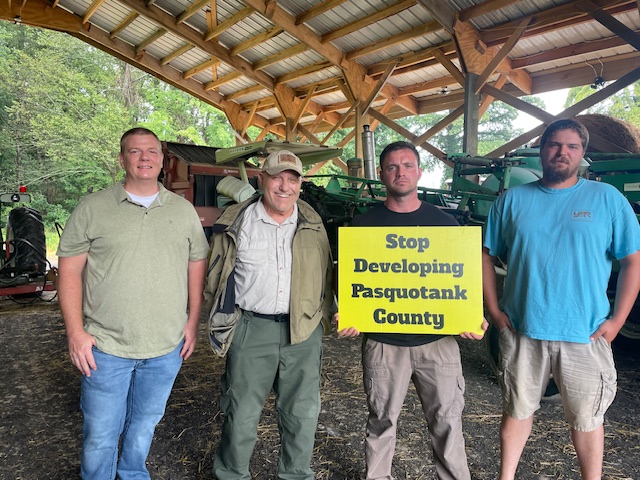
PASQUOTANK COUNTY — Thursday, I traveled out to Wade Reid’s farm to talk to a group of folks – David Long, Ben Barnhill, Will Mercer and Pasquotank County Commissioner Sean Lavin – who are on the front lines of a rising insurgency to protect their communities from an invasion of housing developments and suburban sprawl – unrestrained, unmanaged growth that threatens a way of life.
Through my travels across Pasquotank County, I’ve seen many yellow signs that say “Stop Developing Pasquotank County.” The concerns shared by these rural revolutionaries, who are not anti-growth but seek managed property development that preserves the region’s cultural identity that’s tied to agriculture and small-town values, are not unique to Northeast North Carolina.
Indeed, wherever you live in counties bordering highways leading through Camden, Chowan, Perquimans, Gates, places near and far, you know an invasion is coming, whether it be through gentrification or housing developments as far as the eye can see.
That’s why we met on a quiet stretch of land at a farm where the ground sits barely seven feet above sea level, and family names go back centuries; a quiet alarm has turned into an organized movement. Farmers whose families have worked the same soil for generations, military retirees who moved here to escape the city, and even a sitting county commissioner are finding themselves on the same side of an unlikely fight: slowing down the pace of residential development before it changes northeastern North Carolina beyond recognition.
A quote from our story about Wade Reid says it all.
“My name is not Esau,” he said, invoking the Old Testament figure who traded his inheritance for a meal, “and damn if I am going to sell my birthright for a bowl of porridge.”
This song about country roads comes to mind if we don’t wake up, push back and take a long view of what we could be losing.
Subscribe — it’s free!
A State Losing Ground
The pressure is not imagined. North Carolina is now the fastest-growing state in the nation by population, and by several measures, it is also losing farmland to development faster than any other state. In counties like Pasquotank, Camden and Gates, that growth is arriving from the north — spilling down from Chesapeake and Virginia Beach along the Interstate 87 corridor — and it is landing on flat, rural counties that were never built to absorb it.
For David Long, an eleventh-generation northeastern North Carolinian and first-generation farmer, the fight is deeply personal. Long served 12 years in the Army as an infantryman before coming home to start a small farm of his own — 35 acres where he raises dairy and beef cattle, poultry and hogs. He said finding land as a small farmer was already difficult before developers entered the picture.
“My land beside me was supposed to come up for sale. Fifty acres. I tried to buy it. The gentleman that was selling it was going to sell to a developer,” Long said. He couldn’t afford it himself, so he called a neighboring farmer, who bought the tract instead — but only because the seller, unusually, didn’t take a higher offer from a developer looking to outbid local buyers just to keep the land out of local hands. “They want to keep everybody out,” Long said. “They want that land because obviously they’re going to make a ton of money on it by subdividing it.”
For Long, protecting that land isn’t abstract. “Land is power,” he said. “They print money every day; they do not print land.” He said he’s passed that philosophy down to his children, along with the belief that “land’s worth more than gold.”
“Married to the Land”
That history is what worries Will Mercer, a fifth-generation farmer whose family has worked the same land in Pasquotank County since 1902. Mercer now farms roughly 3,200 acres, much of it leased, and said he isn’t trying to expand so much as hold on to what his family already has. “We’ve lost acreage here and there — twenty acres here, ten acres here — and it doesn’t sound like a lot, but it happens constantly,” he said.
Mercer said he isn’t opposed to development in general and even credits the renovation of Elizabeth City’s old cotton mills and downtown buildings as a genuine improvement. But he draws a hard line at losing farmland and the drainage systems that keep the region from flooding. “Half this county is in some way, shape or form in a flood zone,” Mercer said, explaining that it’s local farmers and landowners — not the government — who maintain the ditches and waterways that keep the area dry. When housing developments build retention ponds near those waterways and then fail to maintain them, he said, “everybody floods out. It costs the farmer, it costs the local, it costs all the businesses.”
Mercer said the land itself deserves protection on its own merits, not just sentiment. The region gets rainfall and soil conditions that make it possible to grow crops that can’t be grown “once you go two hours south of here,” he said. But it’s the human cost of losing it that stays with him. “I’m married to the land first and foremost,” he said. “I can’t just up and leave and try to go somewhere else to redo all of the bloodline work that has happened here. It’s irreplaceable.”
Mercer said the region’s rural character was never an accident — it’s the product of generations of families who settled here to be self-sufficient. “This entire area was historically developed on that principle,” he said, describing today’s full-time farmers as, in effect, “the homesteader that was successful.”
“The Irony of Ironies”
Ben Barnhill, a retired 30-year military veteran, moved to the area 16 years ago hoping to become the kind of homesteader he’d dreamed of during decades of deployments overseas. He now keeps 11 acres for his cattle, a serene and scenic farm. He said the irony of the current wave of newcomers is impossible to miss. “The people that are coming here — basically they want to recreate the place they came from,” Barnhill said. “That is the irony of ironies.”
Barnhill runs a community Facebook page with roughly 1,200 members tracking development news across Pasquotank, Camden, Gates and Perquimans counties. He said the concerns cross party lines and cross county lines, but they all point to the same math: new subdivisions bring new costs long before they bring new tax revenue. “The effect on us of building new infrastructure — new high schools and elementary schools, and also emergency services, police, sheriff, EMTs, fire — all of that stuff costs money, and that gets passed on to the taxpayers,” he said. He added that many of the homes being built will sell for $300,000 to $500,000 — well beyond what most local families can afford. “Who around here can afford to buy one of those?” he asked. “So who’s going to be living in them?”
Barnhill pointed to state zoning law, which currently requires a minimum ten-acre lot size on land zoned rural agricultural, as one of the few real protections standing in the way of large-scale subdivisions. But he warned that protection isn’t permanent — it exists only as long as the legislature leaves it alone. He referenced House Bill 765, a development-friendly rezoning measure he said was authored largely by Charlotte-area developers, which stalled this session but is expected to return. “They want to basically push out of the way the small rural areas that are opposing this and centralize the authority,” he said.
The Commissioner’s View
Pasquotank County Commissioner Sean Lavin, who represents the district north of Elizabeth City, said the issue resonates because it crosses political lines in a way few local issues do. “This is an issue that’s got broad appeal across political lines because a lot of people understand how it impacts them specifically — whether it’s the lifestyle that they live, rural country living, more relaxed, probably more outdoors than most places,” Lavin said.
Lavin said the county has a 20-year master plan meant to steer growth into areas with existing infrastructure, but that Elizabeth City hasn’t consistently followed it. “It’s eating away at the ag land that’s available to us,” he said. “It’s not in line with all of our infrastructure that they need for some of those places, and it’s just compounding some of the problems that we’ve already got with drainage and our tax base.”
Lavin pushed back on the idea that new subdivisions are a straightforward win for county tax coffers. He cited a study from Johnston County showing that for every dollar collected in commercial and industrial tax revenue, the county spent 86 cents on services — but spent $3.86 for every dollar collected from residential development. “You’re going to get the taxes eventually, a few cents every year, but you’ve got to put that initial investment in,” Lavin said. In the meantime, he said, county residents pick up the cost through their own bills — from Dominion Energy power rates to county water fees to solid waste charges, which have already climbed from around $150 a year to close to $190. “Bills by default are going to go up,” he said.
Lavin said the growth is also straining an institution the area depends on for basic safety: the volunteer fire department. Mercer, who has served for more than seven years with the Weeksville Volunteer Fire Department — one of the largest fire districts by area in the state — said membership is already stretched thin, with roughly half the department over age 50. “If you don’t have the folks that are either working on the farm during the day or have a local job, you are not getting anybody on the volunteer fire department to answer the call,” Lavin said.
Not Anti-Growth, Just Anti-Erasure
The group’s demand is not to halt growth entirely — several members said that would be unrealistic — but to slow it down and align it with the region’s existing infrastructure and culture. “We’re not looking to stop growth,” Long said. “But you can curb it to fit the culture of the area, so the gentrification doesn’t push out all of the locals.”
Long said he’s already watching longtime neighbors consider leaving the place their families have lived for generations, driven out less by high prices than by a sense that the culture is shifting under them. “It’s happening everywhere,” he said of the regional pattern. “It’s just in North Carolina, in general, we are the largest loser of farmland to development in the entire nation. But like I said, we’re not doing this smart. We’re not doing this to fit the culture.”
As Barnhill put it, only half-joking, “We’re in the beginning stages of an insurgency” — one built not on party lines, but on a shared fear of watching home become somewhere else.
Make a one-time donation
Make a monthly donation
Make a yearly donation
Choose an amount
Or enter a custom amount
Your contribution is appreciated.
Your contribution is appreciated.
Your contribution is appreciated.