By Nicole Bowman-Layton
EDENTON — What began as a public hearing on Chowan County’s proposed budget evolved Monday night, June 1, 2026, into a broader discussion about taxes, communication, public trust and whether residents feel heard by local government.
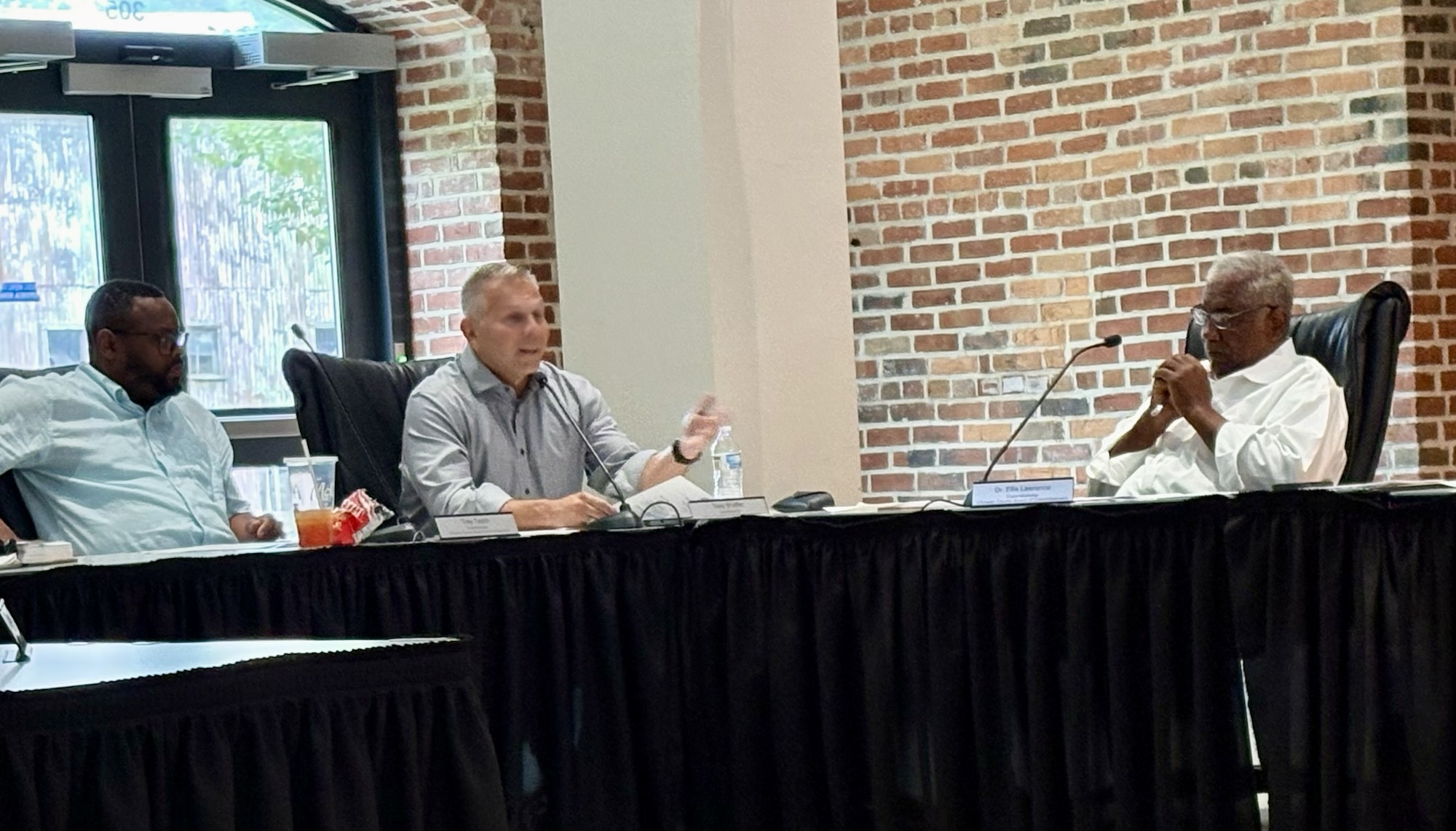
The hearing came as commissioners continue work on the county’s fiscal year 2026-27 budget. Attendance at recent commission meetings has increased noticeably since budget discussions began this spring, with residents regularly speaking about property taxes, county spending, debt and government accountability. The public hearing was part of the board’s regular meeting held at the Chowan County Public Safety Center on West Freemason Street in Edenton.
More about the meeting, appears in a previous story about a future public hearing to discuss a proposal to spend $500,000 for a new grocery store to come to Edenton.
County Manager Kevin Howard opened the hearing by clarifying the county’s revenue-neutral tax rate calculation. Howard said a citizen correctly pointed out that the county needed to apply a state-required growth factor when calculating the rate.
That adjustment changed the county’s revenue-neutral rate from approximately 55.25 cents to 56.37 cents per $100 of assessed value.
“As far as I’m concerned, the 55 is our revenue-neutral rate,” Howard said. “That’s what we’re trying to achieve as far as matching last year’s revenues.”
The discussion soon moved beyond tax rates.

Resident John Sams (a copy of his speech appears below) criticized county spending, property tax increases following recent revaluations, debt associated with the construction of the new John A. Holmes High School and the county’s tax agreement with the Timbermill wind energy project.
Sams also challenged what he described as unequal tax impacts following the county’s recent property revaluation.
Using examples from county tax records, he compared tax increases on several lower-income Habitat for Humanity homes with increases on higher-value properties owned by prominent residents Laurie Buckhout, who is running for Congress against Don Davis, and Commission Chair Bob Kirby.
Sams said a $3 million waterfront home that increased in assessed value by approximately $625,000 would see its tax bill increase by only about $8 under the proposed revenue-neutral tax rate. He said Kirby’s $1 million home in the Rocky Hock area, which increased in value by about $265,000, would see a tax increase of roughly $162.
By contrast, Sams said several Habitat for Humanity homes valued at approximately $150,000 could see tax increases ranging from 30% to 58%.
“Affordable housing is slipping out of their reach,” Sams said of the homeowners. “Taxes is one of those things that causes it.”
Sams acknowledged that the homeowners he referenced had done nothing wrong and were simply operating within the existing system, but argued that county leaders should examine whether the results are equitable.
“The county needs to really honestly ask, is the system working fairly for everybody?” he said. “To me, obviously it’s not.”
Sams argued that many residents feel disconnected from county decision-making and questioned whether taxpayers are adequately represented. He also directed criticism toward several commissioners individually, questioning their responsiveness and accessibility to constituents.
Other speakers focused less on specific budget figures and more on communication between residents and county government.
During general public comment, Lisa Laws urged county leaders to consider distributing printed newsletters with utility bills, saying many residents do not rely on websites or social media for information about county business.
“I just think that would be a great way to inform the public because, as you know, we’re rural, and we don’t have a lot of good service in the entire county for broadband,” Laws said.
During the hearing, Laws echoed concerns about affordability, saying rising costs affect working families and residents living on limited incomes. She argued that keeping taxes manageable is important to maintaining economic accessibility for county residents.
Kim Ringeisen said residents who speak during public comment periods are often frustrated and uncertain whether their concerns are being taken seriously.
“For them it takes great courage to stand up here and do so,” Ringeisen said. “What they’re bringing here is a plea for help that comes from the feeling of hopelessness about the process and a little bit of frustration.”
Ringeisen said some residents may not always express their concerns perfectly but argued county leaders should focus on the concerns behind those comments.
“The question should be, why does the citizen feel that way?” Ringeisen said. “Why is that comment being made?”
He also proposed creating a formal process for commissioners to revisit public comments at subsequent meetings so residents can see whether concerns raised during public comment periods have been addressed.
The discussion also produced at least one area of agreement.
After Ringeisen suggested a formal process for responding to public comments, Commissioner Larry McLaughlin noted that the Edenton Town Council routinely follows up on issues raised by citizens at the following regular meeting and said the county should consider a similar approach.
Howard said he often tries to address public comments later in meetings through his manager’s report, but acknowledged he could do a better job of communicating those responses.
County officials responded by explaining some of the legal and procedural limitations under which local governments operate.
Howard said North Carolina counties are creatures of the state and can exercise only powers granted by state law. Responding to a suggestion that commissioners place an advisory question about county spending on the ballot, Howard said counties do not have that authority.
“We don’t make the rules,” Howard said. “We had to follow a certain process.”
Howard also defended the county’s budgeting process and noted that inflation has significantly increased the cost of providing county services. “An ambulance now is $350,000 versus $175,000 five years ago.”
McLaughlin addressed criticism of the county’s decision to finance the new John A. Holmes High School through a U.S. Department of Agriculture loan rather than a bond referendum. McLaughlin said commissioners believed the USDA loan offered taxpayers a lower interest rate and a longer repayment period than a general obligation bond.
Howard also noted that the grants the county received would only pay for new construction. If the old high school was entirely renovated, the county would have had to pay for the entire project.
“There was asbestos in the entire building,” Kirby said of the old school. “… What we would have had was a 75-year-old building with lipstick on it.”

Commissioners also responded to criticism directed at them personally during the hearing.
Commissioner Ellis Lawrence defended his record of public service and noted that he pays county taxes like other residents.
“I pay taxes too,” he said and added that people can look up his property holdings online.
Commissioner Tray Taylor said serving the community, rather than popularity, is his primary responsibility as an elected official.
“My job here as a commissioner is to serve this community, and I think I’m doing a darn good job,” Taylor said.
Commissioner Tony Shaffer noted that the commissioner and audience are all adults and know how to use a phone. He encouraged residents to call the county offices or set up a meeting with staff to learn about unfamiliar issues. The board noted that one of the speakers had a one-on-one meeting with Howard to discuss the proposed budget.
Shaffer also encouraged residents to become more involved in local government and attend budget workshops if they want a deeper understanding of the county’s finances.
“If you all don’t like the fact that there’s a ballot that someone’s not running for, run for it yourself,” Shaffer said. Later, he invited residents to attend future budget meetings and “come see how the sausage is made.”
Kirby defended the role of elected officials and pushed back against suggestions that commissioners lacked public support.
“We have full consent of the governed because the governed is who elected us,” Kirby said.
He also responded to criticism of the county’s wind energy tax agreement, saying Chowan County receives significantly more revenue from Timbermill than neighboring counties with similar wind farms.
“Our wind turbines this year, the first year that we collected taxes and then gave a rebate, the total we collected was $750,000,” Kirby said. “Perquimans County collects $70,000 a year. Pasquotank collects $70,000 a year. We collect $750,000.
“I think we’re doing it right,” he added.
Commissioners are scheduled to continue budget discussions during a work session Thursday morning, June 4, 2026, before considering final adoption of the budget during the June 15, 2026 meeting.
John Sam’s speech


Let us know what you think by leaving a comment. Comments are subject to approval.