By Miles Layton
EDENTON — During Monday’s Chowan County Commission meeting, a trio of residents pushed back against property revaluations they called excessive and a proposed tax rate they said amounts to a tax increase, as County Manager Kevin Howard presented a $30.6 million budget for fiscal year 2026-27 that reduces the nominal tax rate while generating more revenue than a revenue-neutral rate would allow.
Howard’s proposed budget sets the property tax rate at 60.25 cents per $100 of assessed value — down from the prior rate but 5 cents above the revenue-neutral rate of 55.25 cents. Because countywide assessed property values rose 26 percent following a state-mandated revaluation, most property owners will pay more in taxes than they did last year despite the lower rate.
“There is not a tax increase, but the budget does reduce the tax rate to $0.6025 based on revaluation,” Howard wrote in his budget message. “This rate is questionable because the Senate has moved forward a bill that would put a one-year moratorium on revaluations. That would stop us from using our new values, so we would need to figure out what the tax rate would need to be based on the old values.”
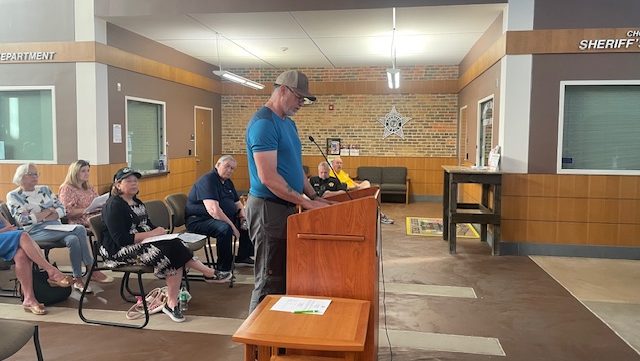
The feature photo with the story comes from the meeting when Kim Ringeisen offered a detailed critique of how the county is balancing its budget by raising property taxes.
More news items from Monday’s meeting will appear in a future story.
Subscribe — it’s free!
Costs real, options limited
Vice Chairman Larry McLaughlin broke down the five cents above revenue neutral into its components for the public. “The salary increase basically is, once covered, about one cent,” he said. “The DSS is about a penny and a half. The jail is a penny and a half. And miscellaneous things gets us up to five cents increase over revenue neutral.”
McLaughlin said he had done the math on his own property and was not pleased with the result. “My taxes will go up,” he said. “So I’m not happy. But then I am looking at this — these are the facts.”
Commission Chairman Bob Kirby framed the commission’s constraints in blunt terms after Howard noted the extent of mandated spending. “Let this statement sink in,” Kirby said. “Seventy-five percent of what we’re doing here is mandated. We can’t do a damn thing about it. It’s fixed and done. Seventy-five percent of your property tax budget — what we’re budgeting here — is set either federally or statewide.”
Editor’s note: Repeat after me – “Unfunded mandates!” Time and again, Kirby has railed against Raleigh and DC’s unfunded mandates — policy changes that have rolled down on local taxpayers for years.
And I’ll say the quiet part out loud – there’s nothing more dangerous than when the General Assembly is in session, regardless of the political party. Senate Bill 889 seeks to bar counties from applying new property tax rates based on recent appraisals — a measure that would affect at least a dozen counties, including Chowan. If NC Senate Bill 889 is signed into law, you’d better grab your wallet because there will be shortfalls in future county budgets.
Looking ahead, Kirby said, “The state people tell us that if we can’t collect enough money to balance our budget, we have to start cutting things. We will have to cut those things that are not mandated by the state (Recreation, ambulance services, senior center). So just be aware of that. We’re not going to cut the schools, but we might have to cut some of these other things. I don’t want to create a firestorm here, but I don’t want to give you the good news of this act because right now, it’s going to be a difficult budget time for us.”
Public: revaluations “absurd,” taxes unaffordable
Steve Karl led off public comment with a pointed critique of both the revaluation process and what he characterized as government spending beyond its means.
“I’ll be honest with you, they’re absurd,” Karl said of the revaluations. “Just going by square footage just doesn’t work. It’s going to have many long-term effects. First of all, people are going to think their property is golden and expect to get property prices of that. Sales prices won’t go anywhere near what these revaluation prices are.”
Karl said he checked his own property against 33 Redfin estimates and found the current revaluation came in more than 25 percent above last year’s estimate. He warned that inflated valuations would make housing unaffordable for working families.
“These little houses that are going up for two hundred and fifty to five hundred thousand dollars — I couldn’t afford one on a teacher’s salary,” he said. “What I’m requesting is that the tax rate keep the budget at where it was last year.”
Karl acknowledged the county faces real cost pressures but argued that households face the same constraints.
“When I have that problem at home, I can’t go to my bank account — it gets lower,” he said. “We don’t have endless supplies of money. So please live within our means.”

Invoking the nation’s 250th anniversary, Karl closed with a warning that hearkened back to Penelope Barker’s tax protest: “And with that 51 ladies had a tea party — they were protesting taxes. My radical feeling is that maybe it’s time for Chowan County residents to also have a tax party.”
Kirby pushed back on the comparison to the American Revolution. “One note needs to be made,” he said. “That protest was about taxation without representation. You are talking to your representatives right now.”
A second speaker, Kim Ringeisen, countered that the distinction was not so clear. “Taxation without representation means that voters have to vote on — if we buy a high school or not,” Ringeisen said. “The voters did not have a vote on that. It was decided by the commission.”
As Kirby would say – the voters elected the commission.
Back to Ringeisen, who offered a detailed fiscal critique, noting that total spending grows five percent this year to $30.64 million while the county’s population is roughly six percent below its 2010 level. He argued the commission has grown the budget faster than the tax base can sustainably support, drawing on reserves and using new revenue to fund projects that bypassed voter approval.
Ringeisen also flagged the Holmes High School debt load. “We’re paying in the budget $1.87 million on that debt that we’re going to have to service,” he said. “At $153,000 per student, Holmes’ system is more expensive per student than any North Carolina peer in the public record, including the Durham School of Arts, that was $116,000. Durham is a specialty school. Holmes is not, and its enrollment is declining.”
Ringeisen framed the proposed rate plainly: “This is a tax increase.” He called on the commission to publicly confirm that taxes will rise for most residents, calculate and publish a revenue-neutral fire tax rate — noting the county fire district rate would effectively jump 25 percent for unincorporated property owners — and publish a one-page breakdown of how many cents of the tax rate go toward specific debt obligations, including Holmes High School and the DF Walker debt.
Ringeisen also asked the commission to extend the property tax appeal window by 30 days beyond the May 11 deadline. “Most homeowners don’t have an idea how to even file an appeal, how to gather the information, how to do comps or anything like that,” he said.
James Frens, of Old Fish Hatchery Road, told commissioners his property assessment rose roughly 50 percent — the second large jump he has experienced on different properties. He said the property was already on the edge of affordability when he purchased it about a year ago.
“This tax rate and the evaluation would put it well over my point of affordability,” Frens said, asking whether the county had considered phasing in large assessment increases or capping individual tax bill hikes.
Howard: mandated costs drive proposed rate
Howard walked the commissioners through the budget’s structure, noting that 69 percent of general fund revenue comes from property taxes, with sales tax accounting for another 15 percent. The countywide assessed value rose to $3.08 billion from $2.4 billion the prior year — a $645 million increase. See our budget story here.
He said expenditures were held essentially flat except for unavoidable cost increases: a salary adjustment stemming from a regional compensation study, rising DSS costs driven partly by federal funding reductions, new jail-related obligations, and two new sheriff’s positions.
Howard said federal policy changes are pushing program costs down to counties with little warning or certainty. “They reduced the funding they’re putting into those programs,” he said of federal DHHS cuts. “So, those programs are actually done through our DSS on the local level. So they push the cost of those programs that are mandated down to the states — and pushed on down to the counties to pay for.”
He estimated the county could absorb roughly $1 million in increased DSS costs over the next two years, cautioning that the figure remains uncertain. “We have no idea,” he said. “That’s an estimate.”
Howard also warned that several pieces of pending state legislation could significantly alter how the budget is ultimately structured, including a proposed one-year moratorium on revaluations and a potential constitutional amendment that would limit how much counties can raise property tax rates in a single year.
“Our flexibility is taken away,” Howard said of the proposed amendment. “If we have huge expenses come up, if things change — which we can’t limit — our flexibility is taken away. No matter what we do, property taxes are the largest source of revenue we have.”
Budget workshops will be held in the coming weeks, during which commissioners said they would examine whether any reductions are achievable before a final vote. Before anyone gets any notion of speaking at these work sessions scheduled for May 28 and June 4, there is no public comment period, and as far as I know, there never has been public comment allowed during work sessions. If you want to protest, symbolically dump some overpriced British tea into Edenton Bay in front of the Barker House.
Make a one-time donation
Make a monthly donation
Make a yearly donation
Choose an amount
Or enter a custom amount
Your contribution is appreciated.
Your contribution is appreciated.
Your contribution is appreciated.
4 responses to “Chowan County budget draws pushback over revaluation, tax burden”
I am preparing a letter to the editor of the Chowan Herald that specifies what citizens can do. Hopefully the Albemarle Observer will publish it also. In the meantime to better educate yourself go to: robinsams.com/tax.htm, govinsights.io, and the Facebook site for Kim Ringeisen. Chowan County has a Spending Problem…Budget in 2021: $15.8 million; proposed Budget $30.6 million…almost double—these are not all “unfunded mandates” from Raleigh and Washington.
John — posted your letter: https://albemarleobserver.news/2026/05/05/letter-chowan-county-has-a-spending-problem/
[…] online to: robinsams.com/tax.htm, govinsights.io, and the Facebook page for Kim Ringeisen — see our story here. Read about how the new high school figures into the new budget. 2) Talk with your neighbors about […]
[…] The debate is unfolding as county commissioners begin work on Chowan County’s proposed fiscal year 2026-27 budget. […]