By Nicole Bowman-Layton
The hope promised by Harbor Towns Inc. has long been a dream for many residents who live along the Albemarle Sound. Going from Columbia or Elizabeth City to one of the other communities along the waterway by boat, rather than by car, is appealing to some — a new way to explore the region.
With net assets of roughly $13.7 million in 2024, the nonprofit promising that vision — Harbor Towns Inc. — has paid its officers more than $200,000 over two years while they reported working one hour per week, and has two fast ferries sitting beside a dock listed for sale.
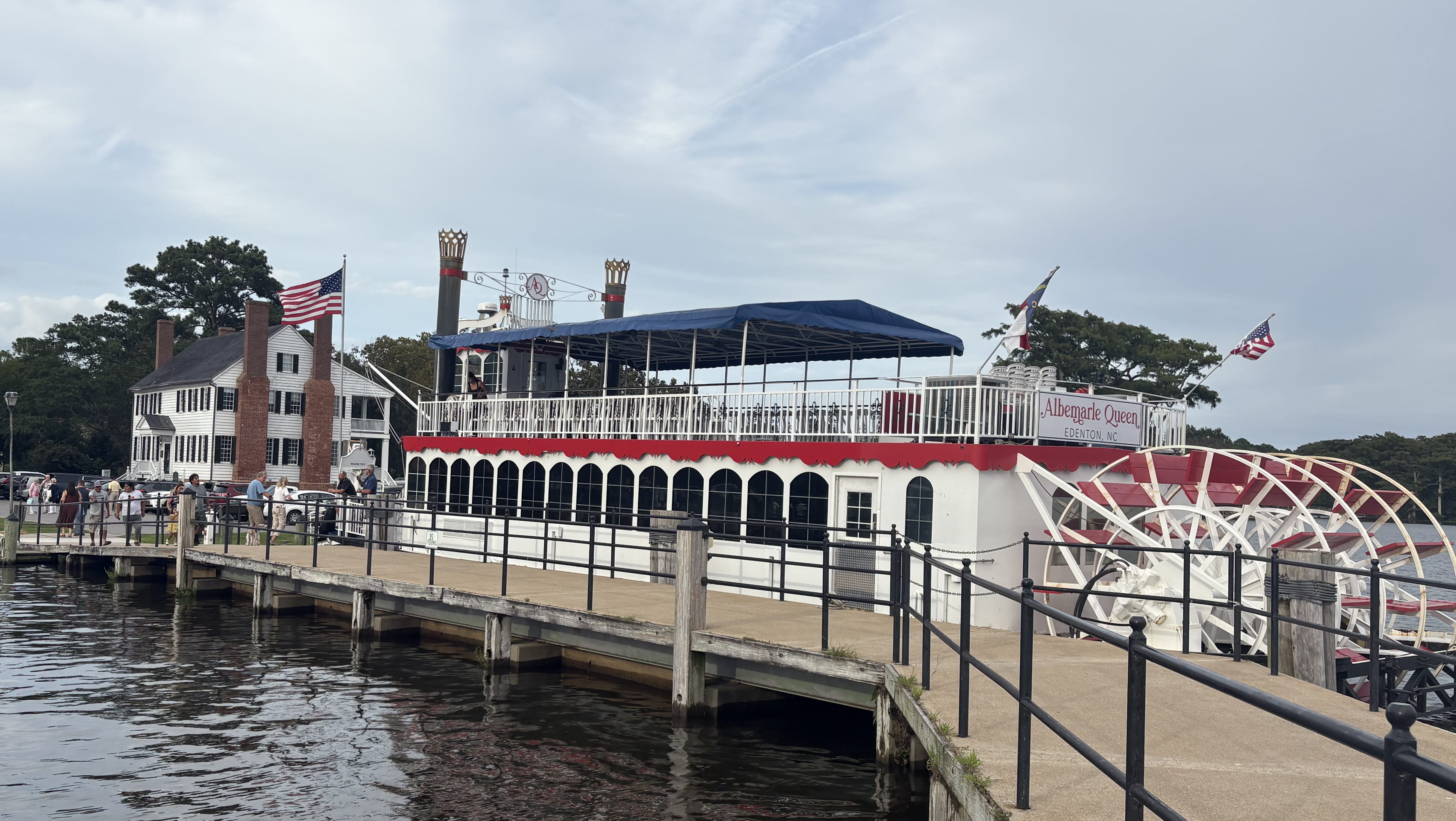
While Harbor Towns’ steerwheeler, the Albemarle Queen, has finished its first full season of private and event cruises, the regional ferry network promised to northeastern North Carolina remains unbuilt.
Now, with a June deadline looming to spend remaining state funds or lose them, the nonprofit is coming to the Edenton Town Council on Feb. 10 with new spending proposals for the town’s allotted grant funding, as taxpayers wonder about their return on investment.
Harbor Towns Treasurer Peter Thomson and Chris Morris, with AR Chesson Engineering, are scheduled to present an update at the Edenton Town Council meeting at 6 p.m. Tuesday, Feb. 10, at the council chambers, 504 S. Broad St., Edenton. While no vote is listed on the agenda, the Harbor Towns presentation notes that some grant spending will need the council’s approval.
The meeting will be held in the Council Chambers, 504 S. Broad Street. Remote Video Access Available via https://us02web.zoom.us/j/2524822155?pwd=T0NFUEJ0MXlnV3B2UFA1S0R0ajgzUT09 Meeting ID: 252 482 2155 Passcode: 458434 Dial in Option: 301-715-8592 (Meeting ID & Password same)
More information on the council meeting, including the agenda, can be found in the accompanying story, which can be found here.
A 30-year circle
The story of ferry service in the Albemarle Sound has been told before, for about 30 years — by some of the people listed on tax documents as officers of Harbor Towns Inc.
In February 1995, Estelle “Bunny” Sanders, then director of the tourism division of the Northeastern N.C. Regional Economic Development Commission, enthusiastically touted her two-year pursuit of a high-speed ferry concept. In reports from those days, she said there was “a good chance a ferry will be operating here by 1996.”
The timeline didn’t unfold the way she planned.
The concept was familiar: a high-speed ferry would “shuttle tourists to the Albemarle waterfront towns” and provide passenger service connecting multiple communities. The ferry would offer “early April service,” Sanders said.
Three decades later, Sanders held a different title — secretary of Harbor Towns Inc. — and the nonprofit’s promises sound remarkably similar: a regional ferry network connecting five towns, regular passenger service and tourism-driven economic development.
And once again, the regional ferry service has yet to materialize.
The board
Harbor Towns’ IRS Form 990 filings from 2022-2024 list five principal officers during the years when the organization received and spent the bulk of its state appropriations. Only one — Ed Goodwin, the current state representative for District 1, who is listed as a director — did not receive any compensation. The filings show that all compensated officers reported working an average of 1 hour per week for the organization.
The 2024 filings report the following compensation:
- Nicholas Didow, President & CEO — $30,000 in 2024; $79,709 in 2023, $0 in 2022
- Philip McMullan, Vice President — $7,500 in 2024; $19,664 in 2023, $0 in 2022
- Peter Thomson, Treasurer — $36,000 in 2024; $78,417 in 2023; $0 in 2022
- Sanders, Secretary — $18,000 through October 2024; $36,000 in 2023; $0 in 2022
- Goodwin, Director — $0 reported compensation for 2022-2024
The IRS requires nonprofits to report both compensation and estimated average weekly hours for each officer. Nonprofit governance experts note that the “hours per week” figure often reflects administrative classifications rather than a detailed accounting of actual work performed. The filings remain the only public record of how Harbor Towns represents its leadership structure and workload.
The filings do not explain how responsibilities were divided among officers, how compensation levels were determined, or how the organization evaluated performance relative to the project’s progress. Harbor Towns has not publicly released job descriptions, internal governance documents, or board minutes that would clarify how decisions were made or how oversight was exercised.
These questions have taken on new relevance following Rep. Goodwin’s comments at a January Chowan County GOP meeting, where he said he had “washed [his] hands” of Harbor Towns and was not involved in day‑to‑day operations.
A North Carolina state representative can be a member of a nonprofit board, but must adhere to strict ethics and conflict-of-interest rules. An example would be if a nonprofit has a government contract or grant, the lawmaker must recuse themselves from voting or participating in that decision.
The law applies only to cities, towns, or villages with more than 15,000 residents and to counties that have municipalities with 15,000 or more residents, making it applicable in about 60 of North Carolina’s 100 counties, according to the Foundation for the Carolinas. It applies to officials elected or appointed to serve, not to government staff or contractors.
Public filings, however, list him as a director during the years when major appropriations were secured and spent. Harbor Towns has not clarified when or whether he formally stepped down.
Prior to Harbor Towns’ creation, Goodwin was the main proponent of the Inner Banks ferry system’s creation in the state legislature. Like Sanders, Goodwin promoted the ferry concept for several years until it received state funding.
Current financial picture
Since 2022, Harbor Towns Inc. has received roughly $15 million in state appropriations. IRS Form 990 filings for 2022-2024 show:
- In 2022: $5 million in contributions and grants ($5M in state grants), and $12,408 in investment income, for a total of $5,012,408. General expenses were $367,874 and included $329,931 for ferry boat expenses, $20,624 for management, $10,218 for advertising and promotion, and $7,061 for travel.
- In 2023: $10.01 million in contributions and grants ($10M in state grants) and $79,728 in investment income, for a total of $10,089,728. Expenses totalled $827,177 and included $213,790 in board salaries; $165,342 for marketing and promotional services (including $135,000 for marketing services to Nicole J and Co. of Elizabeth City); $112,500 to Tex Gallup of Wanchese as senior captain in charge of the crew; $370,000 in various fees; $17,004 for travel; $4,166 for conferences, conventions and meetings; and about $36,000 in “other” expenses. In 2023, Harbor Towns had net assets (fund balances) totaling $14,584,116.
- In 2024: $0 in contributions and grants. The nonprofit made $99,456 in program service revenue, $22,406 in investment income, and $72,802 in “other revenue,” for a total of $194,664. Expenses totalled $1,075,244, and included $91,500 in board salaries, $189,031 for marketing and promotional services (including $135,000 for marketing services to Nicole J and Co. of Elizabeth City); $112,500 to Tex Gallup of Wanchese as senior captain in charge of the crew; about $567,000 for various fees; $29,060 for travel; $2,710 for conferences, conventions and meetings; and about $132,000 for “other” expenses. In 2024, Harbor Towns recorded a loss of $880,580; however, it had an overall fund balance of $13,710,982.
The 2022 filings also list major expenditures on vessels, including the Albemarle Queen paddle‑wheel dinner boat and two fast ferries, Penelope and Moses Grandy. Harbor Towns describes these vessels as central to its tourism strategy.
Because Harbor Towns received an OSBM grant, it must file quarterly performance reports with the state agency.
Challenges and Goodwin’s assessment
The two fast ferries have not been in use and are listed as being for sale, according to the broker.
In an October 2025 speech to the Sons of Confederate Veterans, Edenton Bell Battery, Goodwin addressed the fast ferry situation directly.
“Two boats (fast ferries) sitting in the marina, they haven’t been moved since they got put out there,” Goodwin said, noting that the vessels were purchased from western North Carolina. “They were … built by people who basically didn’t know what they were doing. And you can’t find somebody locally who knows about boats like that.”
While there have been offers to buy the boats, Goodwin said no sale has been finalized.
“They’ve been trying too, but they haven’t sold them yet,” he said. “Some people are coming up wanting to buy them, but they won’t sell them for that price.”
When asked whether the boats could be repaired instead of sold, Goodwin said, “Yeah, that’s been discussed. Probably the best thing to do is fix them so they’d be right, period.”
While the fast ferries remain idle, the Albemarle Queen, launched in 2025, provides event cruises. Harbor Towns recently announced that the vessel hosted 3,191 guests, of whom 1,659 were from outside the Albemarle Sound region. However, a regular regional ferry system connecting multiple towns has not yet been implemented.
Barker House allocation
One Harbor Towns proposal before the council on Tuesday — a $250,000 allocation toward repairs at the Penelope Barker House — is outside of the project’s original scope.
Emails obtained by this newsroom show that Harbor Towns leadership and OSBM approved the use of state grant funds for waterfront building improvements, even though the details had not been finalized.
Didow described the Barker House work as tourism-related, writing that the improvements would “cross promote various tourism and visitor attractions” and support Harbor Towns’ broader visitor experience.
The proposed projects from the Edenton Historical Commission, which operates and is housed in the Barker House, include:
House:
- Fix any rotted soffit/fascia for bird intrusion
- Repaint exterior
- Blue porch ceiling scratch and match
- Re-coat porches
- Shutters rebuilt on the north side of the door, moving to north side of the house, acetylated lumber for longevity
- Window restoration, repair any rotted sash and reglaze with linseed oil base
- New carpet for stairs
- New elevator/other ADA improvements
- Repaint front second-floor exhibit room
- Repair water damage from chimney flashing failure
- Refit third floor door so that it locks
Mechanical Enhancements:
- New HVAC high-efficiency – Closed-cell foam insulation for the attic/HVAC room will greatly improve efficiency and reduce pest access.
- Qualified electrician to look at electrical enhancements
Administrative Space:
- Remove all items in the attic, place in storage or dispose (return genealogy books to the library, send paintings in storage to museum)
- Create more office space and meeting space on third floor. New desks, office equipment
Computer Enhancements:
- POS system that includes outside sales option for closed or busy days for trolley and paddle boat sales, perhaps tie in with the town for kayak rentals, etc.
- New computers and phone system, etc.
The total costs of these projects are estimated to be $250,000. Harbor Towns, AR, Chesson and the Edenton Historic Commission will create a final list of priorities. The most important items would be completed first until the funds run out.
Projects must move quickly
According to agenda materials, Harbor Towns’ leadership is emphasizing urgency. The organization states that remaining state‑appropriated funds must be under contract by early June to meet requirements set by the Office of State Budget and Management (OSBM). Any funds not obligated by that deadline would revert to the state.
Harbor Towns was promoted as a multi‑town initiative involving Edenton, Hertford, Elizabeth City, Plymouth, and Columbia. Agenda materials describe Edenton projects in varying stages of planning or development. Other maritime-related infrastructure projects across the region are in various stages of completion.
Email correspondence reviewed for this story shows Didow delivering the same message privately. In an email to a reliable anonymous source, Didow wrote that “we must have all items under contract by the end of the state fiscal year” — June 30, 2026 — adding that any unspent funds “must be redirected to the state.”
To meet the deadline, Harbor Towns outlines several Edenton-area projects it says are intended to support tourism and waterfront activity, including repairs to the Penelope Barker House, waterfront lighting improvements, breakwater repairs, reconstruction of waterfront washrooms, and construction of a pavilion or gazebo near the harbor.
Harbor Towns describes these projects as complementary to its tourism strategy, stating that they would enhance the visitor experience and support harbor-related activity tied to its vessels.


Promises vs. Deliverables: Then and Now
What Was Promised in 1995:
- High-speed ferry service by 1996
- Shuttle service for tourists to Albemarle waterfront towns
- Early April service launch
What Harbor Towns Promised (2019-2021):
- A regional ferry network connecting five to eight towns
- Regular passenger service using fast ferries
- Tourism-driven economic development across the Albemarle Sound
- Upgraded docks and waterfront infrastructure in each participating town
- A project that would “return water transportation” to the region
- A system that would operate as a multi-town, multi-vessel network
What Has Been Delivered (2025):
- The Albemarle Queen dinner boat launched in 2025
- Two fast ferries were purchased and delivered
- Demonstration cruises and limited events occurred
- Some planning for waterfront improvements has been documented
- No regular ferry network is operating
- No published ridership data for the fast ferries
- No comprehensive accounting of infrastructure upgrades across all towns
- Several vessels remain underused or idle
- No public report showing economic impact or tourism growth tied to the project
The 30-Year Pattern:
- Ferry service promised: 1995, 2019, 2020, 2021
- Ferry service delivered: Never
- Tourism benefits promised: 1995, 2019, 2020, 2021
- Regional economic impact demonstrated: Not documented
- Multiple towns to be served: 1995, 2019, 2020, 2021
- Multi-town network operating: No
One response to “Harbor Towns races deadline to allocate grant funds; wants to redirect money to Barker House”
[…] That said, this story says otherwise — that some board members are paid. […]