BY MILES LAYTON
GATESVILLE — Northeast North Carolina is poised for economic growth and has the ability to attract and retain business development — same as those counties in urban areas.
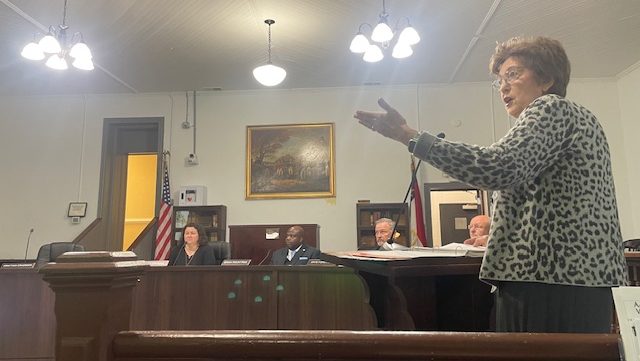
North Carolina Secretary of State Elaine Marshall delivered an expansive presentation to the Gates County Board of Commissioners on Wednesday, urging local leaders to focus on early intervention, community partnerships, and entrepreneurial support to help small businesses survive beyond the critical first years.
And Donna Phillips, MBA, Vice President of Economic Development for the NC East Alliance, shared her vision of hope and progress ahead for rural areas in the region she calls home.
Let’s start with Marshall — she talked about Rural RISE NC initiative — a program designed specifically to support rural economies.
Rural RISE NC — short for Resources for Innovators, Start-ups, and Entrepreneurs — is a Secretary of State–led initiative that connects rural small business owners with mentors, counselors, funding sources, and other free resources to help their ventures grow and succeed. The program, Marshall said, is central to her office’s mission of giving entrepreneurs the tools they need “to thrive and grow their local economies and North Carolina’s economy as a whole.”
Marshall opened her remarks by highlighting growth patterns across the state. “13 of the counties that grew by more than 100%, 10 of them were tier one counties. I was very impressed with that,” she said. But she cautioned that sustaining that momentum requires commitment and timely support. “I’m going to get into what we have to do to keep them alive.”
She told commissioners that since she first took office, “all the Secretary of State’s office since I’ve opened the doors has created 2.3 million new businesses across North Carolina. I don’t look at that as numbers. I look at that as families, people who want to put their time and effort on the line to create a dream for their family, for their community.”
As a self-described “country girl,” Marshall said rural development remains personal for her. “I know what it’s like to feel like a second-class citizen, that you live in a place where nobody cares, nobody knows. But I’m here to tell you that North Carolina does care, and this assistance is available” for all types of businesses, she said.
That assistance, she stressed, must reach entrepreneurs quickly. “We know from our historical data that we have a very short window of time in which to get resources to these folks,” Marshall said. “In three years we lose 25% of these new business creations. And in seven years we lose 50%.”
Because filings come through her office, “we call ourselves a primary communication channel because we’re the very first to know that somebody… said, ‘today’s the day, I’m gonna do it.’” To reach them immediately, the office sends out county-specific bulletins. “This is a Gates County entrepreneurship small business bulletin,” she said, explaining that each notice includes resource contacts by name, desk phone and email.
She also praised the state’s community colleges, calling them “one of the most under-recognized, under-appreciated, valuable resource for businesses.” Their business counselors, she added, offer “confidential, no-cost services” and “experiential learning” that many first-time business owners need.
Marshall said the office’s resource lists have evolved with input from thousands of entrepreneurs. “What we provide in this bulletin… is what people told us they needed.” That includes lenders who work with startups, business counselors, and a detailed checklist. For restaurants, she joked, even ice cream requires clarification: “The first thing you’ve got to go: is it hand dipped or is it soft serve? Different entities regulate different ones.”
She shared anecdotes from roundtables where local counselors helped owners navigate forms and regulations. “These are folks that can help you untangle some of the things that you think are very difficult about government.”
Growing businesses, she said, often struggle with credit readiness. “Far too many people seek funds without having reviewed their financial situation… most lenders are not going to spend much time with them.” She noted the state is posting “nine or ten myths about lending” online to help educate beginners.
Marshall also summarized research conducted with Fayetteville State University, which found that even modest improvements in business survival would have substantial impact. “It would add an estimated 1.5 to $2 billion of economic impact to North Carolina’s economy annually.”
To achieve that, she said local leaders must help entrepreneurs move from “aspirational” to “self-sufficient.” Policies that help just “5% of aspirational businesses become self-sufficient” could generate more than 24,000 jobs, she noted.
Marshall challenged county leaders directly: “I challenge you citizens, I challenge you county commissioners to see what are the low hanging fruit that you can do in this county to help folks.” She cited childcare as an immediate concern. “Daycare is really, really needed… and most probably one of the most expensive things that happens in a worker’s or family’s life.”
To close, Marshall reminded commissioners that rural communities are central to North Carolina’s legacy of innovation. “When even one community feels left behind… that’s bad news for every community.” She invoked the Wright brothers as an example of the state’s entrepreneurial tradition: “How can we be any less determined, innovative, inspired to keep growing a sustainable economy… for generations to come?”
Marshall thanked commissioners for the invitation. “It’s been an honor to be here… And I’ve had a great day in Gates County, and I’ll be back reasonably soon.”
‘I am happy to be home’
Meanwhile, Donna Phillips, Vice President of Economic Development for the NC East Alliance, told Gates County commissioners that her mission is rooted in both professional experience and personal pride in rural eastern North Carolina.
“NC East Alliance is a regional, not-for-profit economic development organization serving 29 counties in eastern North Carolina” that works to “drive growth through workforce development, community revitalization, business support, marketing, and talent attraction initiatives,” she said.
Phillips opened with a smile and a homecoming note. “I am happy to be home. I am not a native of Gates County, but I’m a native of Hertford County,” she said.
Before launching into the Alliance’s work, she gave commissioners a sense of who she is. “I want to really thank you all for having me… Being a native of Eastern North Carolina, I told her when I get done here, I got hamburgers and gravy and a biscuit waiting for me in Murfreesboro.” She added, “I have a love and a fondness of Eastern North Carolina.”
Phillips grew up in Murfreesboro, attended Chowan College, and later East Carolina University. “How about those Pirates on Saturday? Just say Pirates,” she told the room. After earning her master’s degree, she entered economic development unexpectedly.
Her early career included work for the Goldsboro Wayne County Economic Development Office, Duplin County, and the North Carolina Department of Commerce. “My entire career, I’ve been in the eastern part of the state, and I have always worked in rural economic development, so it’s a big passion of mine.”
Phillips also spent eight years with Duke Energy covering 22 eastern counties. “It’s very different working for the largest private utility in the country… I learned a lot, but in my heart of hearts, it didn’t fulfill.” After being laid off, she took a four-month break during her son’s senior year — only to be repeatedly recruited by Van Robinson of the Northeast Partnership. “He hunted me down for four months… and I said, you know, I want to do something that’s meaningful.”
She joined NC East Alliance in July of last year and now serves nearly 30 counties. “Everything in the blue on this map are the counties that we cover,” she said. The region includes 227 cities and towns and “1.3 million people… 30% of the state’s total population.”
A major turning point for the Alliance came earlier this year. “Back in February… NC East Alliance got a $15 million appropriation from the state. Before that, we were a struggling little organization of three people… I always tell our CEO that we’re the cat that caught the canary.”
Phillips praised Gates County’s participation. “Lisa has been a great partner and has been on board since the very beginning.”
NC East Alliance operates across three “buckets”: community development, economic development, and workforce development. Phillips focuses on the economic development side but said all three are critical. Workforce efforts include STEM East, which she described as “a network that nobody else in the entire country has… 15 community colleges… 31 K-12 school systems. Gates County is part of that.”
She highlighted the region’s “industry and schools” program, which connects students with local employers. “You might have somebody right here in Gates County… that doesn’t know that Hampton Farms is right down the road.”
Her economic development work focuses on helping rural counties overcome capacity challenges. “It’s not that you don’t have sites. It’s not that you don’t have anything. You just don’t have the capacity… to respond to some of these intense RFIs… 30 pages long.”
She said she is working aggressively to ensure northeastern counties are no longer overlooked. “It always disturbed me that you often got overlooked… It won’t be as long as I’m here, okay? The rural part of the state and the Northeast is not going to get looked over.”
Phillips recently launched a site identification study, beginning in Currituck County. “One of the things I wanted to do is start site identification studies… another reason that a lot of the counties in my region have been left out… is that you’re not as prepared as some of the other counties.”
She emphasized that rural counties must define what economic development looks like for them. “It’s not going to look like the big Amazon project… You have to define it to what you want it to look like.”
She also pushed back against assumptions that incentives are necessary. “There are projects… that want to be here, not because you’re going to give them incentives, but because that port is there, right? That is your driving force.”
Phillips closed with an invitation and a promise — “That’s what I’m here for — to help out and assist in any way and to push things.”
2 responses to “Boosting Rural Economies: Insights from NC Secretary of State Elaine Marshall”
This is honest question as I do not know the answer.
Does this group ever discuss commercial fishing? Is it even mentioned? Have they talked about the legislative effort to ban shrimp trawling? If not, why not?
How can any entity discuss economic development in eastern North Carolina without concern for the economic devastation that would be caused by a legislative action to ban any significant economic driver?
[…] was first elected to the House. Interestingly enough, I covered a speech by NC Secretary of State Elaine Marshall the other day – she narrowly beat Goodwin in a hard fought battle for Secretary of State back in […]