
Well, now that’s going to be a thing…
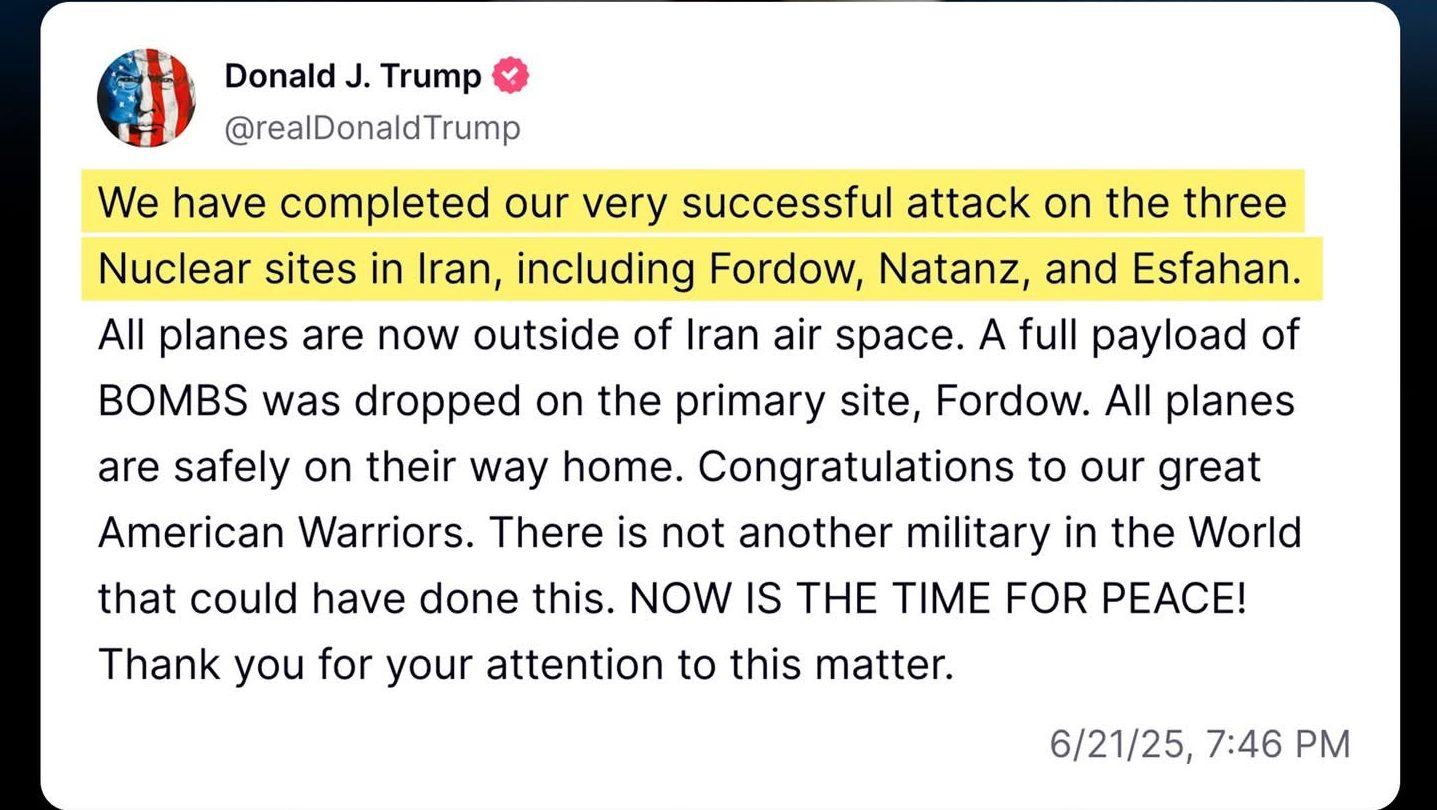
In a dramatic escalation of the intensifying Israel–Iran conflict, the United States launched airstrikes on three key Iranian nuclear facilities in Fordow, Natanz, and Isfahan early Sunday local time. President Donald Trump confirmed the operation via a Truth Social post, stating: “We have completed our very successful attack on the three Nuclear sites in Iran… All planes are now outside of Iran air space”.

Why It Matters
This marks the first direct U.S. military involvement targeting Iran’s nuclear infrastructure, following over a week of Israeli strikes, according to the Associated Press. The targets—Fordow, Natanz, and Isfahan—are central to Iran’s uranium enrichment and research efforts, with Fordow especially fortified deep in a mountain, according to Bloomberg News.
Details of the Strikes

The U.S. deployed stealth aircraft—likely B-2 bombers—equipped with 30,000-pound “Massive Ordnance Penetrators” (MOPs) to penetrate underground facilities, according to AP. Israel, which has already been targeting Iranian nuclear and military sites since June 13, has claimed the destruction of centrifuge facilities and the killing of senior Iranian commanders.

Regional Fallout & Iran’s Counterattack

In recent weeks, Iran has retaliated with over 400 missiles and more than 1,000 drones, most intercepted, but with reported casualties and damage. The Iranian government has imposed widespread internet shutdowns and declared readiness for further action, warning that U.S. involvement would be “very, very dangerous”. Additional forces—including Iranian-backed Houthi rebels—have issued threats against U.S. and allied naval assets in response to American intervention.
President Trump’s Strategy
Defense and intelligence officials reportedly weighed a diplomatic two‑week window before authorizing military action, ultimately deciding that operational force was necessary.
Pressure within Trump’s team was divided: some MAGA-aligned conservatives urged restraint, while hawkish Republicans supported aggressive measures, according to the Financial Times. Trump later endorsed the operation, calling it a display of military capability while urging the world, “Now is the time for peace”, according to various news reports.
Technical Challenges
Experts warn that even with MOP deployment, it may not fully neutralize heavily buried Iran’s nuclear installations, which are built to withstand deep strikes, according to the Washington Post. Satellite imagery from the first week of Israeli strikes indicates above-ground damage but minimal disruption to subterranean systems, suggesting that critical capabilities remain intact, according to Bloomberg News.
Human & Diplomatic Toll
Iranian civilian casualties likely number in the hundreds, with Israeli figures also increasing amid missile exchanges, according to The Guardian.
Diplomatic efforts have effectively collapsed, including a scheduled round of U.S.–Iran nuclear negotiations in Oman.
Global leaders—including UN, EU, UK, China, and Russia—are calling for immediate de-escalation amid fears of a wider conflict.


