BY NICOLE LAYTON
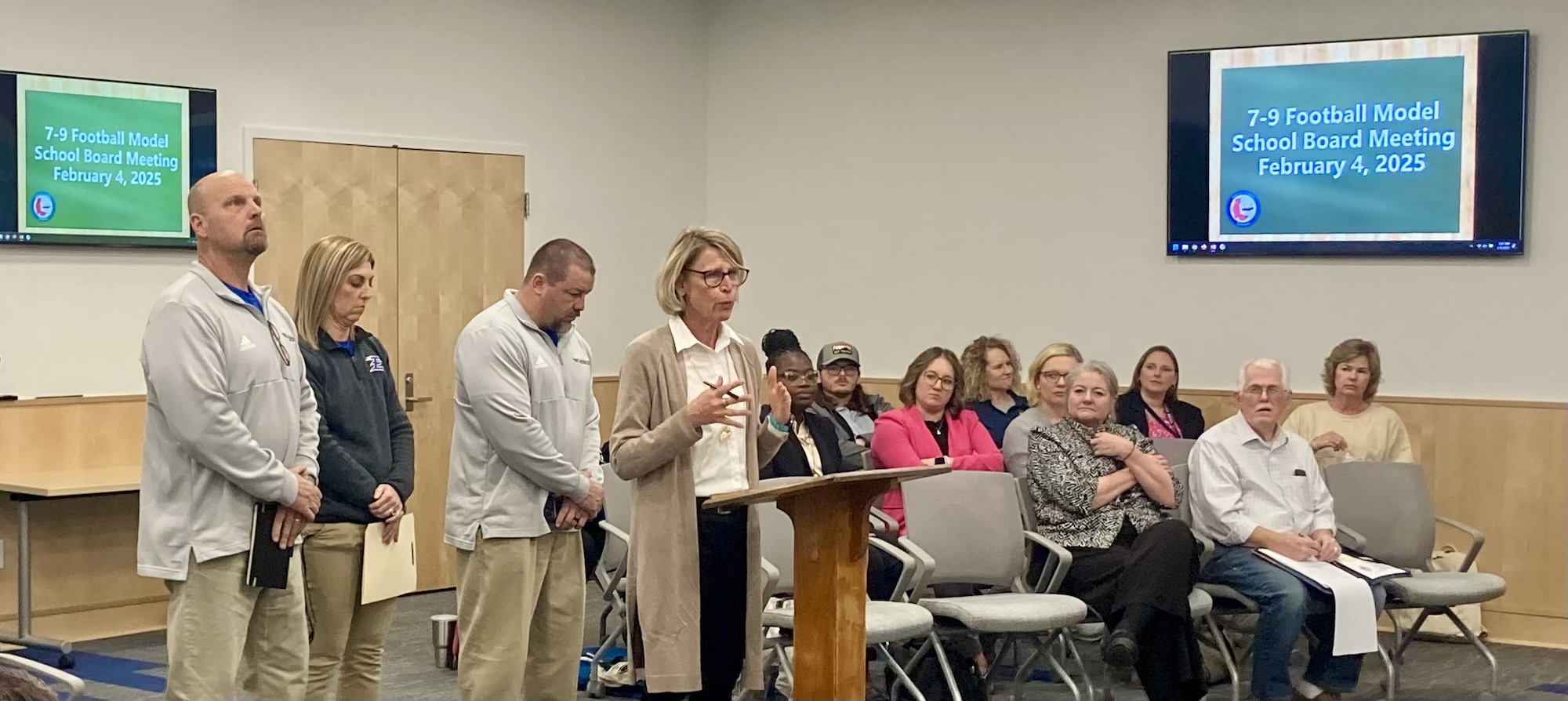
The Edenton-Chowan Schools Board of Education signed off on allowing John A. Holmes High School staff explore a new initiative to create a grade 7-9 football team. The proposal aims to strengthen player development and increase participation in school sports.
The Board met Tuesday in the district’s Professional Development Center.
Principal Sonya Rinehart, Athletic Director Wes Mattera, Athletic Trainer Courtney Phelps and Head Football Coach Paul Hoggard presented their vision for the proposed program.
The plan would see seventh-, eighth-, and ninth-graders forming a junior varsity team, with the intention of providing younger athletes with more playing time and structured development opportunities. All of the players would train at the high school and will all wear Aces’ uniforms.
Keeping the Team Together
Mattera emphasized that while CMS will not have a team, the public shouldn’t think of it as losing a football team.
“We haven’t been able to successfully field a JV team for several years since COVID happened,” he said. “So we’re not losing the team. What we’re trying to do is combine and ensure we keep the team and keep the program intact.”
Last season (2024-25), the JV football team played four game. In the fall of 2023, they played six.
“Our goal with the 7-9 model is to keep (the JV team) together and we get seven or eight games every year within the conference and then those who can move up would move up for the (varsity) playoffs,” Mattera said.
Under the program, if a ninth-grader is good enough to play varsity, they will go to varsity and stay there. If they dress for one varsity game and don’t play, they will still remain on the varsity team.
“There will be not eight-quarter players,” said Board Chair George Lewis, referring to students who play JV games on Thursdays and varsity games on Fridays.
Idea’s Time Has Come
Hoggard noted that the idea was first pitched to him by Washington County Football Coach Robert Cody in 2017.
The program has been used for at least four decades at some schools in the western part of the state, including the Western Highland Conference and Big and Little Smoky Mountain Conference.
Cody could see where Washington County was headed as it competed against western schools in state playoffs and championship games.
“We weren’t in that place yet, but as I speak to you tonight, we’re heading in that direction,” Hoggard said.
School officials have been talking with other schools in the Albemarle Athletic Conference, which the Aces plan to join next academic year. They have also expressed interest in going to such a model.
While Mattera said the football program could implement the change by next football season, he said he wanted to wait until the 2026-27 season to implement the change.
“We can do it now. I mean with the way Coach Hoggard handles equipment, with the way our infrastructure is, adding to what we can do now (we’re ready). … I can say with a clear conscience, we’re out in front of the other counties … Nobody else has been in front of the board yet,” Mattera said of other schools in the conference working to implement this football model.
Off-the-Field Benefits
Hoggard noted how sports impacted his own life.
“In 1977, I was in eighth grade. I was not a very good person. I was a drug user,” he said. “I was going down a bad path. There was a guy named Nick Shook who was the football coach. He brought me into the little old office, the little old football office there. And needless to say, we had a prayer meeting in there. … By the end of the day, I knew he cared.
“It is funny how things work out. Almost 50 years later, I’m now coaching the grandson,” Hoggard said. “So the things that we do have lasting impacts.”
He noted that seventh and eighth grade can be very difficult to navigate.
“What we’re asking is just to have a chance to help with that. To help maybe improve it,” Hoggard said. “We think how we run our program can make a positive impact on students in grades seven through 12.”
Board member Ricky Browder, who is a former coach, echoed Hoggard’s sentiments.
“If we can save one kid from going on the street and getting involved in something they don’t need to be involved in, it’s a win-win no matter what the cost is,” he said.
On-the-Field Benefits
A significant benefit of this model, officials argued, is the seamless transition it offers as students move from middle school to high school sports. The middle school and high school football staff would work together, so students see the same people pretty much all six years.
“The ninth-graders that played this year are going to be 10th-graders next year,” said Browder. “They’re done. They’re now varsity. The eighth-graders who played at the middle school now become the ninth-graders, so they’re playing with the same people who played with last year.”
This continuity is expected to foster stronger team cohesion and player development over time. It will also offer more opportunities for the school to promote coaches from within the program whenever there is a vacancy.
“What this is gonna allow us to do is if we were lose somebody on our staff for whatever reason, we can promote from within,” Mattera said. “It’s much easier than bringing somebody in from the outside and allows young coaches to work their way up the ladder.
Benefits Beyond Football
In addition to benefiting football, officials believe the model could positively impact other sports, such as basketball, baseball, and track.
“As those seventh and eighth graders are working with the ninth graders and having some of that experience at the high school,” Rinehart said, “that hopefully as they go on to play basketball, baseball, track, then some of that leadership and experience is going to translate into those other sports as well.”
Mattera noted that some schools in the new conference have issues with fielding JV baseball teams. This model could allow those schools to field JV teams and also develop staff and players.
“There have been instances where teams in our conference have not had JV baseball,” Mattera noted, emphasizing the need to adapt to changing circumstances to ensure students have ample opportunities to participate.
Looking at Safety
The discussion also highlighted the importance of coaching and safety. Moving younger players to the high school environment would require middle school coaches to obtain certifications mandated at the high school level, including training in CPR, concussion management, and other safety protocols. This change is expected to enhance the quality of coaching and ensure better safety standards for all athletes.
Phelps noted that with an athletic trainer who works at a school with a Grade 7-9 football team. They noted that there may be some difficulty being able to check on middle school students for physical therapy or injury follow-ups, but it can be figured out. Some of the forms will be need to be added to the middle school submissions so they comply with North Carolina High School Athletic Association rules.
Phelps suggested hiring a CMS athletic trainer to help with the continuation of high-quality care and also to help her cover game nights.
“For example, I have on the schedule already baseball, softball, soccer and track all at the same time, so I get pulled in a lot of directions,” Phelps said. “Having another person … we can strategically place at the events … ‘You be here for baseball and softball and then I can go down the street to soccer.’”
Other Considerations
Logistical considerations, such as facilities and transportation, were also addressed. Officials acknowledged the need to coordinate practice times and shuttle services between the middle and high school.
“We’ve talked with the middle school about the shuttle, about shuttling the kids from the middle school to here, and then they would practice with us,” Mattera explained.
The 7-9 team would practice separately from the 10-12 team.
If necessary, the high school would absorb additional fuel costs to support the transportation needs.
Mattera also noted that they are working at figuring out some up-front costs, such as buying new helmets, smaller shoulder pads and uniforms, more medical equipment, etc.
Sports’ Importance
Rinehart reminded the board that the ninth-grade transition can be a pivotal time for young males.
“Over the past few years, we have lost some of our African-American males — predominantly young male athletes — whether it was discipline or academics ,” she said of the school’s student population. “Studies shows when they’re not involved or they don’t play that first season, it’s very hard to get them back to another season.
“Then I’ve lost them, I’ve lost that hook. This is the opportunity to be able to give guidance, role-modeling and have that consistent format for that seven to nine transition. They’ll be with the peer group into the high school, where they’ll be hopefully be more successful academically and have better behavior and attendance because they’ve already got that good set, consistent foundation ready to prepare them,” Rinehart said.
“And hopefully as coach (Hoggard) said, our goal is to provide them at the end of this options and opportunities that no matter where they choose to go, no matter what they choose to do, they have the choice and we’ve opened those pathways to them. And this will help us hopefully make sure that all of our students have these choices.”
Chowan Middle School Honor Roll: Celebrate Student Achievement!
Chowan Middle School announced its Second Quarter Honor Roll, celebrating student achievements. The A Honor Roll includes numerous 6th, 7th, and 8th graders, while the A/B Honor Roll also features many students from those grades.

One response to “Aces Exploring Grades 7-9 Football Program”
[…] Information regarding the study of a Grades 7-9 Football Model appears in another article. You can read the information, by clicking here. […]