By Miles Layton
ELIZABETH CITY – Linwood Williams told Pasquotank County commissioners Monday night that it took him 40 years to build about 80 homes in the Oak Ridge subdivision, and that he wanted to finish the job.
Neighbors who opposed him told the board that the county’s land-use plan, the road, the ditches, and the schools could not take it. Other folks, including the local NAACP President Keith Rivers, voiced their support for the developer’s proposal.
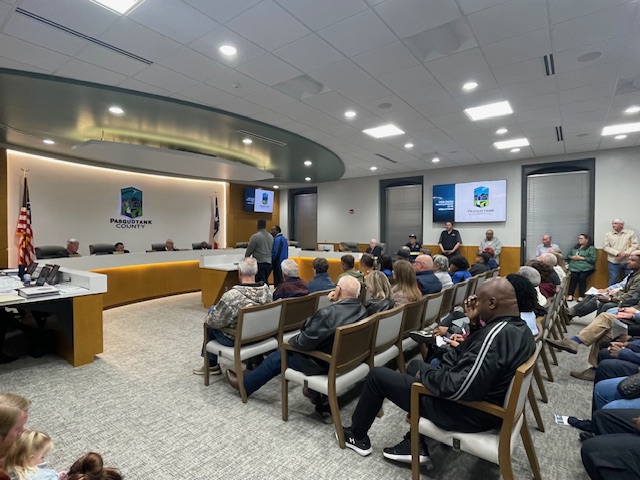
Many people spoke for roughly half an hour at the public hearing on Williams’ request to rezone 33.43 acres off Mill Pond Road from agricultural to residential. The crowd packed the meeting room at the Pasquotank County Courthouse and spilled into the hallway. Commissioners approved the request after the hearing, with Commissioner Sean Lavin voting no. See our earlier story here.
As we all know, Planning Director Shelley Cox opened by telling the board that county staff and the Planning Board had recommended denial. She said the 2023 land use plan classifies the site as agricultural and rural, and the request is inconsistent with it. Under the lot sizes required for septic systems, she said, the rezoning would allow a maximum of 30 homes.
Williams spoke first, with his son Kevin, also a general contractor, beside him.
“It’s taken us 40 years to do this,” Williams said. He told commissioners he would build about four houses a year, which he said would not strain schools or the community.
“We see it as providing an opportunity for folks to have a part of the American dream,” he said.
Williams said the land has been in his family for 150 years. “So it’s not like it’s an outside person buying properties,” he said. He pointed to the people seated behind him who live on Linwood and Fannie drives.
“If you look behind me, you see a lot of folks that might be sitting out here,” Williams said, “in support of what we are trying to do.”
As president of the Pasquotank County branch of the NAACP, Rivers urged the board to approve the rezoning request. How often does the local NAACP president attend a public hearing regarding a rezoning matter!? Probably not that often…
But that’s OK — speaking on behalf of Williams, Rivers highlighted Williams’ standing as a Black developer, noting that he was among the first Black developers to build a community in the area. He closed by asking commissioners for a yes.
“I hope that this board will allow Mr. Williams to develop his project,” Rivers said.
Rivers said denying Williams would send a message beyond this one project.
“If we have an individual that wants to build on his land and he is denied because it’s agriculture,” Rivers said, “then you have set a precedent throughout this county that this is going to be an issue every time that we are here.”
Rivers tied school funding to growth — he’s not wrong there. Communities across NE NC, certainly the state, suffer because of inequalities in school funding.
“We know that we rank near last in the country when it comes to per pupil spending,” Rivers said. He said local supplements for per-pupil spending are driven by property tax, and businesses are attracted by population.
Ben Barnhill, the first speaker against the rezoning, said the board had adopted a plan and should follow it.
Barnhill told commissioners that the rezoning request would allow a major residential subdivision that is not permitted under the current agricultural zoning.
“Based on the minimum lot size, that can mean as many as 30 new homes on land the land use plan designates to remain agricultural and rural,” he said. “This request is not consistent with the land use plan. The plan sets out where growth belongs, the rural and agricultural character we want to keep, and the density we will not accept.”
Pressing the point that the county’s own plan should guide its decisions, Barnhill said zoning should follow that plan rather than reshape it piece by piece.
“Zoning is supposed to follow that. Not rewrite it one project at a time,” said Barnhill, a retired veteran and farmer who has voiced his opposition near and far to unrestricted growth. “State law requires consistency. That’s the standard, not a suggestion.”
Barnhill then turned to the recommendations already before the board. He noted that county staff and the Planning Board had recommended denial, and that staff found the request inconsistent with the future land use map. “Public interest is a legal standard specified by state statute,” Barnhill said.
Beyond this single request, Barnhill warned that approving it would invite others.
“The next applicant will point to this decision and demand the same treatment,” he said, “and the plan starts to come apart.”
Looking ahead, he said he was “looking down the road to larger developers” and pointed to a 1,700-unit development going in at Camden Plantation, across from the Welcome Center on U.S. 17.
Still, Barnhill did not oppose growth outright.
“Growth can be fine when it’s actually needed, matches infrastructure the county can build and maintain, and pays its own way so existing taxpayers aren’t left covering schools, roads, drainage, and public safety,” he said. “This doesn’t meet that test.”
He closed by urging commissioners to hold to the course they had already set. “I’m asking you to stick with a plan you already adopted, follow the staff and planning board recommendations, and deny the rezoning request,” he said.
Dale Hoak, a Navy veteran whose family runs a horse-boarding business next to the site, said he does not oppose growth.
“I’m here today to respectfully but firmly oppose” the request, Hoak said. “I’m not opposed to growth or development or private property. I’m opposed to development that disregards established land use plans, threatens existing agricultural businesses, and places unnecessary burdens on neighbors and property owners.”
Hoak said the site comes within about 30 feet of his horse pastures, and new neighbors change the way people see farming.
“Anytime you introduce new residents into an agricultural community, it just becomes a matter of time before the agricultural activities become the nuisance and not the norm,” he said.
He said his family’s operation depends on safe access for horse trailers, veterinarians, delivery vehicles and emergency crews. “Adding 30 homes means additional vehicle demands on a rural roadway,” Hoak said. “Before approving this request, the county should demonstrate that the existing infrastructure can safely accommodate that growth.”
Hoak also raised drainage. “Converting open agricultural land into roads, rooftops, driveways, and other developed surfaces now changes how stormwater moves across the landscape,” he said. He said construction could remove culverts and push water across Mill Pond Road, which he described as a dirt road that he and his neighbors maintain themselves.
“We don’t get any help from the county or the city or anybody else,” Hoak said. “So that’s an additional burden that that construction will lay on us.”
He closed by asking, “How can this board confidently determine that nearby properties will not be adversely affected?”
Jon Van Dalsum, a subcontractor who has worked with Williams for 43 years, spoke in favor. He said he has gone back to Williams’ homes decades later for upgrades and checked for settling.
“I can testify that these homes are done right,” Van Dalsum said. He said he pulled his records for the past 26 years and found Williams built about 4.25 homes a year. “That’s a nominal impact,” he said.
“You can’t ask for any more controls than a man who builds four homes a year,” Van Dalsum said.
Carolee Fleming, who farms on Lilburn Road with her husband and works in real estate, told commissioners the parcel has no county water or sewer. She cited the Newland Township resilience study the county commissioned in 2024 through the state’s Resilient Coastal Communities Program, which she said identifies the township as frequently flooded. One of the study’s priorities, she said, is a watershed drainage model.
“The county doesn’t have one yet,” Fleming said.
Her husband, Brandon Fleming, a small beef producer, said his family has been trying to buy unused farmland to expand its operation.
“If we go ahead and change the zoning to residential,” he said, “we’re going to have to start looking at moving so we can expand our operation.”
Katie Canning, a city resident who recently ran as a write-in candidate for school board, told commissioners she doesn’t live in Newland but wanted to speak anyway. She asked them to table or deny the request.
“Residents have raised concerns about flooding, road safety, and impacts on agriculture,” Canning said. “Where are the site-specific drainage and traffic studies?”
She asked whether the county had compared expected property tax revenue with the longer-term costs of infrastructure and public services.
Canning said she heard about schools during her campaign. “I’ve had teachers tell me how drained they are with the overcrowding in the schools,” she said. She urged the board to slow development in the area.
“I just really think that we need to reconsider approving developments at this moment,” Canning said.
Susan Ayers, who moved to Mill Pond Road from Virginia Beach four years ago, said she was speaking from the heart.
“I bought myself a little slice of heaven,” Ayers said. “And I don’t want to see it turned into a free for all.”
She said the traffic is already a challenge. She said she is sure lovely people would move into the new houses, but that has nothing to do with it. “We live on a farm,” she said. “The peace, the quiet, it’s wonderful.”
Schools were her other concern. When her granddaughter moved down with her, Ayers said, she tried to put the girl on the school bus.
“We drove her to school because there was no room on the school bus for her to ride to high school,” Ayers said. “So that’s another concern.”
Pastor Daniel Spence, a longtime resident of that neck of the woods, said residents of Newland and the Mill Pond area back Williams.
“We support him,” Spence said. He disputed claims that new homes would clog the road. “The biggest traffic comes from the farm trucks,” he said, naming the tractor-trailers that haul feed and grain.
Spence echoed Rivers on precedent. “I hope you don’t set a precedence in stopping this project from being built,” he said, “because I believe it will cause more issues for the county later on.”
Let us know what you think by leaving a comment. Comments are subject to approval.