
By Miles Layton
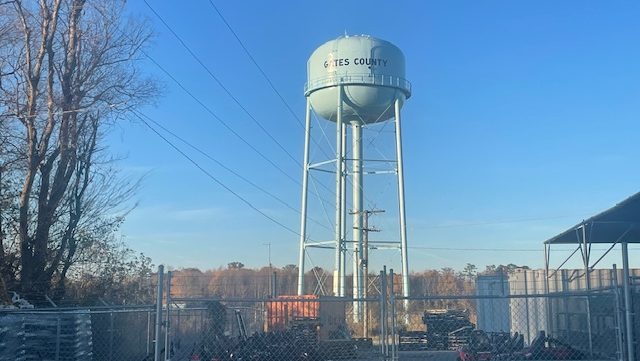
GATESVILLE – Students in Gates County Schools missed about a day and a half of classes recently after a subcontractor cut a county water line, but lab tests have since come back clean and the water is safe to drink, County Manager Scott Sauer said.
Public Utilities Director Brad Arnold estimates that 400,000 to 500,000 gallons of water were lost during the break in a water line that was laid in the ground during the malaise days of the Carter administration, back when bell bottoms were cool, in 1978.
Side NOTE: A standard swimming pool holds between 15,000 and 20,000 gallons, which puts the loss at roughly 20 to 33 pools.
After that water line break, I got a few texts and talked to someone who works in Gates County, and I even traveled to Merchants Millpond for a cross country meet – Red Barons have a good team.

As such, I wanted to know more about the water line leak. Thanks go to Sauer, who answered the Albemarle Observer’s questions about the break, the repair and the county’s longer-term plans for its water system.
The line was cut on Wednesday, Sept. 30, near the intersection of Sarem Road and NC 37 in Gates Township, where a subcontractor was installing fiber-optic cable. The loss of pressure affected about 1,000 customers.

Superintendent Chante Jordan sent out the early-release message Wednesday, Sept. 30, as the break disrupted water service in the Gates area.
Following state guidelines and in consultation with the regional office of the N.C. Department of Environmental Quality, the county issued an advisory boil water notice.
Sauer said the notice was a precaution — it remained so until lab testing confirmed all results were negative Oct. 1.
A section of 8-inch line was replaced by Gates County Department of Public Utilities staff. Arnold said the section that failed was built in 1978.
Sauer said the hardest part of the job was not the pipe itself.
“The most time-consuming part of the repair was the identification of the appropriate valves to temporarily shut off the water and isolate the section in order to pump the water out of the ditch,” he said.
Sauer did not give a dollar figure for the repair. He said the cost of staff time and materials is covered in the department’s operating budget. When a contractor cuts a line or other problems arise, he said, “the county staff are equipped to handle most, if not all repairs.”
Not the first cut
Line strikes by telecommunications contractors are not new to Gates County. At the March 19, 2025, meeting of the Board of Commissioners, Arnold reported that since Jan. 1 of that year, utilities staff had dealt with nine water line cuts by contractors working for various telecommunications companies.
Six of the nine were blamed on inaccurate county maps, 50-year-old as-built drawings that staff use to locate lines. The other three happened when contractors began boring without waiting for proper utility locates, according to the county’s 2025 supplemental report to the state. Arnold told commissioners the county was pursuing reimbursement for the cuts. He also said the department once received 50 locate requests in a single day, more than staff could handle in a reasonable time.
The county has since bought ground penetrating radar with local funds to find water lines that do not appear accurately on the old drawings, according to a September 2025 letter from Board of Commissioners Chair Emily Truman to the state.
Projects under construction
Asked whether the county has a plan to upgrade its water system, Sauer answered yes and attached the county’s current project list. Four water line projects are under construction, he said.
See the files at the end of the story.
The list totals $17,293,026. Of that, $9,992,825 comes from state directed-project money approved by the General Assembly in Session Law 2023-134, and $7,300,201 comes from NCDEQ grants and loans. The water projects include a directional bore at Bennetts Creek and a line extension, a directional bore at Carters Road and Trotman Creek, a SCADA upgrade, water plant improvements, a transmission line at Gatesville, system improvements along Highway 158, water tank replacement, two new deep wells and improvements to Well 2A.
The list also covers wastewater work, including restoration of the county’s original treatment plant and sewer connections for T.S. Cooper and Buckland elementary schools.
Room to grow
There’s no denying that Gates County is a wonderful place to live and raise a family, so folks want to move there. If I ever win the lottery, I’d buy or rent one of those two-story white farmhouses that I pass on my way to and from Gatesville each week.
Since other folks want to live in Red Barons’ country, Sauer said the system can handle new development. About 76 single-family homes have been permitted since Jan. 1.
“Yes, there have been approximately 76 single family dwellings permitted since January 1, and the county’s water system has the capacity to serve them,” he said.
Looking ahead, he said commissioners have approved building two new water supply wells with state grant money. The project is in the permitting stage. The county has also committed what Sauer called significant local funds from water revenue reserves to upgrade its current well system, which is nearly 50 years old and has three supply wells.
Gates County has fewer wells than its neighbors, Sauer noted. Chowan County has eight wells, Edenton has three, Bertie County has 13 and Hertford County has 14. Perquimans County has nine wells and three emergency wells, and Pasquotank County has 30.
The supplemental report makes the same point. In recommendations the commissioners received in September 2025, the report cites the “limited number of active wells” as a reason to seek more production and backup capacity.
Leaks and lost water
Back in the day when I lived in the West Virginia mountains, I’d write stories about water systems needing repairs and planned infrastructure upgrades. There, I learned that many water systems lose more than a bit of water each year due to aging pipes and the like.
Applying those lessons to Northeast NC, Gates County’s losses have been high. Arnold said the county’s most recent reporting shows a water loss of 7% to 8%. In 2022, he said, the reported loss was 31%.
That year was a turning point. In August 2022, NCDEQ and the Local Government Commission designated Gates County a distressed unit of local government for its water and wastewater systems. The state’s first concern for the water side was financial. An estimated 1,000 meters, or 25% of the system’s more than 4,300 active accounts, were not working.
Truman described the designation in her September 2025 letter to the Division of Water Infrastructure as “a wake-up call, and an important call to action for the Board of Commissioners.”
The county has replaced meters with radio-read units, a $1.4 million project the supplemental report described as 98% complete. It has also raised water rates. In February 2023, commissioners increased the base rate for up to 2,000 gallons from $24 to $29 and raised the charge for each additional 1,000 gallons from $3 to $5 a month.
The county went through heavy staff turnover along the way. Its public utilities director and finance officer resigned in 2022, and the county manager resigned in January 2023. Truman wrote that the board is “taking bold steps to build a management team” and aims to “correct the mistakes of the past; and plan, invest and prepare for the next fifty years.”
Fluoride and the October work session
The county’s best-known water problem is not the line break. Gates County’s groundwater contains naturally occurring fluoride. The supplemental report says the most recent 12 months of testing showed the water leaving the treatment plant averaged 3.02 milligrams per liter, the highest of any public water system in the state as reported in 2024.
The federal limit is 4.0 milligrams per liter. Results above 2.0 require public notice and further study. The system has stayed under the federal limit.
In September 2025, commissioners unanimously set a project target of 0.7 milligrams per liter or lower and directed a working group to develop an advanced water treatment system. Local money committed to the effort passed $600,000 by that point, covering well sampling, performance testing and new pumps.
Sauer invited residents to a work session on Oct. 21, where county officials will go over what the plans look like so far.
“Please consider attending the work session on October 21 for more details as we present preliminary information for a new water treatment plant specifically being designed for the removal of Fluoride, which is naturally occurring in our groundwater,” he said.


Let us know what you think by leaving a comment. Comments are subject to approval.