
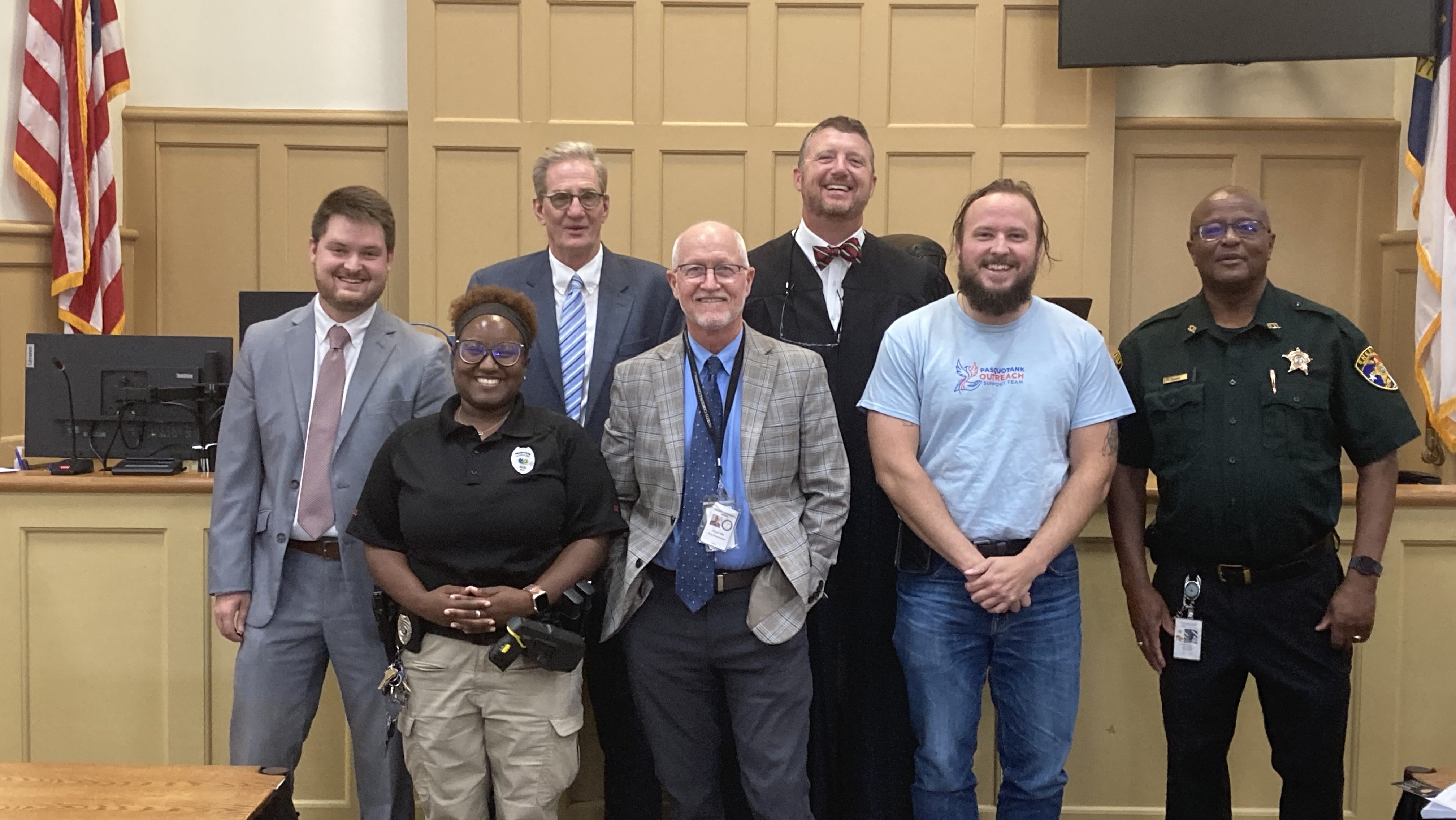
ELIZABETH CITY — The Pasquotank County Recovery Court (PCRC) held its first session on Tuesday, October 6.
Organized by Chief District Court Judge Robert P. Trivette, District Court Judge Meader Harriss and Court Coordinator Cody Marks, the PCRC joins the normal players in the criminal justice system – judge, probation officer, defense attorney and prosecutor (the “court team”) — with behavioral and mental health providers in the local community in an intensive and systematic effort to assist and coerce people with high-risk substance and mental health disorders to follow an individualized recovery plan. The process is administered by the court coordinator, according to a press release from the First Judicial District.
A recovery court offers a person suffering from addiction who has been convicted of a non-violent drug or property crime the option to seek recovery through the program rather than go to prison.
The participants must agree to the program’s guidelines and be approved for admission by the district attorney’s office and the court team. Generally, every individualized recovery plan includes intensive probationary and court supervision, intensive drug and mental health treatment if recommended, and intensive drug screening. Participants must appear in court before a judge twice a month. If they fail to follow the program rules, they are subject to sanctions, including periods of incarceration or dismissal from the program.
“Recovery courts have been called the most successful justice intervention for people with substance use and mental health disorders ever devised,” said Judge Meader Harriss who will preside over the court. “They unite safety and public health, prevent overdoses, help strengthen families, and save tax dollars.”

“Sure, it’s about helping people,” said Chief District Court Judge Trivette, “but it is also about cutting down on recidivism (the tendency of convicted criminals to reoffend) and saving taxpayers dollars.” “Addiction is one of the biggest risk factors for recidivism as convicted criminals struggle to reintegrate themselves into society without support and treatment,” Trivette added. A successful recovery court can cut recidivism by more than 50%. The average savings to taxpayers for each person in a recovery court versus prison is about $6,000 a year per person.
Judge Harriss noted how destructive and pervasive addiction is. “Over the course of my career, I have witnessed the opioid epidemic destroy many individuals and families in northeastern North Carolina. Drugs do not discriminate. Addiction affects every aspect and every person in our communities,” he stated. “And most heartbreaking,” he added, “when drugs destroy the adults, the children are often dragged under too.”
The PCRC will start slowly but is expected to grow very quickly. City Councilman Tim Jackson, who is on the PCRC advisory committee, stated, “This is a long overdue and much needed program in our community to combat the drug and recidivism problem in Pasquotank County.”
The first recovery court was started in Miami-Dade County Florida in 1989. Today there are about 4,000 recovery courts in the United States. About 90 recovery courts operate in North Carolina.
The PCRC will be the third one in the First Judicial District, which consists of seven counties in northeastern North Carolina. Judge Trivette helped start the first recovery court in the district in Dare County about 6 years ago and began presiding over that court in May of 2025. He organized and began presiding over the Currituck County Recovery Court in January of 2026.
Recovery courts are supported at the highest level of the court system by the Chief Justice of the North Carolina Supreme Court, Paul Newby. “Chief Justice Newby has made it clear in several conversations that he wants these courts set up across the state where possible,” Trivette stated.
“And this is a great time to set up a recovery court,” Trivette added. “Currently every county in the state has a source of non-taxpayer money to support the extra costs of the courts.”
About 10 years ago North Carolina, along with 30 other states, sued the national manufacturers and distributors of opioids who made billions and billions of dollars off the drugs, but ignored or hid their true dangers from the public. “Big pharma and smaller ones recklessly pushed the pain killers out to the public as perfectly safe miracle drugs, denying their true dangers,” Trivette noted. It is estimated that about 1 million people died during the opioid epidemic. Millions more became addicted.
In 2022, the states forced a settlement of the lawsuits, and North Carolina was allotted $1.4 billion as its share. The funds began arriving in every county in the state in 2022. The amount the county receives is based on population.
The opioid settlement funds received by the counties must be used to address issues of substance use disorders. “Pasquotank County received $362,000 from the settlement in 2026, and next year it will receive $286,000,” Trivette noted. Funds from the settlement will continue to be distributed to Pasquotank County in various amounts until 2038. In 2025, another court settlement was entered into with the largest manufacturer of opioids, Purdue Pharma. Those funds have yet to start flowing to the counties.
“Because of the settlements from these lawsuits, it does not cost taxpayers anything if they would like a recovery court set up in their county,” Harriss noted. “The extra cost of running a recovery court, which is primarily the salary for a court coordinator, can be paid for with these opioid settlement funds.”
This is what Pasquotank County has done. The PCRC Court Coordinator, Cody Marks, is also the program director of the Opioid Settlement Fund Subcommittee of the Pasquotank County Board of Commissioners. “It is our hope that through the PCRC, individuals will receive the needed services and support on their recovery journey from addiction,” Marks stated. “Whatever the path of recovery may look like, they will have advocates and cheerleaders in their corner from PCRC as they are restored to their community and loved ones.”
“This program marks a historic moment for Pasquotank County,” said County Commissioner Cliff Shaw, who also sits on the PCRC advisory committee. “This court is more than a courtroom. It is a doorway to hope, healing, accountability and a second chance. We are choosing to believe that recovery is possible, that lives can change, and that our community is stronger when we help people rebuild their lives,” Shaw added. “This is not just the beginning of a program; this is the beginning of a new chapter for Pasquotank County.”

Left to right, back: Assistant Public Defender Nick Potter, Chief District Court Judge Robert Trivette, District Court Judge Meader Harriss, Pasquotank County Commissioner Cliff Shaw, who is on the advisory committee ; left to right, front: Probation Officer Ty’Kiara Waters, Assistant District Attorney Greg Wills, Court Coordinator Cody Marks. Potter, Waters, Wills, Marks, and Judge Harriss make up the Pasquotank County Recovery Court Team.

Judge Meader Harriss presiding over the first session of the Pasquotank County Recovery Court with clerks Tonya Jennings and Tori Waters of the Pasquotank County Clerk of Superior Court.

To the left, Cody Marks, Court Coordinator, and Assistant Public Defender, Nick Potter on the right with a participant discussing the case in front of Judge Harriss at the first session of the Pasquotank County Recovery Court.


Let us know what you think by leaving a comment. Comments are subject to approval.