By Dave Forsythe
Like cities, towns, and counties across North Carolina and the United States, Gates County has to deal with growth—commercial, industrial, and residential. For Gates County, however, the growth we are most likely to experience is residential. Based on the limited commercial and industrial interest we are seeing, housing growth will likely place the greatest additional demands on our water and sewer infrastructure.
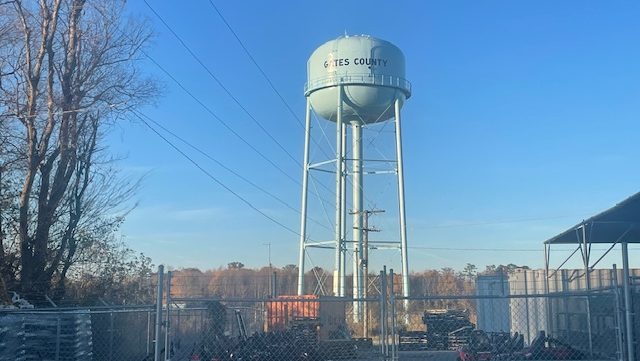
Over the past couple of years, we have undertaken significant additions to our water system, including a new water tower and transmission line toward Gatesville. Some might say this investment is primarily intended to address the concerns of one of our largest employers. In my opinion, that is a reasonable and responsible investment. Supporting our existing businesses and employers is important to the future of Gates County.
Gates County’s water comes from 3 deep groundwater wells. The volume of water they produce is not extensive; it meets our needs with some extra. When one of those wells began to fail this past year, we responded quickly to drill a new well at no insignificant cost and with a quick transfer of land. That was only possible by realigning money already given to us by a grant for another project.
But there are other issues that we cannot overlook.
We are currently repairing existing wastewater treatment systems and expanding sewer services to address sewage concerns associated with our schools, including T.S. Cooper and Buckland. At the same time, we are still only scratching the surface of addressing the long-term problem of elevated fluoride levels in our drinking water—levels that have been high for more than 13 years.
Pilot testing of various treatment methods to remove fluoride continues even as we move forward with adding sewer service to a dormant school at Buckland.
I have a hard time understanding those priorities.
Much of the cost of these improvements may be funded through grants, and we should certainly pursue every grant available to us. But grants do not eliminate the long-term financial responsibility. Once these facilities are constructed, the county still has to operate, maintain, repair, and eventually replace them. Those ongoing costs do not disappear simply because the initial construction was funded with grant money.
Put another way, we are investing money to treat sewage that isn’t currently being produced while we continue to struggle with treating the water that is going into our homes, our schools, and our children’s mouths.
Recent events have also highlighted another concern: the reliability and capacity of our existing water system.
Historically, some areas of the county have experienced routine low water pressure. Corapeake, where I live, is one of those areas.
Recently, that pressure was further reduced when large volumes of water were drawn from the nearest water tower to fight a large fire several miles away. I have no problem with that. When there is a fire, we need the water to fight it. That’s exactly what the system is supposed to provide.
Then another water-line break caused by NCDOT work reduced flows even further.
More recently, cable installers struck water lines, once again causing pressures to drop dramatically. The consequences went beyond inconvenience. Schools had to close and boil-water notices were issued.
These events should cause us to ask some serious questions before we continue adding demands to the system.
Gates County is a small county with limited financial and personnel resources. We cannot simply continue adding connections and infrastructure and assume that the system will somehow keep up.
At this point, I believe we need to seriously consider a moratorium on new additions to our water system—or, at a minimum, limit new additions to small, manageable increments while we evaluate the impact of each one.
Before we approve additional growth, we should know that our existing system has the capacity to support it.
If adding a new development could create the need for the county to make emergency investments in additional water storage, booster pump stations, larger transmission lines, or other infrastructure simply to maintain acceptable pressure and flow, shouldn’t we identify that problem before approving the development?
Our drinking-water regulations establish minimum pressure requirements for a reason. If we allow the system to fall below those requirements, the county could be forced into expensive and potentially urgent corrective action.
We should not wait until that happens.
Growth is not inherently bad. In fact, responsible growth can be very good for Gates County. But growth without adequate infrastructure is not responsible growth.
We need to know what our water system can reliably provide today, what it will be able to provide tomorrow, and what improvements will be required before we add additional demand.
Let’s stop assuming the train will stay on the tracks simply because it has so far. We need someone at the helm, looking down the track, understanding the limitations of the system, and making decisions based on facts rather than simply moving forward because an opportunity to add something comes along.
Gates County deserves that kind of responsible planning.

Dave Forsythe is a Gates County Commissioner.
Let us know what you think by leaving a comment. Comments are subject to approval.