By Miles Layton
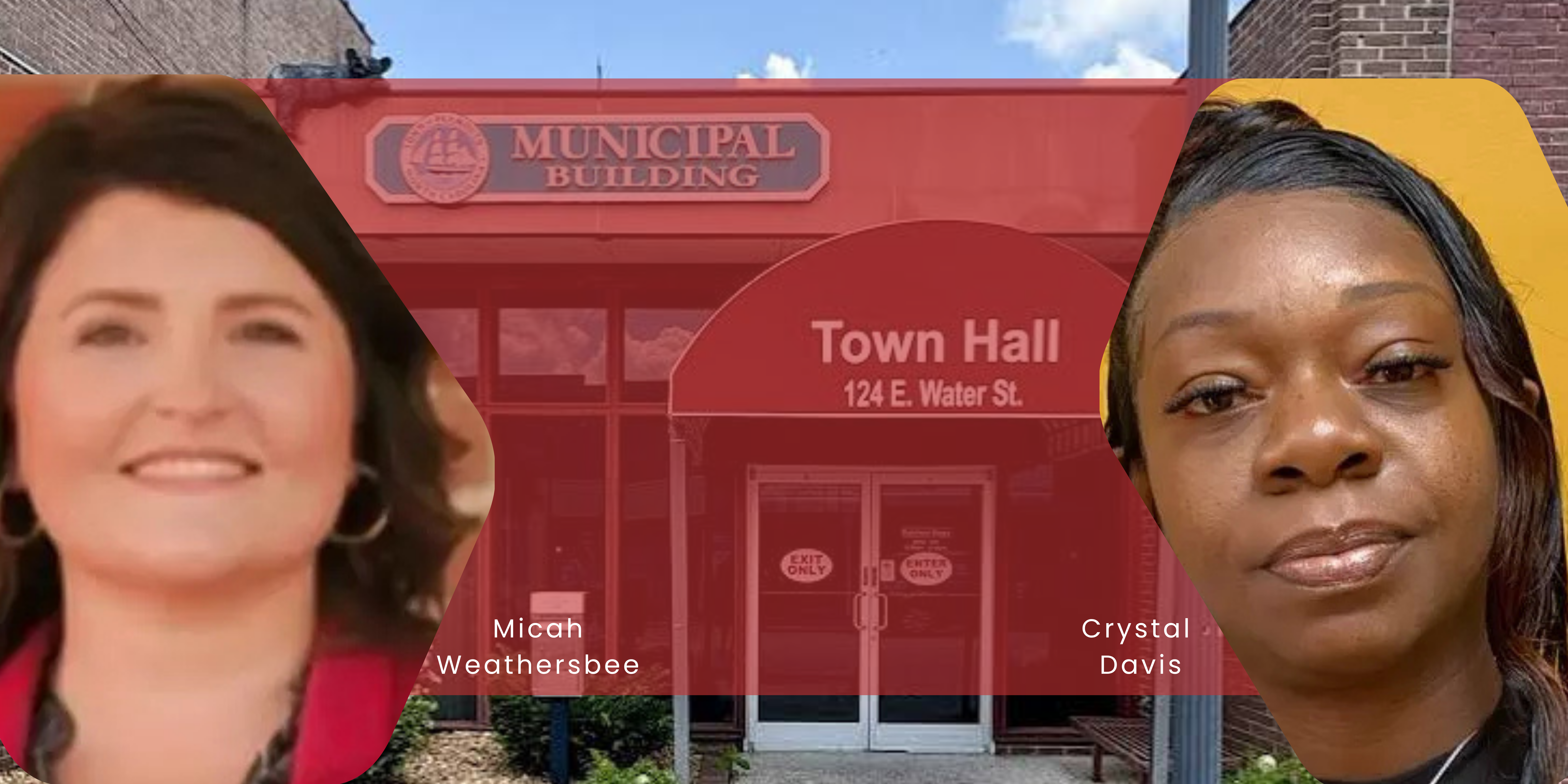
PLYMOUTH — Mayor Crystal Davis spent much of Monday night’s Town Council meeting defending the police department, repeatedly scolding Councilwoman Micah Weathersbee for what Davis called unfair badgering of Police Chief Louis Banks, even as the exchange exposed a department stretched thin by staffing shortages, aging equipment and an incomplete accident report.
There will be more from Monday’s multi-hour council meeting in future articles.
The exchange began when Weathersbee sought to address concerns about traffic accidents during the police department’s monthly report.
“So one of them is we have traffic accidents, and there was 13 that was listed,” Weathersbee said. “Were these accidents like mostly in the same spot or something like that? Because what I’m asking, if they were in the same location, is there something that we need to do different, like a different light structure or something like that to prevent that? Because there’s 13, and that’s an awful lot for our little town.”
She acknowledged the town had seen heavier traffic recently — “even though I know we had a lot of traffic with the beach season ending and people moving stuff back” — but pressed Banks for specifics: “Do we have an idea of where they were? They in a central location or what?”
Banks, who joined by phone while out sick, said he could pull together more detailed numbers later but tried to explain the pattern from memory. “We could definitely put some together at a later date,” Banks said. “I can honestly tell you, I work day shifts, and Captain (Kevin) Phelps also works opposite — when he’s working, I’m off, and vice versa. Most of the traffic accidents do happen to occur a lot during the daytime, so me and him probably do more accident reports than any of the other officers at the agency because of that.” He added that wrecks aren’t confined to one part of town: “Traffic accidents are all over town — and parking lots, and obviously the main intersections, those high traffic areas.” He also downplayed the total. “13 is not unusual,” Banks said.
Pressed further, Banks named the worst intersections he could recall — U.S. 64 and Rankin Street by McDonald’s, 64 and Washington Street, and near Fire Station 4 — but said he’d need the actual records for a complete answer.
That’s when Davis stepped in, and the meeting’s tone shifted, with her sticking up for Banks and the Plymouth PD. “If we look at this report, in the month of August he responded to 206 calls,” Davis said. “For him to remember where the location of 13 accidents were today — he’s sick right now. That’s kind of hard to answer at this moment.”
Weathersbee didn’t back down. “I don’t think my question is so far off beat,” she said. “It’s 13 traffic accidents, and we normally don’t have that many.”
The tone sharpened when Davis pivoted from traffic accidents to shootings, telling council most gun violence calls come out of Ward 1 — Weathersbee’s ward.
“I’m not saying it’s not legitimate,” Davis said of the traffic concerns, “but we need to be less concerned about the 13 traffic calls than the 100 and some shots that were shot in Ward One… We got to walk our wards, because a lot of those shootings are occurring in Ward One.”
Weathersbee noted the report itself was incomplete: “There’s also 206 calls and we only have 92 of them” accounted for.
Davis responded that there were more pressing matters — the town had a shooting over the weekend involving juveniles. “We had a shooting over the weekend,” Davis said. “Kids were in a shooting.”
Weathersbee pushed back hard. “So me walking my ward and walking into White City is not going to change somebody who wants to shoot somebody,” she said. “That’s not.”
Davis underscored her point about the need to walk the wards with a series of rhetorical questions. “So, what are we here for? We’re not going to do nothing!? Just shoot each other. We don’t care about it. Let’s worry about accidents. Let’s not go talk to the people and figure out why we’re shooting each other in Ward One.”
“Okay, first off, that’s not my job,” Weathersbee said. “He’s the chief.”
“Absolutely it is (your job),” Davis shot back.
“He’s the chief, okay,” Weathersbee continued. “It’s not my job to go and conduct evidence findings and that sort of thing. I didn’t swear into that, okay. Two, there’s two of us that have Ward One in here. It’s not just me, so let’s not go with that. I can ask any questions I want to. When it has one shots fired, and that’s a normality around here—”
“It’s not,” Davis interjected.
“Yes, it is,” Weathersbee said.
“It’s not — that’s a normality for August,” Davis countered.
“Go back and look at the reports, Mayor,” Weathersbee said. “There are 13 traffic violations. I’m just asking: Do we need different lights? Is there something else we need to be doing? Only half of the report is being reported. So who’s to say what the other 115 reports that didn’t make it onto the report — what they are concerning?”
“The point I’m trying to make, Councilwoman—” Davis began.
“I’ve made my point,” Weathersbee said.
Davis fired back without missing a beat. “Well, now I’m going to make one with you.
Weathersbee fired back, “Try!”
Davis said that’s “aggressive” before she continued.
“I’m not saying the traffic is not something that we need to discuss. I’m saying first of all, let’s give these guys credit for what they do, and they work real hard. Every time we come in these council meetings, we give these guys a hard time when they’re doing the best they can…”
Using hyperbole, because the Mayor’s job involves much more work, often working nights and weekends, Davis said, “If you look at the statute, my job says that I kiss babies and look cute. That’s what it says.”
Davis then advanced her point about knowing the people and problems facing the citizens.
“But I go in every community every day, and I talk to these people, and I make sure what can I do to prevent y’all from killing each other. So when we’re worrying about traffic, we need to worry about the shootings in Ward One. … But did you know in your ward that somebody shot two kids at each other this weekend?”
Circling back to the August report, Weathersbee said, “I did not know, because it didn’t get stated. This is the August report. We’re in September.”
Mayor and Weathersbee talked over.
Davis said, “I’m saying you should be aware of that in your ward…Our job as elected officials is to meet people where they’re at. We need to find out the why. What we do is not just sit in these boardrooms — we go out in the community and meet people where they’re hit.”
Weathersbee broke in. “I’m in the community already. You’re barking up the wrong tree here… I asked him, what was there? Thirteen? Could we do anything to help? And you’re saying I’m badgering the man.”
Davis interjected, “You do — you give him a problem every time he comes before council. And he’s doing the best he can.”
Councilwoman Yan Weiner then said she didn’t want to be there past midnight, prompting Davis to turn her frustration toward both councilwomen.
“Listen, you two are the least productive council people who have come in here with an attitude all the time that nobody ever sees,” Davis said.
Mayor and Weathersbee started talking over each other with Davis defending the chief and Weathersbee objecting to the characterization. “I was not nasty to him,” she said, referring to Chief Banks.
Davis responded, “If you guys would take the time to get to know him, you would know that he’s working as hard as his people. You would never know how hard these people work if you never come and sit down and talk to them.”
“So we’re fighting again,” Weathersbee said. “Fighting again. That’s where we’re at.”
“She does it every meeting,” Davis said.
“I don’t do it every meeting,” Weathersbee fired back.
Long-story-short — Banks agreed to compile a written report on the locations of the 13 accidents for Weathersbee once he was feeling better. But being sick is the least of Banks’ problems these days.
Buried under the sparring was a report showing how thin Plymouth’s police force has stretched. Councilman Jerry Rhodes asked Banks how many officers the town has on staff.
“Full-time officers right now working is we only have four,” Banks said. “We have one that is out on workers’ comp.” A sixth officer is awaiting final certification paperwork from the North Carolina Criminal Justice Education and Training Standards Commission before he can be sworn in.
That leaves Plymouth four officers short of full strength. “Your full force would be 10?” Rhodes asked. “Yes, sir,” Banks answered.
Rhodes asked whether the department was doing anything beyond routine hiring, and whether pay was competitive with similarly sized towns.
“In my honest opinion, I don’t think our starting pay is very competitive with local agencies,” Banks said, noting the department was downsized from 12 full-time positions to 10 years ago to raise wages elsewhere in the budget.
Williams said pay isn’t the only problem. “Their working conditions here are horrible,” she said. “If anyone ever took a tour in the back, that setup is just atrocious. I wouldn’t want to come and work here. We have to do a lot to upgrade our department.”
Davis said the town has reached out to state and federal lawmakers for funding to renovate the department, while Councilman John Shelton raised relocating council meetings out of the municipal building to free up space — an idea stalled amid unresolved questions about the town’s Sound-front meeting space.
Banks also described the department’s aging, partly inoperable vehicle fleet, which includes a Ford Taurus with three flat tires near the boat ramp, a totaled Taurus, and a Ford Explorer with a blown engine. Public Works has recommended surplusing several vehicles, but the process stalled after the employee who oversaw the fleet left town employment without finishing the paperwork. A formal surplus list should be ready next month, Banks said.
Say again — there will be more from Monday’s multi-hour council meeting in future articles.
Let us know what you think by leaving a comment. Comments are subject to approval.