By Nicole Bowman-Layton
CURRITUCK — For residents who have followed the Mid-Currituck Bridge for years, the state auditor’s recent report (found below this article) contains few surprises.
The report released Monday, June 22, 2026, by State Auditor Dave Boliek largely confirms information the North Carolina Department of Transportation presented to the Albemarle Rural Planning Organization earlier this year: The project’s cost has more than doubled, a substantial funding gap remains, and the bridge is not currently financially feasible without additional funding.
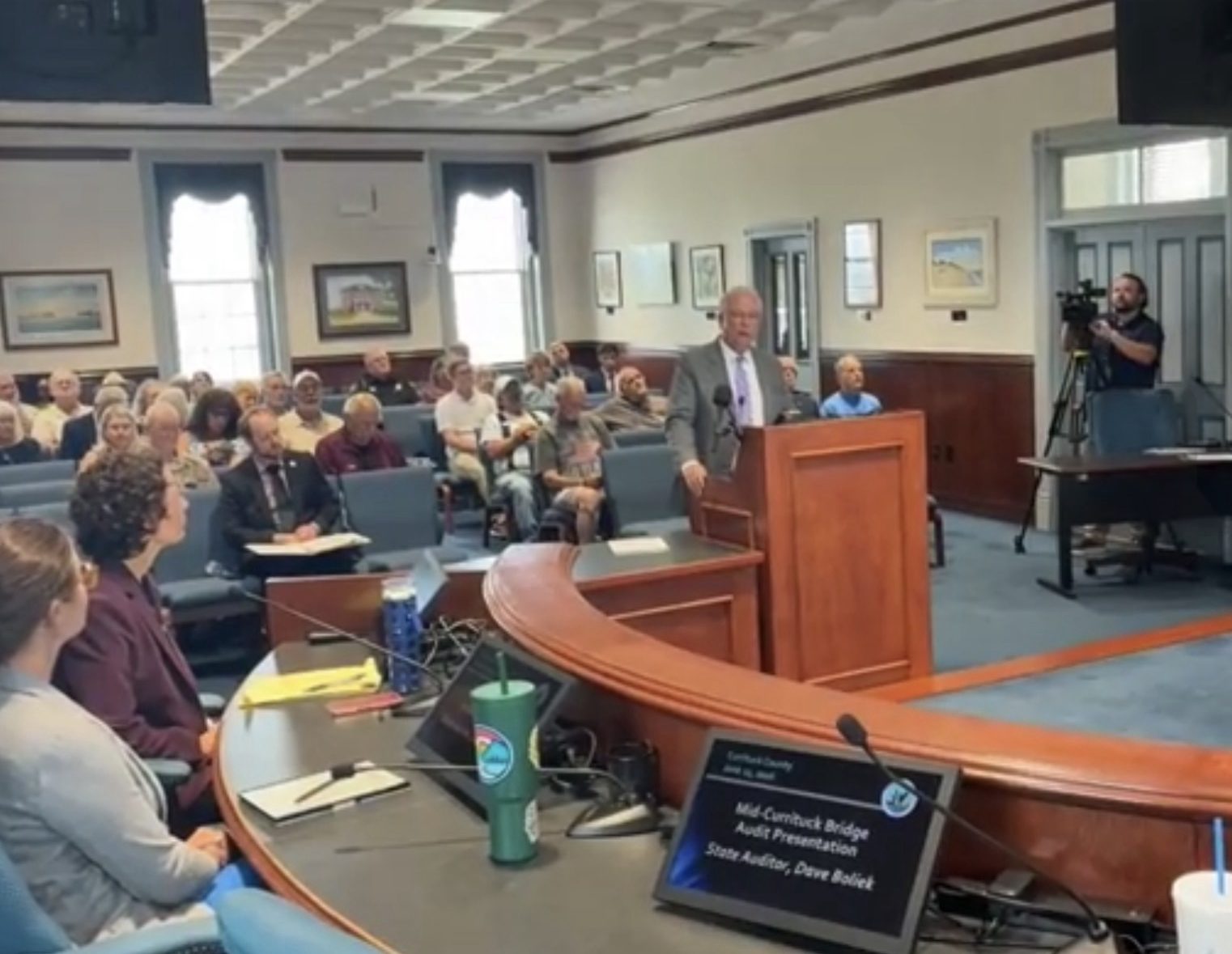
Boliek detailed the report during a Currituck County Board of Commissioners meeting and a press conference.
What the report provides is the most comprehensive public accounting to date of where the project stands after more than three decades of planning, permitting, litigation and engineering work.
“The people here deserve better. They deserve action. Whether that’s to move forward or not is ultimately up to what happens next,” Deputy State Auditor Charles Dingee told Currituck commissioners during a presentation of the report.

The proposed bridge would connect the Currituck mainland near Aydlett with Corolla, creating a direct route to the northern Outer Banks. Supporters have long argued it would reduce travel times, relieve congestion on the Wright Memorial Bridge and provide an additional evacuation route during hurricanes.
According to the Auditor’s report, the bridge’s estimated cost has risen from roughly $490 million at the time of federal approval in 2019 to $1.118 billion today. When delivery and administrative expenses are included, total project costs approach $1.2 billion.
The report also confirms that approximately $61.1 million has been spent on the project despite no construction contract being awarded and no construction schedule being finalized.
That spending has become a focal point of the discussion, though the report shows most of the money was spent on activities typically required before a major infrastructure project can move forward.
“Here, north of $61 million in taxpayer money has been spent on a proposed Mid-Currituck Bridge and not a single piece of dirt has been turned on that project after nearly 30 years of this process,” Boliek said.
The largest category, $26.3 million, went toward environmental studies, permitting, legal defense, right-of-way planning and compliance with federal environmental review requirements. The project underwent two separate National Environmental Policy Act review cycles and successfully defended a federal lawsuit brought by environmental groups.
Other expenditures include:
- $7.9 million related to an earlier public-private partnership effort that was later abandoned.
- $7.1 million for geotechnical investigations and soil testing.
- $3.8 million for traffic and revenue studies.
- $2.4 million for permit applications.
- $8.4 million for acquisition of five right-of-way parcels.
The report does not suggest the expenditures were improper. Instead, it questions whether state leaders can continue investing resources in a project that still lacks a viable financing plan.
That concern echoes discussions held earlier this year when NCDOT presented updated figures to ARPO. As previously reported by the Albemarle Observer, transportation officials informed regional leaders that the project faced a funding shortfall exceeding $700 million and was unlikely to move forward without significant new funding sources.
The Auditor’s review reaches the same conclusion.
Depending on the financing model selected, the report estimates a funding gap between $702 million and $832 million, even after accounting for $173 million in committed state transportation funds.
The report also highlights declining traffic projections. Earlier forecasts estimated the bridge would carry approximately 12,600 vehicles per day. Updated projections now estimate about 7,700 daily vehicles, reducing the amount of money that can be borrowed against future toll revenue.
During the presentation, Currituck County commissioners said many residents have grown frustrated by decades of uncertainty.
“I think the citizens want to know one way or the other,” one commissioner said. “For 30 years, it’s coming, it’s not coming.”
Boliek emphasized that his office is not taking a position on whether the bridge should ultimately be built.
“We’re not really here to say ‘yes bridge,’ ‘no bridge’,” he told commissioners.
Instead, he said the purpose of the report is to provide taxpayers and decision-makers with a clear picture of where the project stands after decades of study and spending.
“If it’s a ‘no’, then let’s let it be a ‘no’ quickly,” Boliek said. “Or let’s move forward with the bridge project. One of those two needs to happen now.”
For now, the bridge remains alive. In April, the Albemarle Rural Planning Organization voted 6-1 to keep the project as a regional priority, preserving $173 million in committed transportation funding.
But the question remains the same one raised during ARPO’s discussions this spring: Where will the remaining hundreds of millions of dollars come from?
Until that question is answered, the Mid-Currituck Bridge remains what it has been for much of the last 30 years: A project with potential benefits, significant challenges and an uncertain future.

Let us know what you think by leaving a comment. Comments are subject to approval.