By Miles Layton
EDENTON — On a warm Sunday afternoon, supporters of the Chowan County Democratic Party packed the front lawn of the Water Street home of Susan Inglis for a chance to meet the two women fighting to keep their seats on the First Judicial District bench.
District Court Judge Jenny Wells and Superior Court Judge Eula Reid fielded questions for nearly an hour, offering candid insight into life on the bench in Eastern North Carolina — and making a case for why voters in November should send them back.
Held at Homestead, the candidate meet-and-greet gathering drew a lively crowd eager to hear from both judges and learn how to spread the word ahead of the general election. There were many familiar faces in the crowd — former Chowan County Commissioner John Mitchener, local Democratic party leader Colleen Nicholas and Congressman Don Davis — more on him will appear in a separate story.
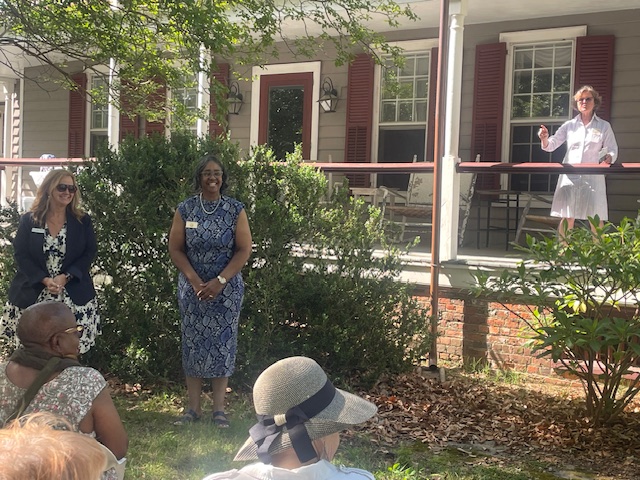
The story’s featured photo shows Susan Inglis on the porch with Wells on the left and Reid in the middle at Homestead — an historic home that overlooks Edenton Bay.
Subscribe — it’s free!
A District Shaped by Decades of Service
Between them, Wells and Reid represent more than three decades of legal experience rooted in the communities they serve.
Reid, a native of Elizabeth City and a graduate of Elizabeth City State University, has spent her career in the First Judicial District. After eight years as a paralegal and earning her law degree from North Carolina Central University, she was first elected district court judge in 2006, serving 15 years before moving to the Superior Court. Appointed to her current seat by Gov. Josh Stein in May 2025 following Judge Jerry Tillett’s retirement, she returned to a courtroom she knows well.
When asked Sunday what supporters should tell neighbors when canvassing, Reid was direct: “I would want you to tell them, and I would want the people to know, that I have served this district for over 25 years. My reputation should show that I am impartial and fair, and I’m dedicated to the citizens of the First Judicial District.”
On the Superior Court, Reid handles the district’s most serious matters. “I handle major felony cases,” she explained. “I do a lot of murder cases, a lot of sex offense cases, and high-dollar civil cases.”
Eula Reid’s husband, Melvin, who accompanied the judge to Sunday’s event, offered perhaps the most personal endorsement of the afternoon. A first-time courtroom observer after 25 years of marriage, he said watching his wife preside left him speechless.
“To sit there and listen to all the facts in the case and then give the jury the ruling — what they need to go by — is unbelievable,” he said. “If you ever get a chance, please go.”
Wells, originally from Elizabeth City and raised in Dare County, took a less conventional path to the bench. After graduating from Tulane University — her studies interrupted mid-semester when Hurricane Katrina forced her to complete coursework at Duke — she spent three years working in mental health before attending Campbell University Law School. She returned to Eastern North Carolina to be close to her aging parents, settling down near them in Kitty Hawk.
She served 11 years as a public defender across all seven counties of the First Judicial District before being appointed district court judge by Gov. Stein in March of 2025. When the position opened, her peers took notice. “I was the number one vote getter among the attorneys in this district,” Wells told the crowd. “So I had the support of my peers, and now I’m asking for your support.”
An attendee who described herself as a supporter put it plainly: “She’s dedicated her career to public service — first as a public defender. It really speaks to the heart of who she is and what she brings to the bench.”
The Scope of Their Courts
An early question about the kinds of cases judges see in Eastern North Carolina prompted both women to pull back the curtain on the sheer volume of work their courts manage.
Wells noted that the district court, covering the same seven-county region as the superior court, handled more than 45,000 cases last year — roughly ten times the volume of the superior court’s 4,500. The most common matters in district court, she explained, are misdemeanors and traffic infractions such as speeding tickets, which together account for about 80 percent of the caseload.
One of the most animated exchanges of the afternoon came when the conversation turned to rehabilitation and drug recovery courts. Wells, who serves as backup to the chief district court judge in the recovery courts of Dare and Currituck counties, spoke enthusiastically about the model.
“Dare has had a recovery court or drug treatment court for about six years now,” she said. “Currituck just started in January of this year, and they are phenomenal.”
She described the program’s structure — ankle monitors, curfews, and drug tests three times a week in the early stages — but emphasized what sets it apart from traditional court proceedings. “The recovery courts, to me, they are so wonderful because it’s the only court setting that involves incentives as well as punishment,” Wells said. “You see people — for me, especially people that I have represented over and over and over again — now in this recovery court program.”
The result, she said, is something rarely available to judges. “Usually as a judge, I have a case come before me, I sentence them. If they do fine on probation, I never see them again — and that’s good. But you don’t get to celebrate their successes that way like you do in a restorative court program.”
Wells said there is momentum to expand recovery courts to all seven counties in the district, but acknowledged the challenge: “It’s driven by money.” She encouraged community members to press their town and county councils to fund the effort, noting the first step is hiring a recovery court coordinator with a treatment background.
For Reid, the philosophy of rehabilitation extends even to routine child support cases on the district court bench, where she developed a reputation for meeting defendants where they are financially rather than defaulting to incarceration.
“I try to craft a way that they can meet their obligations and still not get arrested and put in jail for failing to pay child support,” she said. “Because if you put someone in jail” over child support, she added, it only compounds the problem.
She recalled one moment that stayed with her: a young man she had worked with through the child support process who encountered her later while working in at a grocery store. “He was like, ‘I thought you were kidding, Judge,’” she recounted with a laugh. “But thank you.”
Women on the Bench
Perhaps the most pointed argument of the afternoon came when Wells addressed the question of representation in the judiciary. Before she and Reid were appointed, six of the seven judges in the First Judicial District were men. If both face successful challengers in November, she noted, it would return to that imbalance.
“Forty-four percent of the attorneys in our district are women,” Wells said. “I firmly believe that women deserve to be represented — they deserve to be represented on the bench, in leadership positions in that district.”
She cited research to back the point: “They’ve done studies that have proven that female judges are better at finding compromise, particularly in family law cases, that they’re more empathetic with victims of domestic violence, and that they are harsher on sentencing for people who abuse women and children. In my mind, all of those are good things.”

Taking the Case to the Community
As the event drew to a close, both judges encouraged the room to do the simplest thing they could: talk.
“Campaigns like this, in towns like this, are won by word of mouth — by people talking and spreading the word,” Wells said. She urged supporters to go back to neighbors and family members across the First Judicial District and make the case for both judges.
Reid seconded the invitation for anyone curious about the court system to see it firsthand. “Our courts are open,” she said. “You can go and see a judge live.” Wells agreed: “If you haven’t sat through a case or a couple days of a case, it’s fascinating. It’s a really interesting thing to do. You learn a lot.”
The judges encouraged supporters to follow their campaigns online and to contribute through their campaign websites or by check made out to their respective campaign committees.