
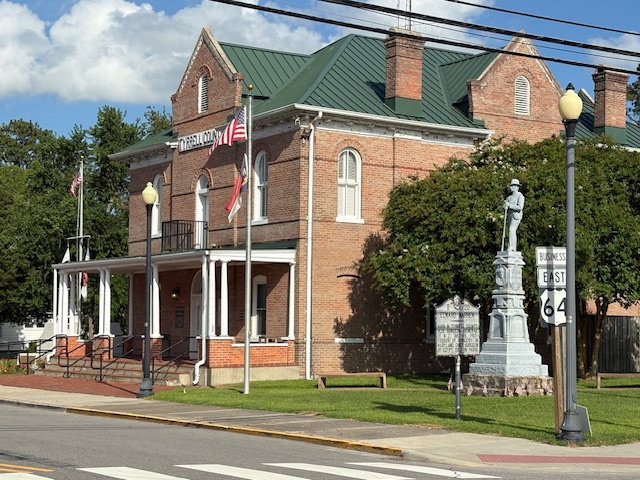
By Miles Layton
Rather than dance with word games around the lawsuit regarding Tyrrell County’s Confederate Memorial, I’m just going to talk straight about what’s at stake.
Tyrrell County isn’t just defending a lawsuit about a statue that has a controversial phrase engraved on it; it’s the front line of a war being waged to overturn state law through the application of equal protection under the law to objects, perhaps expand federal power and maybe curb free speech itself — whether you can have a statue or monument to anything that doesn’t offend someone. The plaintiffs are not seeking the removal of the entire monument; instead, they want the county to cover or alter the offending phrase, which they argue violates their constitutional rights. But there’s more to it than that.
Costs to date for the county defending the case are included further down in the story.
Though state law protects historical artifacts, does this Confederate memorial, engraved with the saying “In appreciation of our faithful slaves” violate a person’s 14th Amendment right to equal protection under the law?

The answer may depend on your political perspective within the “soft” civil war being waged between blue- and red-state identities and beliefs.

About a year ago, when US District Judge James Dever signed an order allowing the plaintiff’s complaint to proceed through the court system on equal protection grounds, he wrote that the “faithful slaves” phrase violated the plaintiff’s equal protection rights.

That said, a recent decision by the North Carolina Court of Appeals allowing a Confederate monument to remain outside the Gaston County courthouse may carry implications for ongoing legal disputes in eastern North Carolina involving Confederate memorials in Chowan and Tyrrell counties.
The ruling, reported by the News & Observer, concluded that the presence of a Confederate soldier monument outside a courthouse does not violate constitutional rights unless plaintiffs can show it actually prevents access to the courts. That conclusion could influence how judges evaluate similar claims connected to monuments in Edenton and Tyrrell County, where legal disputes remain unresolved.
In the Gaston case, plaintiffs contended that the monument’s symbolism created an atmosphere of racial hostility and signaled bias within the justice system.
A three-judge panel of the North Carolina Court of Appeals rejected that argument.
In a written opinion, the panel determined that the plaintiffs had not demonstrated that the monument actually interfered with their ability to access the courts. The judges concluded that subjective feelings about the monument were insufficient to establish a constitutional violation.
The Gaston County decision emphasized that plaintiffs must prove an “actual denial of access to functioning courts,” rather than relying on perceptions that the monument might discourage someone from entering the courthouse.
Because the plaintiffs could not demonstrate that level of harm, the court allowed the monument to remain in place.
Tyrrell County’s legal battle is not just about a phrase engraved on the statue, but about the state law itself, because the outcome of the case may not only weaken the law intended to protect historical artifacts but perhaps create another avenue to challenge other state laws that social activists say infringe on the Equal Protection Clause.
Red flag — why was the lawsuit filed in federal court? Isn’t state court a good enough forum to pursue a ruling?
This is not like the Edenton case, which is being adjudicated in the state courts, though there are similarities.
No, this is a legal strategy the plaintiffs are pursuing to win their case: either by a federal judge’s ruling that would be a direct challenge to state law or by slowly strangling Tyrrell County financially as it uses scarce taxpayer funds to defend itself against this lawsuit.
Moreover, consider this: in this day and age, any object can be considered offensive to someone. For example, a Revolutionary War statue or a Betsy Ross flag — some folks who view America’s past with contempt consider these symbols offensive. How utterly bizarre is it that after dismantling a Confederate statue at midnight on Labor Day weekend nine months ago in Edenton, a slave owner’s mansion is poised to be moved to the downtown waterfront — you can’t make this stuff up…
In the wake of the happenings in Charlottesville in 2016, lawsuits were filed near and far challenging the placement of Confederate memorials.
The Tyrrell lawsuit is a test case — as far as I know, no other lawsuit regarding North Carolina’s Confederate memorials has been filed in federal court.
If the federal court rules against the plaintiffs, then the plaintiffs may try to pursue the matter through state court. That’s a rough row to hoe because state law is pretty clear about removing such monuments.
However, that’s not stopped other plaintiffs from trying their luck in state court. See our story about Edenton’s Confederate statue.
During Tuesday’s Edenton Town Council meeting, Sons of Confederate Veterans Edenton Bell Battery Commander Michael Dean said the SCV warned that the organization may sue the town again if the statue, which has been in storage since the town took it down at midnight on Labor Day weekend, perhaps indefinitely, is not re-erected, preferably in front of the 1767 Chowan County Courthouse.
If the federal court rules in favor of the plaintiffs – that may spark a second wave of litigation because not only would Tyrrell County have to weigh the costs of an appeal, but it would also set a legal precedent, more or less challenging state law, that would affect statues or historical artifacts anywhere and everywhere. Since monuments are in front of courthouses everywhere, particularly in small towns between Currituck and Windsor, establishing a legal precedent would most likely spark a barrage of new lawsuits.
But more to the point: that means there will be ongoing litigation – endless war – that is certain to last longer than the Civil War.
What does that mean? That means Tyrrell County may be on the hook with legal bills for a long, long time.
The dispute has already cost Tyrrell County $9,541 in legal fees, with County Commissioner Rob Thompson saying that costs could climb dramatically — potentially exceeding $100,000 — if the case is not settled. See our previous story here.
The county carries an insurance policy for legal matters with a $50,000 cap that is expected to be reached soon.
This lawsuit is not just about removing what many would consider to be an offensive phrase – no – the legal strategy here is much like the Anaconda Plan favored by the Union, which slowly strangled the South’s will to resist during the Civil War.
Being that Tyrrell County is the poorest and least populated county in the state – the plaintiffs may have discovered a strategy that, by the mere threat of financial uncertainty that comes from endless litigation, they can achieve their aims by getting the Confederate statue removed.
Poor people know this better than anyone – your will and financial ability to defend what’s right, no matter how just the cause, is less important than how much a rich man will spend to fight your case because the golden rule has always been, he who has the gold, makes the rules.
Though I have faith that the Tyrrell County Commission can balance the need to defend lawsuit taking aim at the Confederate Memorial with the needs of the citizens, that may be a challenge longterm, same as it would be for any rural county.
And I’ll say it again, more important than debating a statue’s inscription is deliberating on the fact that rural schools are still, in truth, considered “separate but equal” compared to affluent suburban schools, not because of race but because of modern-day funding formulas flowing from Raleigh.
Applying Tyrrell tax dollars to pay to defend this ongoing litigation regarding the statue – that’s important, but there are bigger issues at stake.
Rather than spending time and money to debate a 120+ year old phrase that you have to search out to find on the statue, maybe those efforts would be better spent fighting how discrimination in education funding on the basis of wealth or income level violates the Equal Protection Clause of the Fourteenth Amendment, particularly in less affluent rural counties.
If state and local governments near and far cave into legal extortion or bend to federal authority – death by a thousand cuts – then we surrender our ability to local governance. That means meaningful local change earned through the democratic process will always be at risk from plaintiffs who don’t like the outcome at the ballot box.
Co-founder of the Albemarle Observer, Miles Layton can be reached mileslayton1969@gmail.com
Op-Ed: Become a Republican? I’d be terrible.

By John Fetterman
US Senator, Democrat-Pennsylvania
Many might not know, but I won my first race by a single vote to be mayor of Braddock, a small steel town — one of the poorest in the commonwealth of Pennsylvania — where 90 percent of the population has left. It was a forgotten community.
I wasn’t interested in playing political games. I wanted to help deliver change. It wasn’t about being a Democrat or Republican, but about making sure places such as Braddock received the benefits, focus and investments they deserved for their contributions to this great country.
As a U.S. senator, I still believe in that principle. It doesn’t matter if my colleague is in my party or across the aisle. My focus remains on working together to find wins and deliver for my constituents. And though I was elected as a Democrat, I’m proud to serve all Pennsylvanians.
It has become increasingly lonely to serve in that way, but I firmly believe it’s what is needed.
My party cannot simply be the opposite of whatever President Donald Trump says. The president could come out for ice cream and lazy Sundays, and my party would suddenly hate them. Such pointless pile-ons and attacks are unproductive. The American people want us to work together to find solutions on issues they and our country face.
It wasn’t long ago when Democrats wanted a secure border. I voted on an immigration bill in 2024 to make sure an influx the size of Pittsburgh doesn’t come through the border like it did under the previous administration. I have co-sponsored legislation to stop the flow of fentanyl. I was the lead Democrat on the Laken Riley Act, and I strongly believe that someone who comes here illegally and commits a violent crime should be deported. Full stop.
It wasn’t long ago when Democrats believed shutting our government down was wrong and put American livelihoods at risk. I consistently voted to end back-to-back government shutdowns because our Transportation Security Administration agents, our homeland security, our airports and everyday Americans were hurting and should have never been held hostage. I took no pleasure in voting against my party. While the base targeted me for putting the country first, the demand to keep the lights on weighed more heavily than partisan games.
It wasn’t long ago when we believed it was crucial to support allies such as Israel against threats to their safety and peace. In the wake of the war in Gaza, Iran-backed Hamas and Hezbollah have ramped up their attempts to dismantle our ally. I remained committed to fully backing the elimination of these terrorists and their leaders. My party’s recent presidential candidates identified Iran as a significant global threat, one that shouldn’t be able to acquire a nuclear weapon. They emphasized a view I still hold: that the leading state sponsor of terror should be held to account. I appreciate that this administration acted on the threat Iran and its proxies pose.
These once-common views have become increasingly toxic in the Democratic Party, a result of catering to the fringe and agitated parts of our base. The party is fractured by their demands, heightened after the Gaza war and even more after Trump was elected in 2024. Numerous protesters have followed me around D.C. or shown up at my Braddock home to tell me I’m a traitor simply for voting my conscience, unapologetically standing with Israel and the global Jewish community, keeping our government open and our workers paid, securing our border — stances that were not unusual. My values have not changed, and I have always turned to those kinds of ideals that defined being a Democrat. I remain strongly pro-choice, pro-weed, pro-LGBT, pro-SNAP, pro-labor and even pro-rib-eye over bio slop.
I refuse to cave on my conscience because Pennsylvania deserves someone who is honest and can work across the aisle.
Transportation Secretary Sean P. Duffy and I worked together to unfreeze $1 billion in federal funding for transportation projects across Pennsylvania. Sen. Dave McCormick (R-Pennsylvania) and I have delivered hundreds of millions of federal dollars to our state for projects that improve the lives of our 13 million constituents, including $600 million to rebuild the Delaware River Bridge and improve the Pennsylvania Turnpike. Sen. Jim Justice (R-West Virginia) and I introduced the Hot Rotisserie Chicken Act to allow Supplemental Nutrition Assistance Program recipients to use their benefits to buy hot rotisserie chicken. Sen. Katie Boyd Britt (R-Alabama) and I have worked together to protect the mental health of kids with our Stop the Scroll Act. Sen. Cynthia Lummis (R-Wyoming) and I have taken Pennsylvania’s wildly successful Whole-Home Repairs Program and introduced a bill to bring it to the national level to keep Americans in their homes.
Being an independent voice that works with the other side to deliver for Pennsylvanians might put me at odds with the party that I have stayed committed to and have no plans to leave — but I will continue to put the commonwealth and the country first.
Posted to Senator Fetterman’s US Senate webpage, this column was originally published in the Washington Post.


2 responses to “Editorial Page: The Anaconda Strategy: Why the Tyrrell Confederate Monument Case Is About Far More Than One Phrase”
Mr. Layton,
The Anaconda Strategy was new terminology to me but I certainly get it. Your point: “How utterly bizarre is it that after dismantling a Confederate statue at midnight on Labor Day weekend nine months ago in Edenton, a slave owner’s mansion is poised to be moved to the downtown waterfront — you can’t make this stuff up…” is quite insightful.
Those who attacked / invaded the South in 1861 are still very much at play. New generation . . . same mentality. I feel some of those who have ‘signed on’ to such efforts to REMOVE century old monuments and memorials are simply useful fools in the hands of socialists who want nothing more that to destroy America from within. If those in opposition would get their heads straight and realize Civil War history is part of American history – good or bad – they would realize America is a work in progress . . . always has been. I don’t believe the “faithful slaves” phrase was derogatory but a recognition of diligence. Those who read the Bible have likely read the admonitions to servants to be faithful. Most of the peoples of earth were taken slaves at some point, perhaps called by different terms like ‘indentured servants.’
Not only is America evolving, the whole world is evolving, as it has been for centuries. We must realize (and be thankful) that things do change over time.
Thank You for another insightful and well articulated article.
J. McRoy
Pitt County
Thx for reading
Not sure about this tidbit of Tyrrell history — I heard it somewhere — maybe true, maybe not. When the Yankees invaded, Tyrrell County court’s records — very old records dating back to Colonial times — were saved by quick thinking by men, who were then slaves. That may be where the term in appreciation of faithful slaves comes from. Don’t know and I don’t want to debate keyboard warriors who may read this post. I’ve always been fascinated with our local history. If true, that story would provide a bit of context to the phrase engraved on the statue.