By Miles Layton
Well… Monday’s Plymouth Town Council was… interesting, definitely not boring.
There were two women shouting at each other, a heated discussion about the Betsy Ross American flag being racist, a debate over the Bear Festival, a recently deceased Councilman Danny Wobbleton’s wife, Judy, being asked to leave the meeting, Police Chief Louis Banks’ update on shootings, and so much more. For more about these stories, see next week’s Roanoke Beacon. For now, here are a few highlights.
Subscribe — it’s free!
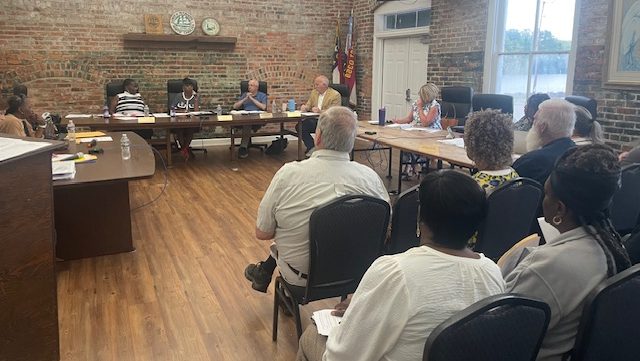
PLYMOUTH — A Plymouth Town Council meeting Monday night stretched across hours of tense debate, with members clashing over Colonial-era symbolism, festival funding, nonprofit partnerships and public safety — while residents in the gallery vented frustration over water bills, violence and the direction of town leadership.
Flag Debate Divides Council
A discussion over what flags should fly downtown produced one of the evening’s sharpest exchanges, as Mayor Crystal Davis and Council member Micah Weathersbee repeatedly talked over one another in a debate that touched on slavery, religion, corporate boycotts and the meaning of American history.

Davis raised immediate objections to the Betsy Ross flag itself, arguing that its associations went well beyond colonial history. “A lot of hate groups have actually adopted this. The KKK have adopted the Betsy Ross flag,” she said. She also cited Nike’s decision to pull a shoe featuring the flag as evidence of its contested symbolism, and questioned what the flag represented to Black Americans. “In 1776, when this flag was established with the 13 colonies, how does it relate to African Americans? That is why I voted against it last time because of how offensive it is. It doesn’t represent my people.”
Weathersbee pushed back, arguing the flag’s meaning in the context of the nation’s 250th anniversary was rooted in founding ideals, not racial exclusion. “The 250th is celebrating the fact that our country, based upon freedom of religion, is celebrating 250 years,” she said. “Betsy Ross was a Quaker. She didn’t have anything to do with slavery.”
Davis rejected that framing. “The flag is not about religion. We’re talking about 1776 when she made the flag. In 1776, we were still slaves. That flag did not exist for African American people.”
“That doesn’t mean that’s what that flag represents,” Weathersbee replied.
“I am telling you that it is,” Davis said. “Why would Nike pull it if it wasn’t evidence of that?”
“You can’t twist everything to mean something else,” Weathersbee said.
“That’s not a twist. This is factual,” Davis responded.
Davis added a historical note about the flag’s origins. “She was invited over by George Washington, who at that time had slaves too. Miss Betsy Ross was indeed a slave owner.”
Council member Jerry Rhodes attempted to thread the needle, acknowledging the nation’s troubled history while arguing for the flag’s place in the upcoming anniversary. “There is some question as to whether or not Betsy Ross actually made that flag,” he said. “But that was the flag of the American Revolution and this country’s independence from England. Granted, there was slavery during that time. But we’re getting ready to celebrate a 250th anniversary of our country’s independence from England, warts and all.”
Council member Kim Williams proposed sidestepping the controversy altogether. “Why don’t we get flags that are blue with white letters that say Plymouth? We’re here in Plymouth. The people are from Plymouth. Then we don’t have to take them down. This will be Plymouth forever.”
Council member John Shelton supported the idea and noted that cost may not have been a factor in either original proposal. “I think the America 250 was going to pay for the flags, and I think the lady that organizes Juneteenth was going to pay for that, so it wouldn’t have been a cost,” he said.
Williams acknowledged the point but held firm. “Thank you for telling me that. But still, we don’t need anything up to just cause separation.”
No vote was taken, leaving the question unresolved.
Food Pantry’s Future Uncertain
A separate but related dispute unfolded over the fate of the town’s displaced food pantry — a discussion that grew heated as council members clashed over what the administration knew about the condition of the pantry’s former home at 811 Washington Street, and when it knew it.
Town Manager Joanne Floyd described 811 Washington Street as effectively beyond use. “That building is in a bad, deteriorated state and possibly not going to pass building inspections,” she said. The question before the council was whether the food pantry organization could temporarily relocate to 118 Washington Street, a town-owned property previously voted for surplus, while the 811 situation was resolved.
Davis said the building at 811 had been uninhabitable long before the current administration took office. “The floors are rotted, the windows are broke, the electricity is from the eighties, there’s black mold everywhere,” she said. “It shouldn’t have been operated. This building has been like that for twenty-five years with no upkeep.”
She said demolishing 811 could be handled by town staff at no cost to taxpayers, and that 118 Washington Street represented a faster path to getting the food pantry back in operation.
Councilwoman Williams recommended that if the food pantry moved to 118 Washington Street, its lease clock should reset entirely. “It is my recommendation that the lease starts over when they can go into a usable building,” she said, “because the months they’ve already used — they’re using months and haven’t been able to operate.”
Davis agreed. “Under the law, you can’t amend that lease. She’s never been able to occupy that property at 811 because it can’t be used.”
Shelton, however, raised a concern about 118 Washington Street’s own condition, saying he had been told by Downtown Development Authority contacts that the building had rotted floors in the bathroom area due to plumbing leaks. “If we’re going to spend money to make this building on Washington Street usable on a temporary basis for the food pantry, while we make the other building usable for the food pantry, then we’re spending money twice,” he said.
Davis said the food pantry had collected tens of thousands of dollars in outside funding over the years with little evidence it had been used to maintain the building. “They have received funding for the last twenty years on that building,” she said. “I know in the last five years, they’ve gotten about thirty-four thousand dollars. It has not been used towards any upkeep of that building at all. They did get a grant from Food Lion — I actually have documentation of that — for windows, just recently before the eviction, and those windows have not been touched at all.”
Weathersbee pushed back, saying the organization had planned to ask the town to co-fund the window project because the grant alone was insufficient. She then turned the argument on the mayor directly. “When you put this food pantry in there, you knew the conditions of doing it. You did have a lease and it was for that building and is what you asked for.”
Davis disputed that sharply. “Absolutely not. They were never allowed to go in there because it was inoperable. We did not have access to that building until after the eviction. We evicted the last tenants for noncompliance — for operating a town property without a lease for twenty-five years. It was about thirty days after the eviction when we finally had access to the building.”
Floyd said Wright would present evaluations of both properties at a special meeting scheduled later this month.
Festival Funding Fight
The debate over flag symbolism was followed by an equally contentious presentation from Davis on the town’s finances and its relationships with nonprofit organizations — a discussion that quickly turned into an argument over the Black Bear Festival and the town’s economic future.
Davis framed her remarks around Plymouth’s Tier One municipal status, which she said signals financial distress. “I would like the citizens to be mindful of the decisions made in the future by the council as far as Tier One status and how it directly impacts your inflated water bills and also your tax rates,” she said.
She argued that festival funding represented an unjustifiable drain on public resources. “There is no return. There is no return. If the town spends taxpayers’ money but doesn’t generate revenue, the funding becomes a loss,” Davis said. “Spending money on a festival is hard to justify when basic needs may be underfunded.”
She went further, calling on the council to cut ties with all nonprofit organizations. “I’m asking the town of Plymouth for the town council to separate from all these entities,” Davis said, warning that inaction would force her to seek outside intervention. “Failure to separate from these nonprofits and entities tonight, it will force my hand to contact the LGC and file a formal investigation.”
Shelton immediately challenged the mayor on the consistency of her position. “You just were ready to go to battle with Councilmember Weathersbee over supporting the food pantry,” he said. “And now you’re saying the exact opposite — that we should divest of all 501(c)(3)s, so you’re contradicting yourself.”
“That’s not true,” Davis replied.
Shelton pressed on. “We had an entity that was distributing food and you evicted them. That was a 501(c)(3) that was successful and had been in place for decades.”
Weathersbee challenged Davis on economic grounds. “If we’re trying to move out of a Tier One bracket, we’ve got to be able to have our businesses make more money. The Black Bear Festival — the money that some of these businesses make — it keeps them floating.”
Davis stood her ground. “My focal point is not bring in people (tourists) in first. My focal point is dealing with the people here first.”
Weathered responded, “You have to bring more people in. You have to bring more money in. That’s what happens when you try to build a town and come out of a Tier One.”
Council member Donsenia Teel voiced concern over the direct cost of the festival to the town. “We have men from maintenance that work that’s getting overtime. We have the police department. We have EMS. But we don’t profit anything. We don’t get anything in return. Nothing. Zero.” She added, “We already pay $110 for water we can’t drink. And then you got taxes. We are talking about raising taxes, but here we are paying for a festival to entertain everybody else.”
Williams called for financial transparency before any decisions were made. “I don’t understand why we don’t have a printout. We should have a printout of what they make, what we contribute, what the benefit is. If we have a printout of everything, we don’t even have to argue.”
The town attorney clarified that nonprofit funding is permissible only when there is a demonstrated public benefit. Teel moved to separate the town from the Black Bear Festival and Historical Society. The motion received a second from Williams but failed.

Police Chief Addresses Violence, Staffing
Police Chief Louis Banks addressed the council on the town’s recent shootings, telling members his department is treating each incident with urgency while managing the constraints of ongoing investigations.
“These incidents are being taken extremely seriously by the Plymouth Police Department,” Banks said. “Acts of violence, especially those involving firearms, have no place in our community.”
Banks confirmed arrests had been made in at least two cases — a Main Street shooting and a homicide on Water Street — while noting that more recent incidents remain under active investigation with FBI assistance. “There’s a lot of times we know what happened, we know who was involved, but knowing it and proving it are two different things,” he said. “Without something to develop probable cause, we can’t go make an arrest.”
He said staffing, a persistent concern, had improved significantly. “At one point there was only three of us working,” Banks said. “We are now above half staff. We have two detectives, we have sergeants, and we also have a cadet that just started basic law enforcement training today.”
Shelton asked whether a Crime Stoppers program could help encourage anonymous tips. Banks said it could, referencing his experience in Martin County. Williams raised the question of anonymous reporting. “They don’t want to be identified,” she said. Banks confirmed callers can provide information without giving their names, and that a formal Crime Stoppers line would offer additional protection. “That would be a means to be able to do it where they wouldn’t be able to be identified,” he said.
Banks acknowledged the challenge investigators face when witnesses are unwilling to testify. “If you don’t have a witness who can go in court on it, then it ties the hands,” he said.
A community policing meeting is tentatively planned for April 25. “I think it’s a team effort among all of us,” Banks said. “It takes the help of all of us.”
Public Comment: Water Bills, Grief and Accountability
Public comment brought its own drama, beginning with a shouting match between resident Cassandra Brown and Terri Pitt that briefly halted proceedings before yielding to a sustained chorus of community frustration.
Brown, a North Broad Street resident, criticized Mayor Davis over the elimination of the food pantry and what she called hostility toward the Black Bear Festival. “I feel like you are not running the show — somebody else is handling the show, and you are doing what someone else has told you to do,” Brown said. “When we have the Black Bear Festival, many people do benefit: those people who have restaurants, those people who have motels and hotels, the gas stations. Everybody does benefit.”
As Brown concluded, Pitt interjected from the audience.
Mayor Davis tried to restore order — “Ladies, ladies, ladies, hey, hey” — but Pitt was direct: “You better walk out — you better not never tell me to shut up.” When others in the chamber intervened, Pitt added: “You got me messed up for real.”
Davis banged the gavel. Order was eventually restored.
Judy Wobbleton, wife of the late former councilman Danny Wobbleton, followed with a tribute to her husband and a plea for unity. “Danny was a good man. He would be here tonight — bless y’all — because he would not like a thing that’s going on. He loved this town,” she said. “Up until about the last six or seven years it’s been rough. This could be a beautiful town if you didn’t stop everything.”
She directed her closing remarks at the council. “Please work together for the town, for the taxpayers. They’re the ones that keep this town going. You don’t pay any taxes, you don’t need to be head of the town.”
Later, when Wobbleton asked to speak during a meeting, Mayor Davis shut her down and asked that Wobbleton be removed from the council chambers. Though Wobbleton left on her own accord, she was not happy.
Water bills dominated much of the remaining public comment. Tristan Spencer told the council his monthly bill had jumped from around $130 to as much as $300, despite the fact that he and his wife are truck drivers rarely at home. “Our money is hard earned. I can’t go from paying 130-something to 250 or 300 for them to tell me my water came through the pipes,” he said. “I need my water bill lowered now.”
Pitt returned to the microphone after apologizing for the earlier confrontation and echoed Spencer’s frustration. “It ain’t but two people in my house and my water bill is sky high. I don’t have no leaks and I’m not hardly home because my husband’s in treatment. I wash once a week.” She called on residents to unite across racial lines. “This is a poor community. The only way things are going to change is if all of y’all pull together — not by color, but by what is right and what is supposed to be for this town.”
Wanda Pettiford appeared for the second consecutive month to demand a public apology from The Roanoke Beacon over what she described as a disrespectful headline about her nephew, Quadre Khalil Pettiford, who was killed.
Wayne Pittman closed the public comment period with a call for proactive law enforcement engagement. He said many residents — including business owners — could not identify their own police chief. Pittman called for community meet-and-greet events, neighborhood watch programs and job training as longer-term answers to the violence.
See next week’s Plymouth Beacon for more about Monday’s council meeting.
Make a one-time donation
Make a monthly donation
Make a yearly donation
Choose an amount
Or enter a custom amount
Your contribution is appreciated.
Your contribution is appreciated.
Your contribution is appreciated.
3 responses to “Flags, Finances and Crime: Plymouth Council Meeting Marked by Sharp Exchanges”
Miles and Nicole Layton, you are a tremendous credit and asset to so many communities through your comprehensive, factual, and well presented newsworthy journalism. I began reading The Raleigh News & Observer in the third grade at Frederick L. Woodard Elementary School in Wilson, North Carolina. Back then, newsprint was trusted and a valuable learning tool. Quite often today, that is not the case: think “WOKE.”
THANK YOU BOTH FOR YOUR DEDICATION TO PROFESSIONALISM IN JOURNALISM.
Mike McArthur
04/14/2027
Mayor Davis is very narrow minded. Why do I say that, well – her words:
“In 1776, when this flag was established with the 13 colonies, how does it relate to African Americans? That is why I voted against it last time because of how offensive it is. It doesn’t represent my people.”
Mayor Davis is so narrow minded that she ONLY views herself through the lens of race and while participating in the American political process that has, and continues, to evolve for the last 250 years, she is unwilling to be celebratory of how it all started.
Where would we be if we ALL viewed “Our people” through such a narrow lens? Sad to think about isn’t it?
Should we just ignore the 250th because in her mind (African Americans that fought FOR the revolution would disagree with her) it meant nothing to “Her people”? Perhaps she wants to start counting in 1866 when most formerly enslave MEN could vote – oh wait – perhaps that’s not good enough either – Mayor Davis is a woman – maybe she wants to ignore America until women win right to vote in 1920 so perhaps we need to fly a 48 star flag and celebrate the 106th birthday of an America that is more inclusive of “Her people”.
As I said – America (like everywhere else) is constantly evolving – the world spins round and round and is constantly in flux and if folks look for fault at any moment in time, they will always find one. If finding fault means “Do not celebrate” well then there would never be celebration and a lot less joy in the world. Always looking to where a nation, a cause, or a person falls short and ignoring their goodness makes for a bitter way of living life in my opinion.
It appears to me that davis does not realize her position requires her to represent all citizens of Plymouth no matter their race. She appears to think her position only requires her to be prejuidice and only represent HER PEOPLE
It is so very sad that someone of her caliber is a so called leader.