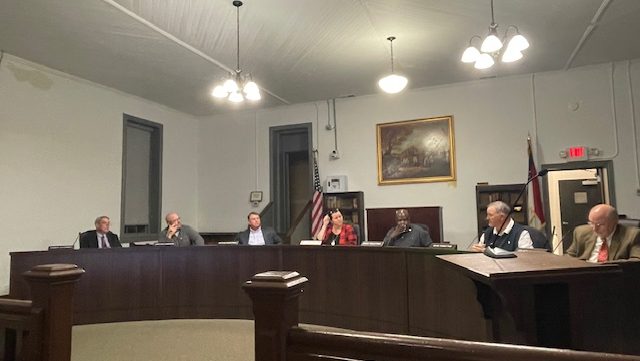
GATESVILLE — Gates County commissioners on April 15 approved an architect for the long-planned community and senior center, heard presentations on energy assistance and food access programs, and received detailed updates on the county’s ongoing water infrastructure challenges.
Let’s start with a water infrastructure update — County Manager Scott Sauer delivered an extended update on the county’s water and sewer infrastructure, centering on the replacement of well number two, which went offline in late January.
The replacement design — now tentatively approved by the state as of April 7 — calls for five water-intake screens, compared to the original well’s two, significantly increasing potential output. “The hydrogeological analysis determined that we could expand production by going with the five screens,” Sauer said.
The expanded design carries an additional cost of $100,779 above initial estimates, which Sauer proposed drawing from the water plant improvement budget. He said the state declared the situation at the emergency level on March 20, expediting the approval process.
Sauer also reported that the county’s transition from bimonthly to monthly water billing, combined with the replacement of approximately 25% of malfunctioning meters, has produced measurable results. The county is projecting water and sewer fund revenue of $1.6 million by June 30 — currently tracking at $1,661,000.
On the planned sewer connection to Merchants Mill Pond State Park’s new family campground, Sauer said the county is pursuing a temporary 3,000-gallon pump-and-haul tank as a workaround to allow the campground’s anticipated summer opening while the permanent sewer line — still roughly six months from completion — is built. “They will pay the cost,” he said of the arrangement with the state.
Property Tax Resolution; Transportation Update
Commissioners unanimously adopted a resolution opposing proposed state legislation that would limit counties’ authority over property tax rates.
“This is about state level legislators trying to take away the ability of local governments to determine and have ultimate say in their tax rates,” Commissioner Dave Forsythe said. “Ultimately it takes away local people making decisions about their property, their counties, their communities.”
Chair Emily Truman added that while large counties might absorb such changes, “for smaller communities like Gates and Hyde and Tyrrell, it would be pretty devastating to our local communities if it goes forward.”
Ethan Summers of the Albemarle Commission presented a transportation planning update covering pedestrian safety improvements planned for intersections at N.C. 137/37 and near the local pharmacy, as well as feasibility work on a roundabout or reduced-conflict intersection at U.S. 158 and Acorn Hill Road. Summers also outlined scoring submitted for potential modernization projects on the U.S. 13 and U.S. 158 corridors, with a June deadline for express design submissions.
Subscribe — it’s free!
Energy Assistance Program
Jasmine Carter and Christy Gibson of the Center for Energy Education in Roanoke Rapids presented an overview of the Energy Saver NC program, a state initiative administered through the N.C. Department of Environmental Quality that provides financial assistance for energy efficiency upgrades.
“Qualified residents may receive up to $16,000 through the HOMES program and up to $14,000 through the HEAR program depending on eligibility and household needs,” Carter told the board. She noted that the average median income for a single-person household in Gates County is approximately $41,350, meaning many residents may qualify.
The program covers upgrades including HVAC systems, water heaters, insulation, air sealing, ranges, refrigerators, and washers and dryers. Renters are also eligible, provided their landlord grants permission for an assessment and work to be completed.
Carter said a statewide pot of $204 million funds the program, of which less than $100,000 has been spent to date. She emphasized the organization’s limited role in the process. “We are simply volunteers helping the community,” she said. “We are not the ones who approve or deny applications and we have no access to any information on an application once we help submit it.”
The Center for Energy Education plans to return to Gates County on May 12 at the Gates County Community Center from 10 a.m. to 3 p.m., with computers and scanners on hand to assist residents in completing applications. Required materials include a valid email address, 12 months of utility bills, and income documentation for all household members 18 and older.
Commissioner Forsythe asked whether contractors interested in participating in the program needed to be licensed. Gibson confirmed they must hold a VPI certification, noting that DEQ is offering it at a discounted rate of $500, down from $999. Contractors working in rural communities also receive a $500 bonus on top of their project fees.
Commissioner Rountree, who invited the presenters, urged residents to take advantage of the opportunity. “There’s a need for our constituents to take advantage especially during these economic times to save money in their homes,” he said.
Ripe Revival Mobile Market
Christine McKeel, community engagement coordinator for Ripe Revival, presented the nonprofit’s mobile market program on behalf of founder and CEO Will Kornegay, who was absent following the birth of his third child.
Ripe Revival operates a fleet of 11 mobile market units — buses and trucks with trailers — conducting 33 weekly events across 22 counties. The units carry fresh produce, meat, eggs, and pantry staples sourced from North Carolina growers, priced approximately 30% below standard grocery store prices under a “pay what you can” model.
“There’s no application process,” McKeel said. “You just show up and shop.”
McKeel said the nonprofit is preparing to launch a second distribution hub in Plymouth, to be located on the campus of Washington Regional Medical Center, targeting 20 routes across 35 counties by the end of 2026. She said Gates County is on the near-term horizon. “Gates County is on the horizon and I think maybe we could be here as soon as June,” she said.
Several units also include a wellness center equipped with Starlink-enabled telehealth access, funded through a USDA grant. Health partners use the space for screenings, care navigation, and connections to primary care providers.
Chair Truman called the program’s reach significant. “The access to care is huge,” she said. “We talk about whole person care and access to screenings and connecting to care and how limited we are.”
McKeel noted that Blue Cross Blue Shield, through the assistance of Dr. Stanley Elliott, has already provided seed funding to begin operations in Gates County.
Senior Center Architect Selected
Commissioners unanimously approved Skinner Farlow Kirwan Architecture as the design team for the new community and senior center following a competitive selection process.
County Manager Scott Sauer told the board that 11 firms from across North Carolina had submitted qualifications, from which five were selected for in-person interviews. “The county received a grant several years ago that will provide funds to pay for the design and engineering work,” Sauer said.
Odds and Ends
The meeting approved a consent agenda that included the formation of three new advisory bodies: the Gates County Animal Services Advisory Board, the Merchants Commerce Center Committee, and the Opioid Prevention and Intervention Committee.
Three residents spoke during the final public comment period, each raising concerns about a residential development by Ryan Homes. Two speakers said they supported measured growth but called on commissioners to consider revising minimum lot size requirements and to ensure incoming developers contribute to county infrastructure needs, including fire, EMS, and schools. A third speaker also pressed commissioners to increase resources for animal services, warning that rising development would worsen the county’s stray animal problem.
Leonard Brothers of the Hobbsville voting district was also approved to fill the final seat on the Merchants Commerce Center Committee.
Make a one-time donation
Make a monthly donation
Make a yearly donation
Choose an amount
Or enter a custom amount
Your contribution is appreciated.
Your contribution is appreciated.
Your contribution is appreciated.