By Miles Layton
When I cover local government meetings across Northeast North Carolina, I tend to pay close attention to the public comment portion of the meeting. Why? Because this is the one place where citizens can make their case to public officials, who have to sit there and listen — not hide behind staff or claim sudden scheduling issues or play phone tag. Citizens’ words become part of the public record and are included with the official minutes from the meeting.
Sometimes these words put local elected leaders on notice and reveal issues that need to be addressed, while other times it can be … a filibuster… entertaining, but stfu.
That said, these speeches are important to democracy because they not only shed light on community issues but also give voters a chance to be heard.
Subscribe — it’s free!
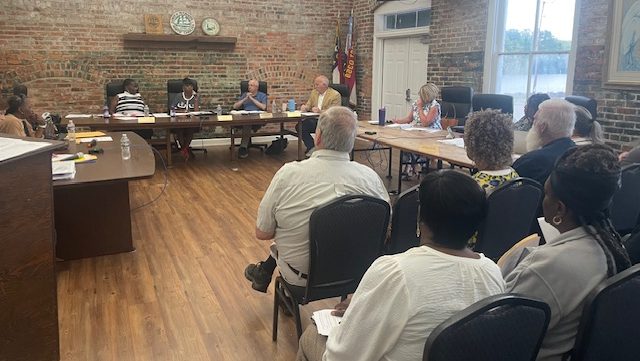
PLYMOUTH — A shouting match between two residents briefly threatened to derail public comment at Monday’s Plymouth Town Council meeting (April 13), but the outburst gave way to a sustained chorus of grievances over high water bills, public safety, and the direction of town leadership. A lot more council news will appear in this week’s Roanoke Beacon.
The confrontation erupted near the close of Cassandra Brown’s remarks, a North Broad Street resident who had come to the meeting to speak on behalf of a former police officer Brown alleged was treated unfairly after attempting to rescind her resignation.
Brown directed much of her criticism at Mayor Crystal Davis, accusing her of lacking independence.
“I feel like you are not running the show — somebody else is handling the show, and you are doing what someone else has told you to do,” Brown said. She also criticized Davis for eliminating the town’s food pantry and for what she characterized as hostility toward the Black Bear Festival. “When we have the Black Bear Festival, many people do benefit: those people who have restaurants, those people who have motels and hotels, the gas stations. Everybody does benefit.”
As Brown concluded, Terri Pitt, another resident seated in the audience, interjected.
Mayor Davis attempted to restore order — “Ladies, ladies, ladies, hey, hey” — but the exchange sharpened quickly. Pitt, addressing Brown directly, was unapologetic: “You better walk out — you better not never tell me to shut up.” When others in the chamber tried to intervene, Pitt pushed back. “You got me messed up for real,” she said.
Davis banged the gavel — “Let’s get some order.”
Order was eventually restored.
Among those who followed at the microphone was Judy Wobbleton, wife of former town councilman Danny Wobbleton, who died recently. She began by thanking the community for its support during her family’s bereavement.
“Thank you everybody for their prayers during our time of grief,” Wobbleton said. “Danny was a good man. He would be here tonight — bless y’all — because he would not like a thing that’s going on. He loved this town.”
Wobbleton said the last several years had taken a toll on a place that still holds great promise. “Up until about the last six or seven years it’s been rough. This could be a beautiful town if you didn’t stop everything.”
She grew pointed when addressing the council directly, saying self-interest had no place in public service. “What you want and what you want is not right. Please work together for the town, for the taxpayers. They’re the ones that keep this town going. You don’t pay any taxes, you don’t need to be ahead of the town.”
Nodding toward the earlier confrontation, Wobbleton made clear it had no place in a meeting called to serve the public. “Just like tonight — that’s uncalled for. That’s uncalled for.”
Water bills emerged as a dominant theme throughout the evening, with multiple speakers describing dramatic increases they said had no apparent explanation.
Tristan Spencer told the council his bill had jumped from roughly $100 to $150 per month to as much as $250 to $300 — a rise he found inexplicable given that he and his wife are truck drivers who spend little time at home.
“My bill should not be two-fifty,” Spencer said. “But when I come to y’all to get an explanation, there’s not one.”
He said a town employee had done her best to assist him but had ultimately referred him to other staff. He called on residents to organize collectively.
“We need to come together — we need to pull our resources together and hold them accountable so they have no choice but to get it right. Our money is hard earned. I can’t go from paying 130-something to 250 or 300 for them to tell me my water came through the pipes.”
Spencer closed with a direct appeal: “I need my water bill lowered now. I’m not paying what I’ve been paying for the last seven years.”
Pitt, who had earlier been at the center of the confrontation with Brown, returned to the microphone after apologizing for her earlier outburst — “Forgive me for the way I acted” — and echoed Spencer’s concerns with equal intensity.
“I come to talk about everybody’s water bill,” she said. “It ain’t but two people in my house and my water bill is sky high. I don’t have no leaks and I’m not hardly home because my husband’s in treatment. I wash once a week.”
Pitt called on residents to look past racial and personal divisions. “This is a poor community. The only way things are going to change is if all of y’all pull together — not by color, but by what is right and what is supposed to be for this town.” She also urged the council to address gun violence more aggressively. “Get a handle on these people around here shooting. If they can’t behave themselves, put a curfew on.”
Wanda Pettiford came to Monday’s meeting still waiting for an apology.
Pettiford, who identified herself as the aunt of Quadre Khalil Pettiford, a young man she said was killed before his time, told the council she had appeared before them the previous month to ask The Roanoke Beacon for a public apology over a headline about her nephew.
Wayne Pittman closed out the public comment period with a measured but pointed assessment of public safety in Plymouth, telling the council that the town’s violent crime problem demands proactive engagement between law enforcement and the community.
“Every time they pick up the paper, every time they look at Facebook, somebody’s getting shot,” Pittman said. “It needs to be proactive instead of reactive.”
He said residents — including business owners of both races — often have no idea who their police chief is. “If the chief walks right up in their face, they wouldn’t know who he was.”

For more about Chief Banks’s speech, see the Roanoke Beacon.
Random thought, so as to be better recognized, I’m not sure Chief Banks should upgrade his fashion sense with a black cowboy hat like Bertie County Sheriff Tyrone Ruffin. As many hours and as hard as this lawman works, I’m sure Banks is pretty recognizable to many folks across Plymouth, though probably not as recognizable as Pittman, who has a white beard and has been speaking his mind at council meetings for many moons.
Pittman called for community meet-and-greet events and said many officers’ habit of working in plainclothes makes it harder to build trust.
He connected the violence to deeper structural issues — a lack of jobs, inadequate school programs, and the despair of grandparents watching grandchildren die. “I know a room full of these people that have had some of their family members killed. I know these gray-haired grandmas and grandpas tired of their family members getting killed.”
Pittman said those in leadership positions who cannot address the problem should step aside. “Some people might not like my way of seeing things, but that’s the way it is. I own it. And I won’t back up from it.“
Make a one-time donation
Make a monthly donation
Make a yearly donation
Choose an amount
Or enter a custom amount
Your contribution is appreciated.
Your contribution is appreciated.
Your contribution is appreciated.
2 responses to “‘You better walk out — you better not never tell me to shut up’ — Water Bills, Grief and Discord Fill Public Comment at Plymouth Council Meeting”
Mr. Layton,
Your opening comment regarding a focus on Public Comments is spot on. I typically watch agendas for Greenville and Pitt County to see if anything of interest is queued up. It is difficult however when some agenda items are vague or hidden by obscure titles. I don’t know if such items are intentionally ‘masked’ or not, but it doesn’t inspire confidence in the citizenry.
To your point, Public Comments are often eye opening and can point out issues that need serious, forthright discussion. In Greenville and Pitt County, residents are limited to 3 minutes per person. Considering how much time council members and county commissioners are allowed to discuss issues, this hardly seems fair. However, I know comments cannot go on aimlessly. But on the other side (example), we have one particular county commissioner who seems quite pleased to go on and on and on. (needlessly) I think he just admires the sound of his own voice. 🙂
I would offer this personal advice for folks wishing to address a local governmental body at a public meeting. Target your comments. Write them down or type them. Run through your comments to reduce them to the prescribed allotted time. (actually time yourself) This strategy will allow you to meet the allotted time and focus on only your key points. (what’s really important) This is the strategy I employ every time I speak to a local governmental body and I find it works well.
Thank You for all you do to accurately report news from your area.
Jerry McRoy
Pitt County
Jerry,
Your comment — see above — is EXCELLENT advice!
And you’re absolutely right — 95 percent of the time, comment is limited to 3 minutes, give or take, so folks should come prepared. Research your topic. If you have written remarks, have enough copies to distribute to council members/mayor and the media. Keep on topic. DO NOT DIGRESS into theatrics or silly side issues — Edenton can not declare war on Gatesville. If lots of people are going to speak, maybe virtue signal, to say the same things about the same topic, maybe just a pick a spokesperson because, sometimes, if speakers become too repetitive, they can be shut down by the person wielding the gavel.
Thx for reading!
— Miles