By Miles Layton
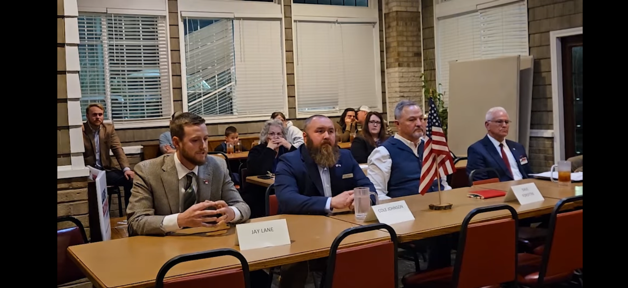
ELIZABETH CITY — Republican candidates seeking the North Carolina Senate District 1 seat laid out sharply different backgrounds and priorities Tuesday night during a forum hosted by the Pasquotank County Republican Party, touching on agriculture, development, abortion, gun rights, taxes, zoning, environmental regulation and the proper role of state government.
Held at Big Daddy’s Pizza, the forum featured candidates Jay Lane, Cole Johnson, Dave Forsythe, and Jerry Tillett, each seeking the GOP nomination to succeed Sen. Bobby Hanning after he announced his candidacy for Congress.
The candidates answered a series of timed questions and addressed a crowd that included local party leaders, activists and voters from across northeastern North Carolina.
Primary election is on March 3.
Subscribe — it’s free!
Lane: farming roots, conservative vision
Lane introduced himself as a farmer based in Pasquotank County.
“My wife and I farm just across town, here in Elizabeth City. We tend about 3,300 acres of corn, soybeans, and cattle,” he said.
Lane said his involvement in farm policy sparked his interest in politics.
“Farm policy got my foot in the door at the legislature,” he said, describing himself as “a then 24-year-old farm boy unqualified to do anything,” who nonetheless found lawmakers willing to listen. “It was very encouraging and really got me fired up about politics.”
Lane said Hanning’s decision to pursue Congress created an opening.
“I want to be influential at the state level,” Lane said. “I think I can.”
He said his long-term goal is to use his relationships in Raleigh to advance conservative policies.
“This part of the world, Northeast North Carolina needs a strong, serious, young conservative to kind of spearhead this movement and hopefully take this state and make it more conservative than even Florida,” Lane said.
Lane also criticized Democrats for cultivating political talent.
“They’ve done it with Roy Cooper, Josh Stein and hopefully not, but maybe Jeff Jackson,” he said. “So I want to be in opposition to that.”
Johnson: Marine veteran, constitutional conservative
Cole Johnson, introduced later in the program, emphasized his military service and conservative values.
“I’m a Marine Corps veteran, first-generation farmer, business owner. I’m a lifetime member of the NRA. I’m a constitutional conservative,” he said.
Johnson said his guiding principles include “food freedom, medical freedom, parental choice, parental rights.”
“God gave us the right and the responsibility to care for and to protect our children,” he said.
He described himself as strongly anti-abortion.
“I believe in the right to life, because Americans don’t deserve to be violently killed on the streets or in the womb,” Johnson said.
Johnson also emphasized fiscal restraint.
“If elected, I’ll work towards decreasing government spending, wasteful government spending,” he said, while eliminating regulations that “harm and hinder small businesses.”
Johnson said he lives in Camden County and was drawn to politics through farming.
“Farming is what brought me into this, but there’s so much more that’s worth fighting for,” he said. “And I’m ready to do it.”
Forsythe: engineer, commissioner, opponent of Raleigh “shenanigans”
Dave Forsythe, speaking from a seated position due to recent knee surgery, detailed a long career in engineering and government service.
“I retired after 31 years of working for the Department of Defense as a federal employee,” said Forsythe, a Gates County Commissioner.
Forsythe said he holds degrees in civil and environmental engineering and currently serves as utilities director “for a 50-plus thousand person county.”
“So I’m very familiar with local government, local operations,” he said.
Forsythe said his decision to run was driven by actions in Raleigh.
“Part of the reason I’m running is because last summer, the shenanigans that came out of Raleigh,” he said, pointing to proposed fishing and seafood bans and legislation related to farm chemical liability.
“When I heard that Senator Hanning was not going to run, I said, ‘We need to have somebody else in there that’s going to stand up to those guys, the good old boys in Raleigh and say, ‘Nope, not going to do it,’” Forsythe said.
He emphasized his family ties to education and local life.
“My wife sitting here is a first grade teacher at Gates County Schools,” he said. “I have two children that are high school students, I have a college student at UNC Charlotte.”
Tillett: longtime judge, local focus
Jerry Tillett emphasized deep family roots and decades of public service.
“I’m Jerry Tillett, I’m seeking your support to be your voice in North Carolina Senate,” said Tillett, who retired last year after more than 30 years serving as a Superior Court Judge.
Tillett said he and his wife live in Dare County and traced family connections across Currituck, Gates and Pasquotank counties.
“We’re lifetime residents of this district,” he said.
Tillett highlighted a career in law, business and public service, including “serving as your superior court judge for 32 years.”
“I am not running for any specific profession,” Tillett said. “I want to be the voice of your issues.”
He said he has deliberately avoided seeking outside endorsements.
“I’ve also not sought endorsement from people outside of this district or Raleigh,” Tillett said. “I don’t wanna reflect Raleigh values.”
“The only voices I want to listen to and be obligated to are your voices,” he said, adding that his guiding principles are “the Constitution, both of them, and Biblical law.”
Development and farmland
One of the forum’s first policy questions addressed large-scale development on agricultural and rural land.
Johnson said he supports balancing growth with preservation.
“I also see that we need to preserve our rural communities,” Johnson said. “That’s the reason what makes this place so great is because we are rooted in farming and agriculture.”
Forsythe stressed local control.
“The local government needs to be able to determine its own destiny,” he said. “I don’t wanna see a point where we have the state determine that you no longer can regulate your own planning and zoning.”
Tillett said development should be “compatible” and “timed.”
“I think it should be compatible with the surrounding area, with the heritage, and also timed and compatible with what’s available in terms of infrastructure,” he said.
Lane framed the issue in terms of housing affordability.
“Folks my age can’t afford to buy homes right now on average,” he said, arguing that development can help reduce costs. At the same time, he said, “as a farmer myself, I’m against obviously turning farmland into any type of housing.”
Zoning and impact fees
Asked whether they support stricter rezoning rules or higher impact fees, Forsythe again emphasized county authority.
“The development has to be controlled,” he said. “There have to be standards in place. It’s up to the counties to be able to set that.”
He criticized low-quality construction.
“Some of these guys build some pretty crappy houses if I can be honest,” Forsythe said.
Tillett said zoning has both local and state components.
“There is a state component to all of these issues, just like there is in development,” he said, while agreeing that “individualized zoning areas should be subject to local control.”
Lane said he opposes state-level oversight.
“I am against state level oversight when it comes to zoning,” he said. “I think it’s up to the municipalities at the local level 100%.”
Legislative priorities
When asked about their top legislative priorities, Tillett emphasized coalition-building.
“The first priority is to attempt to build some coalitions that can stand strong and fight,” he said, citing past controversies like “Shrimpgate” and the lack of a state budget.
Lane said his first step would be understanding how state agencies affect the district.
“My first priority would be to gain oversight, request briefings from the DOT or DEQ,” he said.
Johnson focused on affordability and abortion.
“I would love to abolish abortion in the State of North Carolina,” Johnson said. “We don’t need that kind of evil in this state.”
He added, “North Carolina is a destination location to receive an abortion. The Democrats aren’t gonna stand up for the unborn. That responsibility falls on us.”
Forsythe focused on tax policy, including relief for veterans and homeowners.
“Why are they still paying property taxes?” he asked of retirees. “It’s crazy.”
Conservative values and budgets
Asked how conservative values guide their decisions, Lane said major issues belong at the state level, but local matters should stay local.
“Home is more important than Raleigh is to me,” he said.
Johnson criticized the lack of a state budget.
“We have police officers, teachers and state employees that aren’t getting pay raises that they were promised,” he said.
Forsythe cited his experience pushing back against spending.
“Just because you can put a tax in place, doesn’t mean you should,” he said.
Tillett said, “The best government is the least government,” and emphasized the constitutional requirement for a balanced budget.
Agriculture and the environment
Agriculture dominated one of the longest exchanges of the night.
Forsythe described his environmental engineering background and opposition to shielding chemical companies from liability.
“I would endeavor to try and make sure we hold chemical companies responsible,” he said.
Tillett said farming, logging and fishing have a “symbiotic relationship.”
Lane argued farmers are already strong environmental stewards.
“In this northeastern part of the state, it’s all about the three Fs, farmers, fishermen, and forestry,” he said.
Johnson recounted his experience producing raw milk.
“We were almost regulated out of our farm,” he said, criticizing proposed restrictions he called “false information and fear-mongering.”
Lane later clarified his position.
“I want to make my position clear on raw milk,” he said. “I’m with the raw milkers. I think it’s great.”
Experience and time commitment
Asked what experience they would bring, Tillett cited decades as a judge and legislative work.
Lane emphasized building a farm and raising a young family.
Johnson said his strength is being “not a politician.”
“I know what it feels like to be attacked by the government,” he said, recounting a legislative fight he said nearly destroyed his business.
Forsythe highlighted international negotiation experience with foreign governments and agencies.
“My job, my life has been about going in and working hard topics with diverse groups of people and coming to common consensus,” he said.
In closing, candidates were asked how much time they could devote to the job.
“365 days a year, I can commit to you,” Johnson said.
Forsythe said he is “prepared to do what’s necessary.”
Tillett said retirement gives him flexibility.
Lane said he has structured his farm operation so he can be “in Raleigh full time.”
One response to “NC Senate District 1 candidates clash over development, farming, taxes and government role at Pasquotank GOP forum”
[…] Here’s our story from the Republican political forum featuring NC Senate candidates for District 1. […]