BY MILES LAYTON
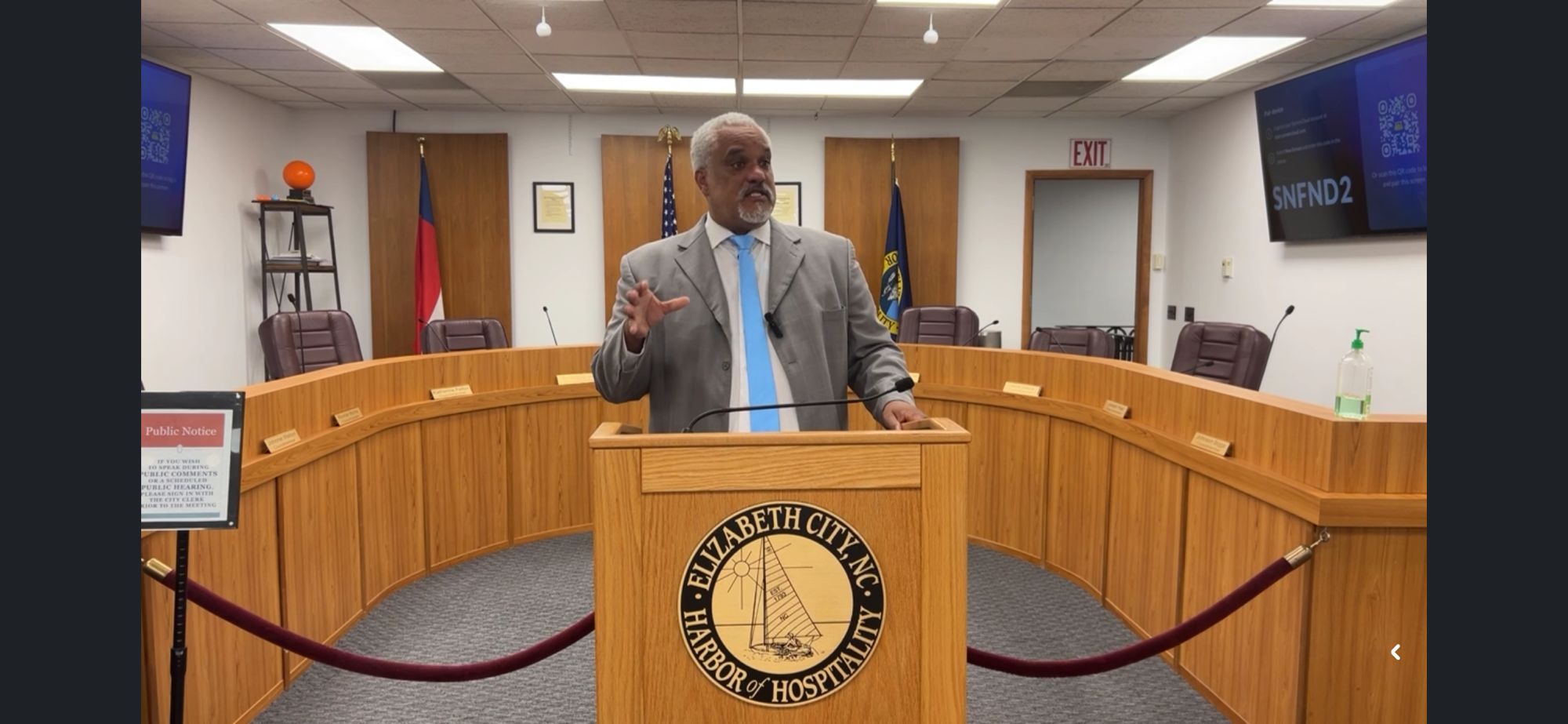
ELIZABETH CITY — Elizabeth City Mayor Kirk Rivers on Thursday addressed the findings of a state audit that uncovered widespread misuse of city procurement cards and lapses in financial controls under former city management, pledging transparency and tighter oversight moving forward.
Speaking during a press conference at City Hall, Rivers acknowledged the seriousness of the audit by the North Carolina Office of the State Auditor (OSA), which detailed years of questionable spending and policy violations involving city-issued purchase cards, or P-cards. The mayor opened his remarks by expressing gratitude to the state for its work and to city staff for cooperating fully.
“We thank the Office of the State Auditor for coming in to making sure that taxpayers’ dollars are being used to make sure that we have an entity that protects our citizens,” he said. “The City Council wants to take this time to say thank you to our North Carolina auditor, the team that was here to make sure and to go through all records to make sure that we are being good keepers of the taxpayers’ dollars.”
Background on the Audit
Flashback — The state’s investigation began after the auditor’s office received a tip about misuse of city funds through the P-card program by a former city manager. The report, released November 3, 2025, described “a major reckoning” for Elizabeth City’s financial management, highlighting $14,640 in purchases by the former city manager between November 2022 and October 2024, including nearly $6,000 in food expenses.
The Office of the State Auditor also examined broader city spending, identifying 591 additional P-card purchases by employees totaling $79,166 between January and October 2024, including what auditors called “excessive or inappropriate” food expenses and missing receipts.
Rivers said the city received the full report this week and would make it available to residents. “We want to make this report available to all citizens,” he said.
Folks can request the audit aonly@elizabethcitync.gov.
OR — citizens can download the audit at the end of this story.
Council’s Earlier Actions
During the press conference, Rivers emphasized that the City Council had already begun addressing concerns with purchasing cards months before the state audit was released.
“We want to make sure that we let all of our citizens know that on May 28, 2024, the council added a discussion to purchasing cards and gas cards to our agenda,” he said. “Councilors began their own review of all past P-card usage and requested copies of the current policy.”
According to Rivers, after that initial review, the city learned the state auditor would be conducting a deeper investigation. “From that, then we received word that the Office of the State Auditor was coming in, and they continued and picked up and finished the investigation,” he said.
Rivers said the city council took action to strengthen rules months before the audit was finalized. “This investigation, before they released this report, City Council had already taken up and on the September 8th, 2025, City Council received and made sure that they put stricter policy for City Council for our city employees, which was adopted,” he said.
He added that council members decided to suspend P-card spending altogether until new controls could be implemented. “Also, during that time, the city council asked for all P cards — once it was made aware that we did not have restrictions or rules in place — they asked for all P cards to be ceased until further time,” Rivers said. “So within that right there, your City Council had been working.”
Rivers also emphasized the council’s commitment to tighter oversight. “The council had been working. This report that we received will also be used to make sure that we tighten up our rules and strict restrictions and the usage of P-cards,” he said.
Audit Findings and City Response
The state audit described multiple instances where the former city manager and other employees failed to comply with city purchasing policies. The former manager exceeded transaction limits, lacked receipts for 14 purchases, and charged meals that overlapped with travel per diems.
Auditors cited examples including $705 spent at Sugarcane Grill and Lounge for brunch, $505 at Waterman’s Grill for a team dinner, and $318 at Sagos on the River for a finance team lunch. The report said these expenditures contributed to a “tone at the top” that discouraged adherence to the city’s purchasing manual.
In his remarks, Rivers acknowledged the issues raised in the report but also emphasized that most funds had been accounted for. “We have noticed and one thing that we will say that on the spending, which I read and the report said that it was $22 that was not, that should not have been used,” Rivers said. “But with that said, everything else has been accounted for.”
He also addressed excessive spending by outside contractors, noting the city’s efforts to internalize financial work. “Since November of last year, our city staff — and I want to say we are excited to announce this — our city staff was able to perform all the audits and complete all of our monthly reconciliations,” he said. “We are no longer using one of the companies that has been listed in this report.”
He credited the finance department for “doing an outstanding job” and said bringing the work in-house “has caused a significant decrease in the line item because now our city staff is doing an outstanding job with our monthly bank reconciliations.”
Clarifying the Timeline
During a question-and-answer session with reporters, Rivers was asked when the council became aware of the state’s investigation.
“The council was made aware on May 28, 2024,” he said. “The first time that the Office of State Auditor team arrived was in February, but we were made aware of it in December and we welcomed it.”
Rivers said he notified then-Interim City Manager Reginald Goodson as soon as the state contacted him. “I received the call and at that time passed it on to the interim city manager at that time, Goodson, and then we received the audit team and we were excited to have them,” he said.
Asked whether the council knew about specific charges before deciding not to renew the former city manager’s contract, Rivers said, “We just opened it up in May 28that we were looking at P-card logs, and that’s when we realized that our P-card policies were not where council wanted them to be. But there was no policy in place at that time.”
P-Card Limits and Distribution
The mayor also confirmed that council has since reduced the number of city-issued cards and set clear spending limits. “When we first addressed this issue before the Office of State Auditor ever came into play, our council found out that it was maybe 60-plus P-cards out there,” Rivers said. “And that’s when it all started — we realized that we did not need that many P-cards.”
He said new policies now restrict cards primarily to department heads and essential personnel. “Council authorized that the department heads would have one, and then what we call essential personnel who make purchases quite often,” he said. “Department heads have access to a P-card, city manager has access, but then those who are deemed essential.”
Rivers said the changes would prevent future misuse while allowing flexibility in emergencies. “Yes, ma’am,” he said when asked if the restrictions would prevent future incidents. “That’s one of the reasons why council wanted to do this. It just makes sure that everything is thought about because as a city of our size, we always need something.”
He added that employees such as firefighters and public works crews may need to use P-cards for urgent materials or safety needs. “When they get on a job, we don’t have a truck that keeps all of our materials,” Rivers explained. “The P-card allows them to go to Lowe’s, go to Walmart, whatever it may be because of emergencies.”
Addressing Specific Charges
When asked about one of the more controversial purchases listed in the audit — a $318 charge at Sagos on the River for a finance team lunch — Rivers said that expenditure was consistent with policy at the time. “That was one of the ones that we looked into,” he said. “So yes, that was once again policy. That’s the city manager’s choice and whether it be for morale or whatever they worked on, he has that right based off of the policy that was at that time.”
Pressed on whether all attendees at the lunch were finance employees, Rivers said, “I would leave that up and I would venture out to say that would have been a question for the city manager.” But he defended the intent of the purchase, noting the finance staff’s heavy workload.
“I will say without a shadow of a doubt that our finance team worked their butts off,” he said. “They did a great job. A lot of times I would come in at 9 and 10 o’clock here at night — they were here doing work, making sure they could get this information to the auditors.”
“If the city manager chose at that time to take them out to complete the audit based off of the way they were working and doing that work, I would venture out to say I would have probably did the same thing,” he added. “Because they were working.”
Rivers stressed that, at the time, “there was no policy to say you could not do it. It’s a judgment call. And that’s the one thing — looking back over something now, hindsight might say yes, only take 14, but that’s once again hindsight.”
He said the audit would help the city identify and close such “gray areas.” “That’s what this report is helping council and the city manager — so that way we can look back to see if there’s some gray area,” he said. “Do we need to tighten the rules up so that city managers will not have to worry about if this is correct or wrong?”
Commitment to Reform and Transparency
Rivers said both he and the council view the audit as an opportunity to improve governance rather than a setback. “Every council person has received the report,” he said. “Every council is looking at it to make sure that what can we do to make sure that we have rules in place so that if they don’t want this to happen again, there are rules being placed.”
He added, “There was nothing — so with that being said, there were no rules that did not allow for it to take place.”
Rivers closed the press conference by emphasizing transparency and a renewed focus on fiscal responsibility. “Once again, to our citizens, we thank you for taking time knowing that your city council is continuing to make sure that we are transparent,” he said. “We want to thank the Office of the State Auditor. We want to thank the city staff who is making sure that all documents were given and that we are excited to receive this report so we can make necessary improvements to our city so we can continue to be the greatest city.”
Next Steps
City officials are expected to review the audit’s 11 recommendations in detail — among those recommendations are calls to strengthen purchasing policies, review all transactions for personal use, and hire a permanent finance director — a position currently held on an interim basis by Brian Lewis.
“The end goal,” City Manager Reginald Goodson wrote in the city’s official response to the audit, “is for the City to be self-reliant on internal staff and the in-house staff having the knowledge, skills and expertise to perform all financial tasks both during the audit year as well as during the audit. That is what we are working toward and where we expect to see ourselves in the near future.”