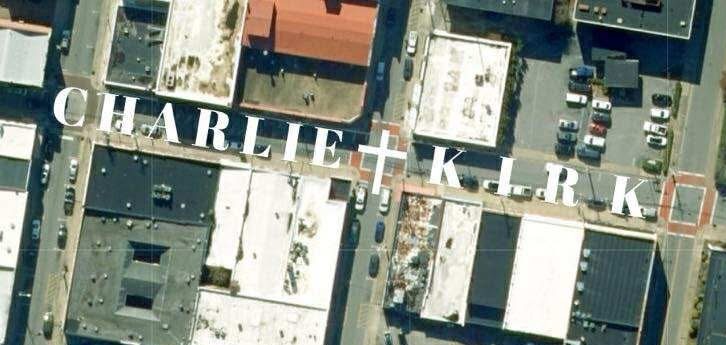
ELIZABETH CITY — A proposed street mural to honor the late conservative activist Charlie Kirk sparked a passionate and overwhelmingly critical public comment session during Monday’s Elizabeth City Council meeting, with dozens of residents and concerned citizens speaking both for and against the controversial tribute.
The proposal, coming just weeks after Kirk’s assassination on September 10, 2025, sought to place a mural on East Colonial Avenue, near an existing Black Lives Matter mural.
The matter has been tabled until the next council meeting Nov. 10.
Two petitions—one supporting and one opposing a proposed downtown street mural honoring Kirk— were circulating ahead of the council meeting.
Petition links and and such from a previous story can be found by clinking this link.
Proponents Cite Free Speech and Faith
Leading the charge for the mural was Steven Young, an Elizabeth City native, retired Army veteran, small business owner, and podcaster, who appeared on his own behalf, presenting the council with a copy of over 1,500 signatures supporting the proposal.
Young framed the mural as an honor for a man “recently martyred on September 10th, 1925 at age 31 for his bold advocacy of free speech, conservative values, and Biblical truth.” He highlighted Kirk’s influence as the founder of Turning Point USA, noting that he “inspired millions, including hundreds here at a September 12th candlelight vigil that was held at the Waterfront Park.” Young also pointed out that Kirk was the “youngest recipient of the Presidential Medal of Freedom with a one-of-a-kind Christian cross engraved on it” above his name.
Young suggested East Colonial Avenue was the ideal location, citing its high traffic and the name’s reflection of “the colonial fight for freedom, echoing Charlie’s mission.” He also drew a direct parallel to the city’s 2021 decision, stating the council “approved the BLM mural here on East William Avenue with a vote of 5-1 setting a precedence that has inspired the very idea and location of this mural.”
Importantly, Young stressed that the estimated “$5,000-$15,000 mural will be funded by grassroots donations and the TPUSA Mural Fund. We are not asking for taxpayers to burden this cost.” However, he did request the mural receive the same protections as the existing one, including “surveillance cameras and security lights and vandalism enforcement,” arguing “In fairness, we request the same protections as the other murals.”
Young closed by comparing the current effort to a previous council discussion on the BLM mural, where it was argued that while “all lives matter,” there was a focus needed on the immediate issue.
“Right now, that house is on fire are Christians and Christian voices,” Young asserted, claiming, “Right now, Christians are being martyred at a rate of 12 per day. That is one every two hours.”
Opponents Detail Divisive Rhetoric and Public Funds
The majority of speakers expressed strong opposition, primarily focusing on Kirk’s divisive rhetoric and the inappropriate use of public property to honor a non-local figure.
Frank Atkinson, Chairman of the Pasquotank Democratic Party, speaking only as a private citizen, voiced his opinion against the mural.
“I object to the idea of spending any kind of public money honoring someone that has not I saw the city,” he stated, adding that he did not “believe in particularly honoring someone who, when I read through some of his comments… are very divisive as far as our community is concerned.”
Resident Jessica Kelly delivered a powerful critique, reciting several of Kirk’s widely reported controversial statements. She quoted Kirk as saying, “We made huge mistakes when we passed the Civil Rights Act in 1964.” Kelly also cited his comments about a “qualified, educated black woman” lacking “the brain processing power to be taken seriously,” his views on the LGBTQIA community, and his complaint about sign language interpreters during California wildfires.
Kelly turned the focus back to Elizabeth City’s demographics, noting, “Elizabeth City is 50% women, over 50% non-white, and 53% non-religious. That makes at least 50% of the city targets for Charlie Kirk’s harmful rhetoric no matter how you slice it.” She concluded, “We cannot afford socially or economically to alienate people from our city,” urging the council to “Reject the mural” and avoid becoming known as the “Harbor of Hostility.”
Heidi French, a non-resident with students at local colleges, said she was there to oppose the mural because placing it on city property “says the city endorses what Charlie Kirk believes.” She cited his denial of empathy—preferring “pity over relating with people”—and a quote about a Black pilot: “when I have a Black pilot, boy, I hope he’s qualified.” French argued that endorsing such a figure would send a negative message to the Coast Guard families and diverse students in the area: “Elizabeth City doesn’t welcome you.”
Dan Johnson, a resident of West Church Street, commended the other speakers who “eloquently have spoken out against this very divisive character.” He described Kirk’s speech as evolving from “racist ways with a wink and a nod and a dog whistle” to being “more openly and overtly racist.” Johnson then read an excerpt from an article detailing Kirk’s rhetoric, including defining the “American way of life” as “marriage, home ownership and childbearing free of, quote, the lesbian, gay, transgender garbage in their school,” and describing Islam as “the sword the left is using to slit the throat of America.”
His wife, Sarah Johnson, a public school art teacher, emphasized the impact of public art on young people. She acknowledged the comparison to the Black Lives Matter mural, but differentiated the intent, saying the BLM art “affirmed an entire community… and called for unity and accountability,” while a Kirk mural “would send a different message.” She stated, “He’s a national figure known for rhetoric that divides and targets marginalized people, honoring him publicly would not reflect the compassion or fairness and faith that would make… our city great.”
Business owner Charlene Wade also spoke against the proposal, noting the city’s diverse makeup of “Caucasians, blacks, Hispanics, Native Americans, Asians, everyone. And we all work together and support each other.” She researched Kirk and found his rhetoric described as “divisive, racist, xenophobic, and extreme by groups that study hate speech.” She also provided an updated tally on the opposing petition: the petition for the mural had 1,545 signatures, while the counter-petition now had 2,549, showing that “clearly the citizens of a city have spoken.”
Pearl Fontana Polatano, who organized the counter-petition, confirmed its reach: over 2,500 people signed in about a week, representing a diverse group of “young, old, white, people of color, people from the LGBT+ community, Christians, veterans, non-Christians, and so much more.” The petition stated that a Kirk mural “would only be seen as a revisionism” of the Black Lives Matter display. Polatano detailed more of Kirk’s controversial views, including his push for “the militarization of our cities as a means of control, stating that it would end black on black crime.”
Karen Cuba and Irina Simmons both echoed the sentiment that Kirk had no local ties, with Simmons suggesting, “If you are going to honor people, please honor people that are indigenous to North Carolina that made North Carolina a great state.”
Megan Hiner called the proposal “wildly inappropriate” and “incredibly disrespectful” due to its proximity to the Black Lives Matter mural, especially since Kirk “spread information and misinformation and called the Black Lives Matters Movement anti-American and anti-Christian.”
Benjamin Stokely urged the council to recognize that “Elizabeth City has spoken pretty much almost unanimously that this mural is unwelcome here and all of the views divide and hurt the city.”
2 responses to “Elizabeth City residents clash over proposed Charlie Kirk street mural”
I support the mural. He was a Christian man with amazing values, someone young people can look up to.
I read this article in its entirety. The comment that struck me the most was: [Kelly turned the focus back to Elizabeth City’s demographics, noting, “Elizabeth City is . . . and 53% non-religious.”] I don’t know where these numbers came from but if the 53% is accurate, I see from where the opposition originates. Sad.
J. McRoy
Pitt County