BY MILES LAYTON
ROCKY HOCK — Since Rocky Hock Baptist Church will be celebrating its 190th birthday on Sunday, October 12, I thought I would write a story about the church’s “living history” by interviewing Lois Ashley, a faithful member of the congregation for many decades.
REMINDER — the Homecoming celebration begins at 10:30 a.m. with a covered-dish lunch after the Sunday service. Guest speaker will be Reverend Ron Cava.
Pictures and an abridged history of the church appear at the end of this story.
Back to Lois – it was the end of a long day of teaching, so God sent me to her house to restore my soul as she talked about the Rocky Hock community, old times, and life in the church. I grew up in a similar church where the community gathered annually to celebrate homecoming and ice cream socials in July, pastors gave powerful sermons, people attended baptisms, weddings and funerals.
Hearing Lois talk about Rocky Hock’s close-knit past as it leads to the present reminded me of how special worship and fellowship of a country church can be.
Located at 113 Rocky Hock Church Road in the heart of God’s country, from time to time I’ve attended this church – great choir and Sunday sermons – so I highly recommend finding a pew to embrace your faith and Christ’s love.
At ninety years old, Lois can still remember every corner of Rocky Hock Baptist Church—the white clapboard walls before the brick, the pump in the yard where the congregation shared a single glass, and the pine-straw path leading to the old outhouse in the woods. Her voice softens when she talks about it, but the memories come easily. “I was born in 1934,” she says with a smile. “And if I live to see the last day of October, I’ll be 91. The good Lord has blessed me, and I thank Him every day.”
Lois’s story is woven tightly into the fabric of Rocky Hock Baptist Church, a rural congregation that began nearly two centuries ago and has grown into one of Chowan County’s most vibrant houses of worship. Born across the field from the church and raised nearby in the Copper Neck community, Lois grew up surrounded by family—and by faith. Her father, Gilbert Harrell, was part of the Webster Harrell family, one of Rocky Hock’s longtime fixtures.
“Daddy was one of six boys,” she recalls, “and Mama was one of twelve—six boys and six girls. You can imagine how many cousins I had.”
Despite family ties to other congregations in the area, including Macedonia Church, Lois’s parents remained loyal to Rocky Hock. “They never moved their membership,” she says. “They always attended and took part in everything that went on.”
The Early Years: Hand Pumps and Outhouses
Lois’s earliest memories of church life predate electricity and plumbing.
“The church didn’t have plumbing,” she remembers. “They had a hand pump in the yard, and everybody drank out of the same glass that sat on a little wooden platform around the pump.”
During the summers, the Chowan County Health Department would set up a clinic outside the church to administer typhoid shots to local families. “That was the bad part,” Lois laughs. “We all dreaded it.”
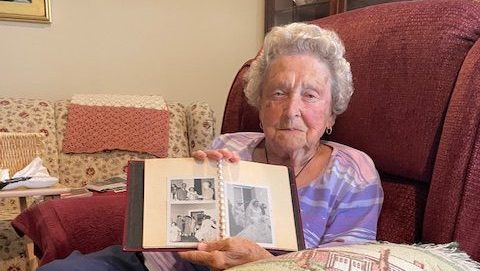
Inside, the church was a simple wooden structure—white on the outside, uninsulated, and far smaller than the brick building that stands there today. “It doesn’t look anything like it does now,” Lois says, pointing to a black-and-white photo from her 1954 wedding. “You can see it was all wood. No brick. Just a country church.”
There was no air conditioning, no screens on the windows, and no indoor restrooms.
“We had a path that led into the woods,” she says. “That’s where the outhouse was. Even in the winter, that’s where we went.” Despite the discomforts, those years shine warmly in her memory. “It was a smaller church, but it was full of love.”
Revival Days and Ice Cream Socials
Every season brought its own traditions. In the 1940s and 50s, Rocky Hock Baptist Church held revival meetings twice a year—one in the spring, one in the fall.
“Hot weather, no air conditioning,” Lois recalls. “We had those funeral home fans with the little wooden handles. We’d wave them during the service.” Revivals were held twice a day, with services in both the afternoon and the evening. “People would come from all around. It was the biggest event of the year.”
Another highlight was the homemade ice cream socials.
“The young folks today don’t know what it’s like to crank ice cream by hand,” she chuckles. “We’d sit outside and take turns turning that handle. The electric ones never froze it hard enough.” Lois still has two hand-crank freezers in her garage, and when her family gathers, they insist she be the one to make the ice cream. “Ours always comes out the best,” she says proudly.
Before the church built its baptistry, baptisms were held at Bass’s Landing on the Chowan River.
“That’s where I was baptized—probably ten or eleven years old,” Lois says. “They didn’t have dressing rooms, so we used the fishermen’s warehouse at the landing. They kept their nets and supplies there, and that’s where we’d change clothes.” she smiles softly. “I don’t remember if the water was cold or not, but it must have been—it was in the fall.”
Photos from Lois’ photo album


A Church That Grew
Over the decades, Rocky Hock Baptist transformed from a small wooden meetinghouse into one of the largest congregations in the county.
“Oh, it’s grown so much,” Lois says. “When I was young, it was mostly family. Now, I see people come through the door and I think, ‘I don’t even know who that is.’” She laughs, not with bitterness, but with a sense of wonder at how the little church she knew has flourished.
The changes came in stages—brick walls replacing wood, a balcony added after hurricane damage, a steeple rising over the sanctuary, and eventually, the addition of chimes that play hymns each afternoon.
“The bells are beautiful,” Lois says. “I’ll be outside, and they’ll start to ring. Yesterday it was 4:30, and I had no idea I’d been outside that long. I just love to hear them.”
Today, Rocky Hock Baptist boasts a thriving youth program led by Trey Rogers, whom Lois praises warmly. “He’s so good with the young people,” she says. “He goes to all their ball games. I don’t know how he keeps up with it all, but the youth love him. That’s what’s drawing people in now—the young families.”
Faith, Family, and Fellowship
For Lois, church was never optional.
“When I was growing up, you didn’t ask if you were going to church,” she says firmly. “You knew you were going.” Her parents set that example, and she followed it throughout her life.
She joined the church as a child, married her husband Thurman there in 1954, and raised her two daughters, Belva and Lisa, in the same pews. Both girls were baptized at Rocky Hock. Thurman farmed the land around their home until his death in 2000, and Lois has managed on her own since then. “It’s been 25 years now,” she says quietly. “But the Lord has seen me through.”
Though the years have taken many of her relatives and friends, Lois still finds deep comfort in the fellowship of her church family.
“It just makes you feel better to be there,” she says. “It’s not the same when you have to stay home and watch online. Being there in person—it lifts you up.”
A Lifetime of Service
Throughout her decades as a member, Lois filled many roles: Sunday school teacher, choir member, Girls in Action (GA) leader, and organizer of bereavement meals for grieving families.
“We’d prepare food for them to have at the church after the funeral,” she recalls. “It was just what you did for one another.” That sense of community, she believes, is what has kept the church strong. “We’ve got a lot of good workers,” she says. “People who are willing to give their time.”
Her daughter Belva, now married to Oscar White, continues the family’s legacy at Rocky Hock.
“Belva sings in the praise band,” Lois says proudly. “And Oscar’s a deacon.” Though Lois often sits alone now, she always takes the same seat—middle way, near the front. “When I come out of Sunday school, I go right to that spot,” she says. “Used to be our whole family sat there. Now it’s just me, but I’m still surrounded by folks who sit in the same place every week.”
Homecoming and Heritage
Every five to 10 years, Rocky Hock Baptist celebrates Homecoming—a beloved tradition that brings former pastors and members back together. This year, Lois is especially excited to see Pastor Ron Cava, who served during her husband’s final years. “He was here when Thurman died,” she says. “He even sang at his funeral. I’m looking forward to visiting with him again.”
Homecoming, she says, is all about gratitude and remembrance.
“It’s like a family reunion,” she says. “We’ll have home-cooked food—no catering—and plenty of fellowship.” Her eyes light up at the thought. “And we’ll feed you good,” she promises with a grin.
The Heart of a Church
For Lois Ashley, Rocky Hock Baptist Church is far more than a building. It’s where she was baptized, married, taught, sang, grieved, and rejoiced. It’s where she has watched generations come and go, each leaving their mark on the church’s history.
“What I like best,” she says, pausing thoughtfully, “is just being there with everyone. The fellowship, the singing, the worship—it all just fills your heart. It’s been my home for all these years.”
As the church bells ring across the fields of Chowan County, they echo the steadfast faith of members like Lois Ashley—faith that has carried Rocky Hock Baptist Church from its humble log beginnings to the thriving congregation it is today.


Church History
Nine miles north of Edenton, in the heart of the Rocky Hock community, stands a church with roots stretching back to the early 19th century. Known today as Rocky Hock Baptist Church, it began in 1835 as The Church of Christ at Rockahock. Since then, the congregation has grown through challenges, building projects, and revivals into one of Chowan County’s most influential churches.
Humble Beginnings
The church was formally organized in 1835 under the leadership of Elder John B. Webb, its first pastor, who received a salary of just $25 a year. The original “meeting house” was a simple log structure built on land given by Robert R. Felton. Members gathered on split-log benches in a building lit by candles, relying on hand-hewn lumber and local labor.
By 1858, a more permanent frame building rose on the present site, again on land donated by Felton. That building served the congregation for decades as the small rural church slowly expanded its ministries.
Growth and Revival
After Elder Webb, a succession of pastors led the flock, including Elders T. J. Knapp, West Leary, and Elect Trotman. In the latter half of the 19th century, Elder Benjamin Brown Williams and Elder W. P. Jordan pastored the church through years when offerings were collected in “mite boxes” and candles gave way to oil lamps.
A turning point came with Elder T. T. Speight (1896–1903). Under his leadership, the church voted to replace the aging frame house of worship. In 1903, a new sanctuary was erected at a cost of $2,312. Much of the labor and materials were provided by members themselves. Dedicated in May 1904, the sanctuary—with its stained-glass memorial windows and new pulpit furniture—still serves the congregation today.
Not long after, Elder James W. Rose (1904–1908) brought a season of revival. Following a 1904 protracted meeting, 70 new members were baptized. The church also expanded preaching services from once a month to twice monthly, raising Pastor Rose’s salary from $200 to $400. In 1906, Rocky Hock hosted the Chowan Baptist Association, where the Woman’s Missionary Union was formally organized—a legacy that continues today.
Building for the Future
Through the early 20th century, Rocky Hock experienced steady growth. Reverend William Franklin Cale, Sr. guided the church into a new era with the addition of twelve Sunday School rooms in 1925. His sudden death in 1933 marked a difficult moment, but his son, Rev. W. F. Cale, Jr., stepped in, beginning a ministry that would carry the church through the Depression years and into World War II.
Electric lights were installed in 1939, and offerings grew steadily through the 1940s. In 1949, Rocky Hock took a bold step forward by moving to full-time preaching. A new parsonage was constructed near the church, marking the congregation’s independence from neighboring fellowships.
Mid-Century Expansion
The 1950s and 1960s were years of remarkable growth. Under Rev. Bomar Raines, the church built a 19-room educational unit at a cost of $40,000. Sunday School attendance swelled, with nearly 500 present on opening day in 1955.
Later, Rev. Thurman Allred (1959–1966) led the church during its 125th anniversary celebration. The sanctuary was bricked, a lighted church sign installed, and membership surged with more than 180 baptisms during his tenure.
When Rev. Meredith Garrett took over in 1966, the church modernized further—air conditioning was installed, pews replaced opera chairs, and a new organ added to worship. Garrett also helped launch a Sunday School ministry at nearby Arrowhead Beach, which later grew into Bandon Chapel.
A multipurpose building with Sunday School rooms, a gym, a commercial kitchen, and a Special Functions Room was added in 2014.
A Changing Community
By the 1970s, Rocky Hock was one of Chowan County’s largest churches. Rev. Larry McClure led the church through the construction of a new parsonage and a $300,000 expansion of the sanctuary and educational space. Membership grew steadily, with offerings doubling in less than a decade.
His successor, Rev. Donald Wagner, shepherded the church for 15 years, during which Rocky Hock celebrated its 150th anniversary in 1985 with a drama depicting its history. The church also deepened its commitment to missions, co-sponsoring the Outer Banks Mission and sending members abroad.
Trials and Triumphs
The new millennium brought both challenges and renewal. In 2003, Hurricane Isabel devastated the Rocky Hock community, blowing out the sanctuary’s upper windows and damaging multiple buildings. Worship services were temporarily held in homes and at the community building while the church undertook a massive $847,000 renovation. By 2004, Rocky Hock reopened with an expanded sanctuary, new sound and visual systems, and modernized facilities.
The congregation adapted, continuing ministries like Vacation Bible School, youth choirs, and mission trips. Monthly family fellowships became a hallmark of community life, drawing members together for meals, devotion, and business meetings.
Modern Ministry
Under the leadership of Dr. James Horton in the mid-2000s, the church emphasized prayer, discipleship, and missions. Baptist Men organized outreach trips to hurricane-stricken areas, while children’s ministries like Team Kid and women’s groups like Embrace provided new opportunities for spiritual growth.
In more recent years, Rev. Mike Denny (Youth & Children’s Minister) and Pastor Tyler Cone (Music & Education) joined the staff, bringing new energy to worship and teaching. Pastor Trey Rogers continues that as he leads the youth and children’s ministry. On Sundays after the Praise Team leads worship in song, you’ll hear Senior Pastor Matthew Dupuy bring the power of the Word from the pulpit. The church continues to balance tradition with innovation, offering both classic services and modern ministries.
Nearly Two Centuries of Faith
From a log meeting house in the fork of the “big A” road to a modern campus serving hundreds each week, Rocky Hock Baptist Church has stood as a spiritual cornerstone of Chowan County. Its story is one of resilience, revival, and renewal.
As the church approaches its 190th anniversary in 2025, members look back with gratitude for the generations who sacrificed and served. And just as those early believers once gathered by candlelight in a log cabin, today’s congregation continues the same mission—lifting high the name of Christ in the Rocky Hock community.