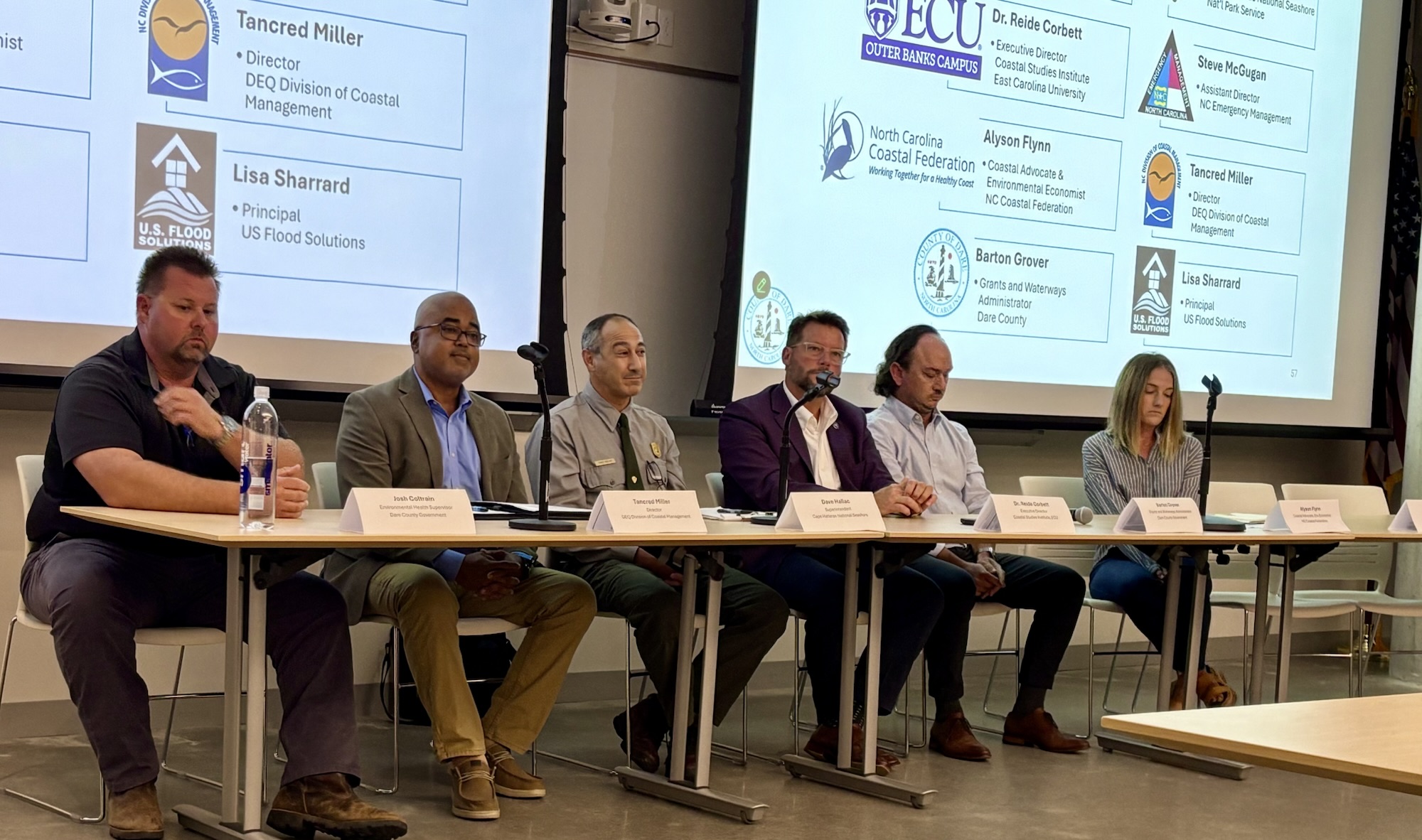
WANCHESE – The anguish was palpable in both the Coastal Studies Institute meeting room and online chat during Tuesday night’s discussion of Dare County’s oceanfront housing crisis. Homeowners facing collapse pressed officials for immediate solutions, while others sought clarity on insurance claims, permitting delays, and why some communities receive beach nourishment while others wait.
The two-hour session revealed the human dimension of a crisis that has already claimed several homes since 2020 and threatens dozens more. More articles about the meeting will be shared in future.
‘I Cannot Wait Months or Years’
The evening’s most urgent plea came through the online chat from the owner of a home beside a home that recently fell into the Atlantic Ocean in Buxton.
“My house is the green house. I cannot wait months or years for help. How are you going to help me make sure my house doesn’t fall in the ocean in the next six months?” the homeowner wrote.
The question highlighted the central dilemma facing many residents: federal mitigation programs take years to implement, but coastal erosion operates on a timeline of months or even days.
Barton Grover, Dare County’s grants administrator, acknowledged the harsh reality: “On the grant side for acquisition or elevation, the timeline has been two to three years plus. So it is not a quick answer.”
Steve McGugan, assistant director from North Carolina Division of Emergency Management, explained that even when a homeowner’s grant application is submitted, it is first evaluated by the state. Then “it has to be evaluated by FEMA, and then the funds approved” before any relief reaches homeowners.
Permitting Frustrations
Several homeowners expressed frustration with permit timelines that seem mismatched to the urgency of their situation. One resident asked why it took 10 months to get permits to move a house on their own property.
Tancred Miller, with the Department of Environmental Quality Division of Coastal Management, explained that the timeline depends on where homeowners want to relocate. In the specific case mentioned, there was “one option to relocate that house to a spot that could have been permitted within 10 days. Or the other option was to relocate to a spot that involved filling wetlands, which takes a longer time to permit.”
Another homeowner reported losing their house Tuesday because they “couldn’t get all the permits quick enough. Even though we had a mover set up and septic approved … and there was enough space on our lot we planned to move to.”
Miller indicated his office would need to review specific cases to determine if faster permitting might have been possible.
Insurance Confusion and Clarifications
Multiple questions focused on flood insurance intricacies that many homeowners don’t fully understand. Matt Williams from Buxton asked about the National Flood Insurance Program’s loss avoidance benefit, specifically whether the $1,000 moving allowance carries a deductible.
Lisa Sharrard, a flood insurance expert, confirmed there’s no deductible for loss avoidance claims, but emphasized documentation requirements: “You can’t pay cash. You got to pay by check … you’ve got to have receipts.”
Another complex question addressed whether homeowners could rebuild on their original lots if their house collapsed during a storm but beach nourishment later restored the shoreline. The answer involved intricate legal questions about whether the land itself had been “taken by the sea” and considerations about public ownership of nourished beaches. The panelists said they’d look into the question more and give a better answer at a later date.
Beach Nourishment Inequities
Perhaps the most emotionally charged exchange came from Amy Cramer, who lives in Rodanthe, and has listened to houses collapse.
“I don’t know if you’ve ever had the unfortunate opportunity to listen to a house fall into the ocean. It sounds like ribs being cracked during CPR,” she said.
Cramer questioned why Rodanthe hasn’t received beach nourishment since 1995 while other areas get regular projects. “So why is it that Rodanthe is the only place that’s not getting beach nourishment? And please don’t tell me it’s because we don’t provide enough money because no one wants to hear that they’re wrong.”
Grover explained that funding constraints prevent adding new projects. Current revenues can only maintain existing nourishment programs, and grant applications for Rodanthe’s estimated $40 million project have been unsuccessful. He noted that most beach nourishment grants he’s been able to obtain have been for $2 million to $3 million.
“We have been denied by FEMA,” Grover said. “They have indicated they would not fund a grant project for beach nourishment, essentially a new beach nourishment project.”
Cramer noted that while she appreciated Grover’s efforts, the panelists needed to do more to advocate for the citizens. “There has to be a solution that’s better than ‘Let me take your home.’ … I live here. I trust you. I don’t have the power to make a change. You do. And so, I’m asking you, even if it’s not your responsibility exactly, or it’s above your pay grade, we trust you to do something. You have the power.”
Wave Barriers and Erosion Control Options
Several questions explored alternatives to traditional erosion control. One homeowner asked about wave attenuation devices as alternatives to sandbags for temporary protection.
Miller’s response was definitive: “Not really. There’s limits on what can be put under state law. … Currently, the only thing you can use is sandbags to control erosion on the ocean front.”
The same restrictions apply to groins or jetties. “There’s prohibition on new hard structures on the ocean front to control erosion, except in very limited circumstances.”
Development and Future Planning
A Dare County resident asked how officials are guiding development given the documented threats. The question touched on a sensitive policy issue about building in areas known to be at high risk.
Dr. Reide Corbett, executive director of Coastal Studies Institute, suggested North Carolina is behind other states in updating development policies, noting the state still uses policies from 2018 while “most states are using policies from 2020 or newer.”
“North Carolina needs to look at how we’re developing, where we’re developing, and update some of those rules to prepare for what’s coming,” Corbett said.
Stark Assessments from Community Leaders
Brian Herrns, who founded the Buxton Civic Association, delivered perhaps the evening’s most sobering assessment. Addressing homeowners in the Tower Circle area, he said: “I think a lot of you guys in Tower Circle are going to have to come to the realization that your house probably won’t be there for beach nourishment.”
He counted “19 houses in the ocean” and questioned whether any homes would survive until April. His comments shifted discussion toward damage containment rather than prevention.
“Can we get cargo netting around these houses? Is there any way we can limit the debris field to miles of Hatteras and just contain it to one little section?” he asked.
National Park Service Superintendent Dave Hallac responded that ocean forces make cargo netting impractical without substantial anchoring systems, though he encouraged homeowners facing imminent collapse to secure cleanup permits and contractors in advance.
Miller noted that DEQ may be able to help homeowners.
Economic Arguments
Questions also addressed the economic logic of beach protection. One online participant noted that Hatteras Island contributes $2 billion annually to North Carolina’s economy through tourism, asking why investments totaling “around 3% of the annual economic impact per year … seems like a good investment to keep up tourism.”
Officials acknowledged the economic arguments but pointed to funding limitations and federal restrictions that prevent simple solutions.
Grover noted that when Dare County applied for federal funding for Rodanthe, an economics expert said a $40 million beach renourishment project would have an economic impact of $60 million to $80 million.
Limited Options, Difficult Choices
The Q&A session made clear that while some assistance exists, it falls far short of matching the scope and urgency of the crisis. Homeowners face difficult choices between:
- Applying for federal grants that may take years and aren’t guaranteed
- Attempting expensive relocations through complex permitting processes
- Pursuing beach nourishment projects that cost tens of millions and require ongoing maintenance
- Accepting that some homes may not survive to see any solution implemented
As the meeting concluded, officials emphasized the voluntary nature of all programs and encouraged homeowners to maintain flood insurance and complete interest forms for future grant opportunities.
The session ended without clear solutions for the most urgent cases, leaving residents with the difficult reality that some threatened homes may not survive the time it takes for longer-term assistance to arrive.
The complete meeting recording will become available on Dare County’s YouTube channel. For current grant application information, contact Dare County’s grants office.
2 responses to “‘My House is Next’: Urgent Questions from Dare County’s Threatened Coastline”
[…] An article about citizens questions and concerns, can be found by clicking here. […]
[…] ‘My House is Next’: Urgent Questions from Dare County’s Threatened Coastline […]