BY MILES LAYTON
EDITOR’S NOTE: I met John Layton a few years back after he made an impassioned speech defending farmers who were getting blamed, wrongly so by the mainstream media, for the green stuff that tends to invade our waters in the area sometimes during the summer. John said farmers care deeply about the environment so whatever causes the algae blooms comes from somewhere else. I think that Layton’s speech opened people’s eyes.
Anyway, because John is busy in the fields, I sent him a few questions so I could learn more about the challenges faced by farmers that I heard about from Senator Norm Sanderson at the Chowan County Republican Convention. Please read this Sen. Sanderson – our farmers need help from Raleigh.
Albemarle Observer is a very farming friendly publication – see our coverage of the 71st annual Chowan County Livestock Show and Sale.

Google Paul Harvey “So God Made a Farmer.” Aside from farming, John’s responsibilities include Farm Bureau Board member, Volunteer Fireman Town of Edenton, and Chowan County Soil and Water Supervisor, so he keeps busy on and off the farm!
Based on my questions to John – thanks – see his own words below – non-redacted, I’m not like 60 Minutes.
First, I would like to tell the reader how fortunate we are to have a local news editor like Miles Layton (no kin to me), who puts great effort into covering the stories of our local community. I was fortunate to meet Miles several years ago at a public meeting about algae blooms. I attended on behalf of local farmers, and he was writing an article for the Chowan Herald. It’s stories like these that set Miles apart and display how effectively he can communicate local issues to the public.
So, to further this comment, a few weeks ago Miles came to me wanting some information about the state of farming and how agriculture is going to be affected by President Trump’s worldwide reciprocal tariffs. Our commodities are being targeted in these tariffs and they are traded on a global scale, the prices we get are based on global supply and demand.
Five Generations of Farming
Now to introduce myself. My name is John Layton, I am a 5th generation farmer born and raised here in Chowan County.
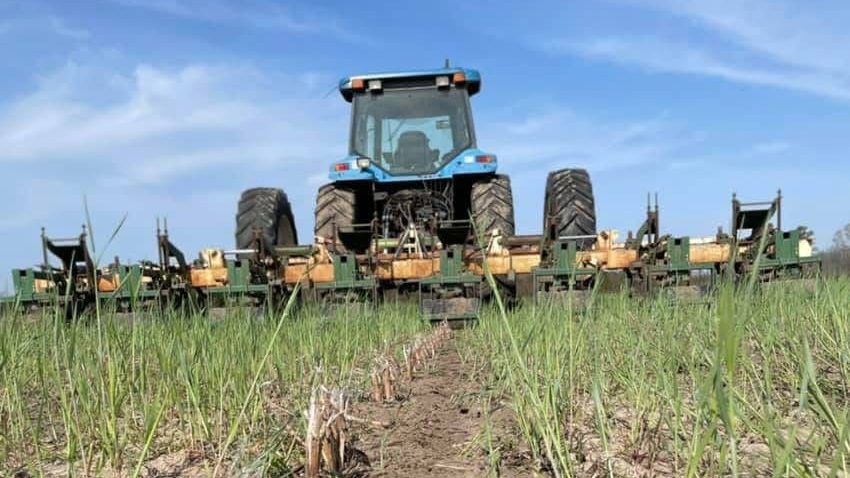
I can remember my young days on the farm handpicking produce and chopping weeds over my summer break, telling myself I would never come back to the farm! Well, it’s funny how life turns out, and here I am 37 years old going on my 14th farming season, since graduating from NC State Dec 2010 majoring in Ag Business/Economics minor. I have a wife and a 4-year-old son whom I hope one day wants to come home and take over the family farm. Our farming season is just getting started, the fields are behind prepped, and equipment is rolling.
I do want to ask that everyone please slow down on the roads and have patience with farm equipment, we want to go home to our families just like you. My dad and I farm in a Partnership of 1,800 acres of row crop.
Today we grow 3 types of crops: peanuts, cotton, and soybeans. We have transitioned and grown a variety of crops over the years. Over time our rotation has adapted to these 3 commodities due to the simple fact they are what we can financially survive on year in and year out.
We once grew clary sage for about 8 years. It was a very profitable crop. That was until a manmade sage oil hit the market, combined with increased acres (all controlled by Avoca Inc.) and the market got saturated and the price fell.
We could still pencil out a profit, but that margin had decreased significantly. As I mentioned earlier, my grandfather and father brought me up in the produce business. We grew watermelons and cantaloupes, (along with peanuts and cotton) but the produce market shifted from selling to roadside stands to having contracts with grocery store chains. That may sound better to some, but that’s called consolidation. Increased gas prices along with labor wages forced the small family-owned grocery business out. That’s just how markets shift in agriculture, consolidation is a part of agriculture.
Better Farming
When it comes down to me protecting my family’s legacy, my first instinct is “to get bigger”, or farm more acres. That’s not always the answer. For any business to grow it’s going to cost more to operate day in and day out. Inputs go up, along with a lot of variable unforeseen costs.
You may be able to spread that cost out over more acres, you still must make a good enough crop yield to offset those costs. Nowadays, we must look at the fact our commodities (cotton and soybean) are trading 50% below the cost of production.
To put that simply, I’m losing money if my crops are not subsidized. It costs me $1,000 an acre to grow cotton. If I yield 1000 lbs an acre and sell it at the current market price of .65 (minus gin fees) to gross $600 in profit, I will net (-$400) an acre. I grow 900 acres of cotton, it’s not hard to see that means I can’t make a profit without government subsidy.
For North Carolina farmers our subsidies come from the federal government (FSA). Our State does not subsidize the farmer.
The U.S. farmer has struggled the past several years due to extreme weather patterns and congress refuses to agree on a new Farm Bill. Items that need attention in the Farm Bill are different for every farmer. Most can agree on crop insurance triggers and reference prices for PLC payments need to be reviewed.
They were last amended in the 2012 farm bill, and with current inflation our input prices far exceed these old trigger prices. Crop insurance is all many farmers have to hedge their risk against a bad crop year. Back in March I was fortunate enough to be invited on a trip to Capitol Hill with the North Carolina Peanut Growers.
Our group of peanut growers visited the House and the Senate to speak with our state leaders. Our main talking point was for them to please sit down and agree on a commonsense farm bill that protects our nation’s farmers. This bill should be the most bipartisan of them all.
Tariffs and Fair Trade
Now, President Trump has placed reciprocal tariffs at a minimum of 10% on imports from most countries trading with the United States. The largest being tacked on to China at 34%. Our neighbors Canada and Mexico are also on the radar for tariffs, but the commodities specified in the USMCA Treaty are exempt. Tariffs in part usually help developing countries protect their domestic industries from more developed economies that produce goods cheaper.
What is ironic is that China is considered a developing country despite having the 2nd largest economy in the world. They do not play fair and have been in a trade deficit to the U.S. since 2014. The U.S. imports surpassed exports to China at a value of 295.4 billion U.S. dollars. Unfortunately, what happens with tariffs is countries will entertain other avenues of trade with more desirable countries.
Some trade partners may never return to the level they once were. In part for the US, the tax for imports from these counties will be passed on to the consumer. Only time will tell what exactly the outcome of the tariffs, the only thing I can do as a farmer is control the things I can control.
Tough times make good business managers. We have a lot of amazing technology at our fingertips nowadays. If we, as farmers, can learn to use it to our advantage, we can considerably lessen our financial risk. We must keep our faith in the good lord and trust he will lead our decisions in the best interest of our farms and families.
Thanks, John for the interview!
Last note – John Layton is no kin of mine, maybe distant, who knows, but I can say with great certainty that there are more Laytons per capita in Chowan County than anywhere else in the world – we even have a bay named after the family – Layton Bay.
One response to “Challenges Facing Farmers: Insights from John Layton”
[…] media outlets, the Albemarle Observer cares about farmers, rural values and the community. See this story about John Layton, a farmer in Chowan […]