BY NICOLE BOWMAN-LAYTON
Do you a navigation app in your vehicle to help you get to a destination in Virginia or Greenville?
Did Facebook give you information about a topic you were interested in?
Do you use a computer program that fixes misspellings and correct grammar and punctuation?
Are you reading this article that was created with the help of a transcription app and Grammarly?
If you answered yes to any or all of these questions, you have used or have been exposed to AI — Artificial Intelligence.
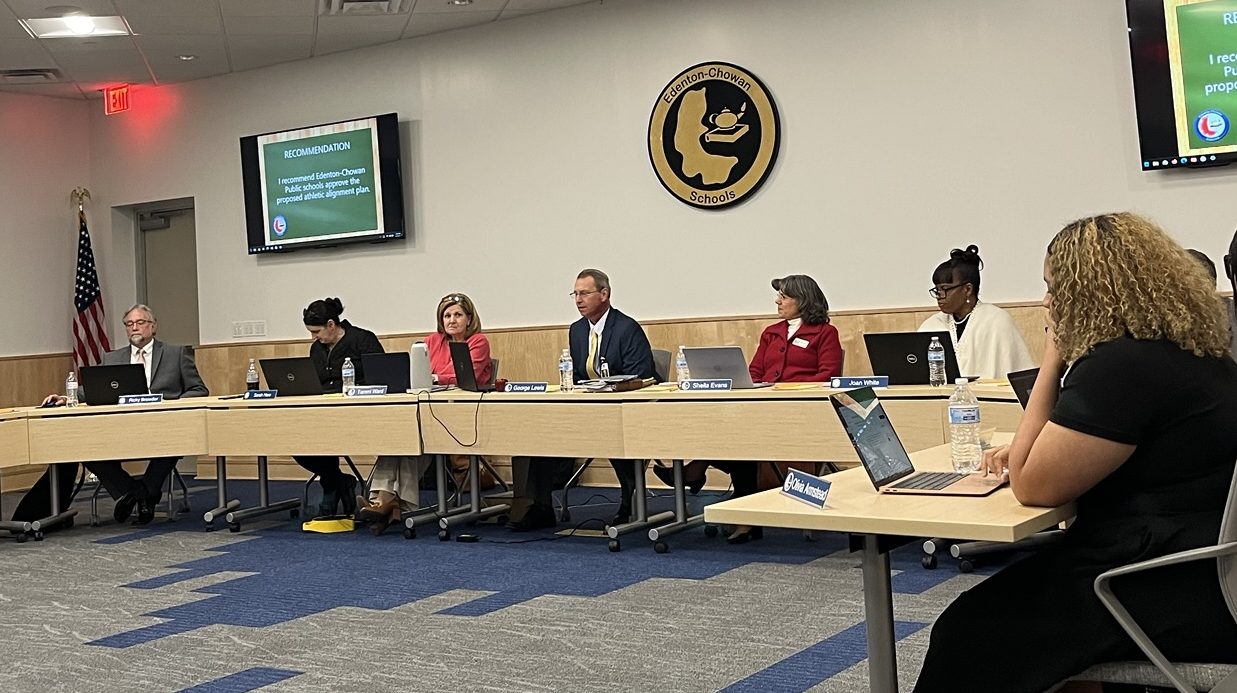
Edenton-Chowan Schools Board of Education held the first reading of a policy that would address the use of AI in classrooms during Tuesday’s meeting in the Professional Development Center, behind the old DF Walker High School along Oakum Street in Edenton.
Chief Academic Officer Mindy Vickers, along with the instructional coaches at the district’s schools, provided an overview of how AI is integrated into classrooms, shedding light on its potential and the careful approach required to implement it effectively.
AI as a Teaching Tool
AI supports teachers in lesson planning, research, and student engagement, Vickers said. Many educators utilize AI-powered platforms such as Google Slides, Canva, and Notebook LM to streamline their workflows and enhance learning materials. Tools like RISC School, Magic School AI, and Adobe Express provide resources for curriculum design, parent communication, and interactive student activities.
“AI can parse through monumental amounts of research quickly and highlight the most relevant information for educators, allowing them to focus on instructional strategies,” they explained.
While AI can be a powerful assistant, many teachers remain cautious about introducing it directly to students. Due to most AI age restrictions, teachers primarily use AI in elementary classrooms, while middle-schoolers and high-schoolers use the tools to enhance class projects, complete assignments, listen to podcasts summarizing reading assignments and more.
Engaging Students Through AI
White Oak and D.F. Walker students are experimenting with AI tools in a controlled manner. The Merge Cube, for example, allows students to interact with 3D holographic images using an iPad, offering an immersive learning experience. Third-grade students can explore the solar system in a hands-on, dynamic way through this technology.
In high schools, teachers have started using AI-powered platforms like School AI to create interactive lessons. English teachers, for instance, employ AI-generated quizzes and writing prompts to assess student comprehension in real time. AI can also generate study guides and provide feedback on assignments, helping students refine their analytical and writing skills.
“For our teachers, it’s like having a personal assistant,” said one educator. “It saves time on lesson planning and allows us to focus on engaging activities and addressing student needs.”
Challenges and Considerations
While AI offers advantages, educators acknowledge the risks and responsibilities that come with its implementation. One of the board’s concerns is ensuring that students develop critical thinking skills rather than relying entirely on AI-generated content.
“AI can lead students in the wrong direction just as easily as it can lead them in the right one,” said Board President George Lewis . “It’s essential to teach students how to evaluate sources, validate information, and use AI responsibly.”
To address this, the district introduced AI usage guidelines, including a “stoplight system” to indicate when AI use is appropriate. Teachers can set restrictions, such as prohibiting AI use during certain assignments, allowing limited assistance, or fully integrating AI as a learning tool.
Educating Parents and the Community
One of the biggest hurdles schools face is addressing parental concerns about AI. Educators and the board acknowledge that some worry that AI may replace traditional teaching methods, while others question its reliability. To bridge this gap, the district is focusing on transparency and education.
“We need to show parents that AI is not replacing teachers — it’s a tool, just like a calculator or a search engine. When used correctly, it enhances learning rather than detracting from it.”
The district plans to introduce informational sessions, open houses, and online resources to inform parents about how AI is used in the classroom. Also, outreach efforts will target families with limited access to technology, ensuring that AI benefits all students, regardless of background.
Looking Ahead
As AI continues to evolve, its role in education will also evolve. The district’s goal is to equip students with the knowledge and skills necessary to thrive in an AI-driven world. By fostering critical thinking, maintaining ethical standards, and keeping an open dialogue with the community, educators aim to prepare students for careers that are still emerging today.
“AI is the number one fastest-growing career field,” said an educator. “Our responsibility is to ensure that students are not only familiar with AI but also proficient in using it ethically and effectively.”

Construction Updates
In other business, the board received an update on the construction of the new John A. Holmes High School.
Superintendent Tammi Ward provided the update for Construction Supervisor Chris Brabble, who was unable to attend the meeting. The board received an aerial image showcasing the progress on the new school. Significant construction milestones were noted, including:
- Classroom Wing: Painting has begun on level one classrooms, with overhead installations nearing completion. Drywall work on level two is expected to be finished by the end of the week, while taping is halfway done. The last staircase has been poured. Window and exterior door installations are set to continue over the next week. The brick veneer is projected to be completed by next week.
- Core Wing: Overhead work is in full swing. Roof construction began on March 31, and brick veneer installation is ongoing on low roof exterior walls. Interior wall construction in certain areas will commence by the end of the month. The CMU firewall is nearing completion.
- Auditorium and Gym: Work in the auditorium will continue over the next few weeks. The gym’s large mezzanine and mechanical stairs are set to be poured by the end of the week. Steel decking is being installed around Area F.
- Site Work: Sewer and water tie-ins are near completion. Edenton Electric Department will begin boring for the primary power transformer next week. The back courtyard is being prepped for closure, weather permitting.
Additionally, the Edenton-Chowan Educational Foundation is offering commemorative bricks for purchase, which can be placed around the flagpoles. Bricks are available in two sizes ($50 and $100), and community members can personalize them in recognition of or as a memorial to individuals. The Albemarle Observer will have more information on the bricks in a later article.
Policy Manual Updates
The board also discussed updates to the school district’s policy manual. In October, an evaluation of the current policies revealed that over 50% were outdated or redundant. The board reviewed options for ensuring policies remain up to date with legal and educational requirements.
Proposed Policy Update Project
- Current Service: The district currently subscribes to the Policies to Lead Schools (PLS) service at an annual cost of $2,500.
- New Proposal: The Board is considering participation in the Policy Manual Project Update, which would assist in reviewing and updating policies over a three-year period.
- Costs: The total project cost is $19,725, spread over three years. After completion, the district would subscribe to an annual custom update service for $6,900.
- Benefits: The initiative would ensure policies are always current and aligned with legal requirements. Additionally, it would reduce the staff hours needed for policy maintenance.
Board members inquired about the accessibility and legal review features of the new policy manual system. It was clarified that while the update would not significantly change the manual’s online format, it would improve efficiency by eliminating redundancies. The service would also provide legal guidance on standard policies but may not cover legal counsel for custom district-created policies.
For information about the Board of Education meeting, please visit our article on the review of the 2025-26 budget by clicking here.
