By Miles Layton
EDENTON — A recent Sunday morning at the breakfast held at St. Paul’s Episcopal Church, I remember sitting across from Scotty Harrell, the church’s Junior Warden, when he told me that through social media, certainly pointed in the right direction by God, he was able to connect with a man who would be able to polish the church’s historic gravestones.
I filed that news tip in the back of my mind when, on Wednesday morning, I was walking the dog past the serene cemetery and saw a ladder next to a 10-foot-tall obelisk and some men polishing stones.
Praise be to God that I walked past the graveyard when I did because here’s a story that needs to be told.

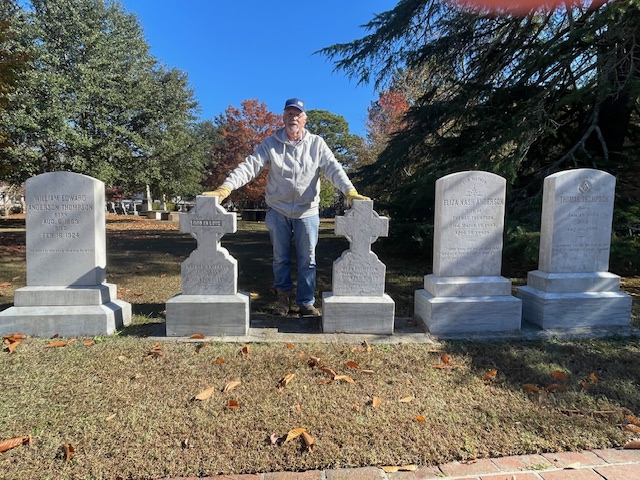
Ray Winstead was kneeling in the grass with a soft brush in one hand, working mold off a marble marker that has stood in the churchyard for well over a century.
He does it by hand, one stone at a time. A visitor might see a man scrubbing a rock, but Winstead sees something he’d like the next generation to be able to read.
“They need to be remembered,” Winstead said.
Winstead, who lives in Roxboro in Person County, has been cleaning, repairing and documenting gravestones for a decade. This week marks his fifth trip to the historic graveyard on Church Street. He talked with the Albemarle Observer as he worked.
His reason, he said, comes down to the written record carved in stone.
“If you can’t read the stones, nobody’s gonna know who they are,” he said. “You can’t trace genealogy.”
Winstead does genealogy research himself, particularly on Civil War soldiers, and he knows what a mold-blackened marker can do to a family search. When descendants die out or move away, a gravestone is sometimes the last surviving record of a life.
“If family dies out, nobody knows who these people are,” he said. “There’s a lot of people that do genealogy when they get older, and they like doing it.”
The work began, he said, with something simpler. He didn’t like the way the veterans’ markers looked back home in Roxboro, so he started cleaning them. Asked whether he felt called to it, he laughed it off and said it’s “just a passion of mine.”
“I love doing it,” he said. “Like I said, if I didn’t, I wouldn’t be doing it. I’m bringing life back to these stones.”
A gallery of photos appears at the end of the story.
Subscribe — it’s free!
A career change, of sorts
Winstead did not start out in cemeteries. He was a music teacher, with private students and substitute work in the schools, and he trained on what he called “a full line of every kind of music instrument imaginable” in music school. Piano, he said, was among them.
Residents noticed his veteran-stone work, especially at Burchwood, the city cemetery in Roxboro, and began asking whether he would clean other people’s stones. The business took off from there.
“I don’t know anybody else that would take the time to do what I do,” he said.
That care is the point. Winstead uses a chemical he blends himself, which he said removes mold and other growth without harming granite or marble. It will dissolve the mortar and sand used in some older monuments, however, so those stones get a different treatment.
“Everything I do is by hand,” Winstead said. He has cleaned monuments he described as “really, really rare” and “one of a kind pieces of art.”
“You can’t let just anybody touch these things because they’ll ruin them,” he said.
He pointed to his work at St. John’s Episcopal Church in Vance County, where a marble cross carved with rose vines had been filthy with grime. The vines, he said, were “so delicate you could put your fingers around them.” He cleaned much of it with a toothbrush over several weeks.
“It was filthy, and now it looks brand new,” he said.
Not all stone ages the same way. Granite is dense and resists the mold that creeps into everything else. Marble does not.
“Marble is porous and it will absorb the mold,” he said. On some old markers he has found as many as four different types of growth. “It takes a lot more effort to get it marble clean than it does granite.”
Because granite wasn’t commonly used for gravestones until after 1900, nearly everything in the oldest part of St. Paul’s is marble, or in the case of a few of the earliest markers, slate. “Everything was marble, marble, marble,” Winstead said.
Colonial roots
St. Paul’s is one of the oldest churches in North Carolina, and its graveyard holds a share of the state’s colonial and early national history. Winstead said the parish dates to 1701, and the original wooden structure is long gone. A brick church was built to replace it, one that, as he put it, would “stand the test of time.” He noted that the church in Bath is the oldest Episcopal congregation in the state, and that St. Paul’s is the second.
The churchyard includes the grave of Governor Charles Eden, a man who knew the pirate Blackbeard. Eden’s ledger stone Winstead hasn’t reached yet, but when it is polished, I can’t wait to read it.
Winstead said Eden’s grave marker is a different material from the marble markers around it, a layer of mortar and sand that will need its own careful treatment. Among the others resting here are judges, doctors, lawyers and military men, along with the families of the merchants who built the town’s fortunes.
He has worked his way across the grounds from one end, and he has already cleaned the stone of Major T. L. Skinner, a Civil War veteran. Skinner’s son died at Mechanicsville, Winstead said, and was most likely buried near the battlefield rather than brought home. Winstead counted three Civil War veterans in the first section he worked.
Elsewhere in the churchyard stands the monument to Augustus Moore, a superior court judge for the state of North Carolina who died at 48. The stone is ornate, and Winstead was quick to note the craftsmanship. “All that was hand carved,” he said.
Moore’s age at death is not unusual in the churchyard, Winstead said. “A lot of men didn’t live long.”
Some stones still puzzle him. One bears a carved symbol that may have marked a merchant’s trade, in the way shopkeepers once hung shingles over their doors. “I haven’t had time to look this up,” he said.
Stones that tell a story
Some of the most affecting work at St. Paul’s, he said, involves the smallest graves. He pointed out a pair of markers from 1849 and 1852 topped with lambs, a traditional symbol of a child’s grave. Nearby stands a carved statue marking a little girl who was born in 1892 and died in 1896, at four years old. Winstead said it took an expert carver to shape the figure from a single block of marble.
“Unbelievable how much time and money was spent on this one stone,” he said. He added that none of the carving was done by machine. “It was all hand done.”
At the south end of the churchyard stands the piece Winstead calls one of his two favorites, an iron-fenced Gothic monument to Margaret Lavinia, wife of Dr. Thomas Warren. It dates to 1854 and stands about nine feet tall. It came from a Philadelphia stonecutter, Winstead said, and would have been shipped south by boat and unloaded at the Edenton waterfront.
“It would have come down here on a boat,” he said.
The monument was assembled in sections, he said, starting with a leveled base and finishing with the dome. He guessed a crew of men needed three or four days to put it up, probably using a hoist. “They call it a derrick,” he said.
A statue that once topped the monument is missing its head, and nobody knows what became of it. Winstead said a sculptor he knows could replace it. He called the monument “irreplaceable and priceless” and “high class art,” and estimated the restoration alone would take him “thirty some hours.”
“You don’t see stuff like this in today’s standards,” he said.
Many of the stones at St. Paul’s bear the carver’s name, a detail that charms him. “These guys were very proud of what they did,” he said, “and they carved their names on it for posterity.”
Still plenty to do
Winstead’s other favorite is a pink granite crypt in the far corner of the churchyard, shaped like a coffin with a lid. It is dull and weathered now, but he said it will brighten considerably.
“This thing will be beautiful when I do this one,” he said.
The work is slow, and the centuries-old churchyard is crowded and sometimes overgrown, with stones leaning at odd angles and old trees pressing in. Winstead said magnolia roots have damaged some of the markers. The oldest stones, he said, need “a lot of tender loving care.”
Winstead said the rector at St. Paul’s, the Rev. Melody Perdue, has been marveling at the transformation since the crew started coming, and church members have been walking by to watch.
He has no plans to stop soon. Next week is Thanksgiving, and Winstead said he’ll take the week off. He’ll leave Thursday night this week for the North Carolina Symphony in Raleigh, where he holds season tickets in the third row. He intends to be back at St. Paul’s as long as the weather cooperates.
“I’ll be down here as long as the weather’s good,” he said.
Stones that echo an eternity — click to enlarge


Let us know what you think by leaving a comment. Comments are subject to approval.