By Miles Layton
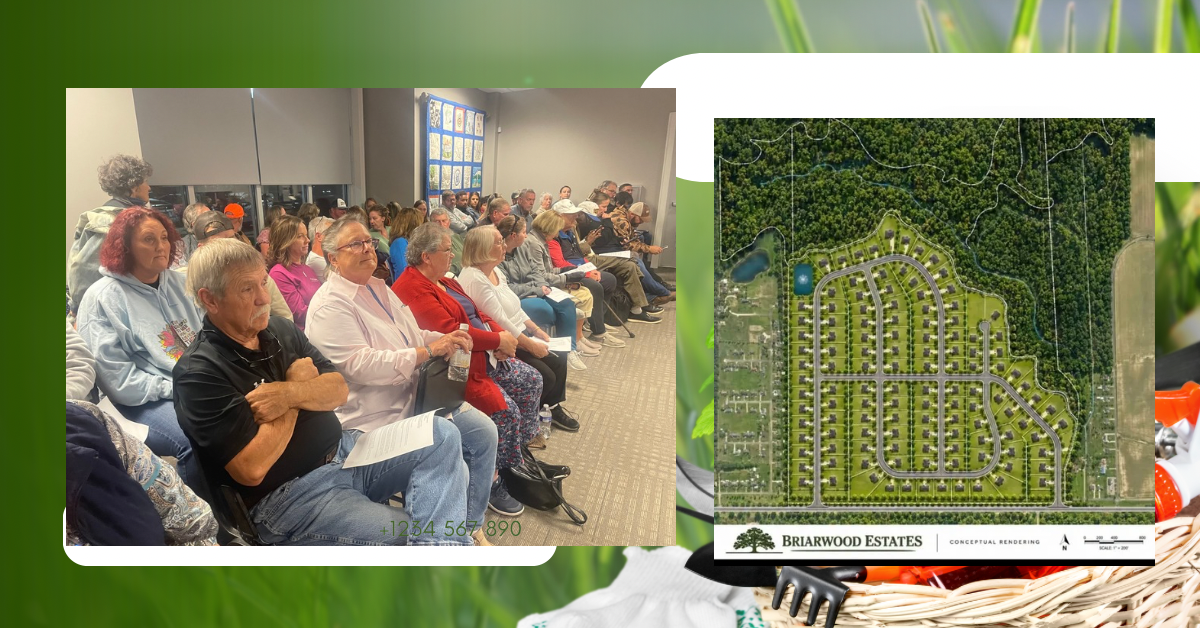
HERTFORD – As a follow-up to Wednesday’s story (see here) about the Perquimans Planning and Zoning Board meeting, I thought I’d share more from the public comments: how retirees, farmers, commuters and a former county commissioner lined up at the podium Tuesday night to tell the board that a proposed 133-lot subdivision on Woodville Road is too much for a rural county to absorb.
As we all know, their comments were made during the consideration of REZ-26-02, a request by Patrick Whitehurst and 2G Investment Group LLC to rezone 214 acres from Rural Agriculture to RA-32 for Briarwood Estates. The board voted 2-1 to recommend approval to the county commissioners, who have the final say.
If any Perquimans County Commissioners are reading this story, the meeting didn’t quite have a pitchforks-and-torches vibe like this scene from Young Frankenstein, but…
Board members reminded speakers several times that rezoning is only the first step, and that water, traffic and septic questions would be answered later. Many residents said that was exactly their worry.
Subscribe — it’s free!
Lynn Mathis built her case around the county’s land use plan. She began by asking staff how the plan classifies the property. Planning staff said the plan calls it residential agricultural, which corresponds to the rural agricultural zoning now on the land.
Mathis said she respects Whitehurst and has no quarrel with growth in general. “I have absolutely no problem with growth in this county if it is done and managed,” Mathis said. But she said the rezoning “fundamentally” conflicts with the plan, which was written to maintain areas where “scattered, low-density residences” are dispersed “among farmland and open space.”
“A 133 lot subdivision is not compatible with that particular part of the land use plan, and certainly doesn’t preserve agricultural values and rural characters outlined in the county’s comprehensive goals,” Mathis said.
Mathis reminded the board that residents helped write those goals. “The people in this room, they’re the ones who helped establish that particular goal, and I don’t feel that it is consistent with that,” she said. Mathis told the board she wanted her position on the record. “I do want to go on record as saying that I do oppose this until the county starts addressing some of these issues within our documents,” she said.
Mathis said the county’s water treatment plant is in its 14th year of an industry-standard lifespan of 20 to 30 years. She said 50 multifamily lots and another 95 residential lots were recently approved at Albemarle Plantation, and that more than a thousand vacant lots are for sale in eight existing subdivisions in the county.
She also said a planned unit development tied to Albemarle Plantation, covering about 1,200 acres from the front gate across Harvey Point Road to the Perquimans River, could eventually hold more than 2,000 homes or apartments. Together with other approved projects, she said, that adds up to more than 3,000 units.
“If you want to talk about infrastructure strain, let’s talk about we already have in place, already approved PUDs and land development in this county that is over 3,000 individual units,” Mathis said. “And if we’re going to talk strain on infrastructure, that’s a strain on infrastructure.”
Tony Drago, a retired Navy veteran who moved to the county 22 years ago, said he isn’t against new neighbors. “I’m all for affordable homes and all that stuff. I’m not against that,” Drago said. But he questioned whether the county can handle the load. “Can our schools handle it? Can our new hospital support it?” he asked.
Drago, who lives on Boat Ramp Road, said some residents there still can’t get public water. “I see where the county can profit from this, but what does the county lose from this?” he said.
His wife, Judy Drago, said she has spent 22 years trying to have her property recognized as a bird sanctuary. “Leave nature alone with your neighbors. We all moved here for that reason,” she said. “We didn’t come here for subdivision.”
She also doubted the homes would be within reach of local buyers, noting the county’s average income is in the $60,000s. “Did you think for one minute they’re gonna sell those houses for $200,000 or less?” she asked.
Pause, I wonder if the Dragos are related to Ivan Drago — yeah, no way Drago loses to Rocky — that fight was fixed.
Back to our story — Crystal Adler of Belvidere said she was speaking for people like herself who moved to the county for a quieter life. She said she owns seven acres along the river that include wetlands she has never been able to build on, and she wanted to know why the developer would be allowed to.
“I have wetlands on my property. I’ve owned it for eight years. I can’t develop it,” Adler said. “Why are they backing up to wetlands? I can’t do it. Why are they allowed?” Later she added, “You have wetlands, and they already admitted that they want to build up on them.”
Adler said she doesn’t live near the site but believes what happens on one road will reach others. “This is a spiderweb effect. What happens in New Hope is slowly going to affect us,” she said.
She said she grew up around Suffolk, Va., and has watched what development did there. “You allow one subdivision, you give one, one turns to five, five turns to ten, ten turns to twenty, and all of a sudden you have Suffolk,” Adler said. “There are barely any farmers in Suffolk. They’re being pushed out further and further and further.”
She said the county should look after the people already here before it brings in more. “When you start taking care of the people that are here, that are paying for these roads, that are paying for the schools,” she said. She pointed to Drago’s comment about Boat Ramp Road. “You just had somebody say they don’t even have water. Water? Are you kidding me? In 2026,” Adler said.
Adler also said the county’s schools are already stretched. “We just built a brand new school. It’s at capacity,” she said. “That intermediate school is bursting at its seams.”
“Did you move here because you like the city, or did you move from the city and come here because you wanted country and you wanted to raise your kids with low crime rates?” she asked the crowd. Several people answered with “Amen.”
She also took issue with the idea that the project is low density. “133 homes is not low density. It’s a major subdivision,” Adler said.
Adler made clear her objection wasn’t personal. She told the board that the Whitehurst family had been good to her. “Y’all delivered dirt to my yard. Everything. I will support you forever. I can’t get behind this,” she said. “Yes, this is a baby step,” she said, but she urged the board not to take it. “Why are we even considering the rezoning of this?” Adler asked.
Nichole Hoggard, who lives on Godfrey Lane about six miles from the site, read a prepared statement. “I’m hoping that this doesn’t get rezoned,” she told the board before she began.
Hoggard argued the request conflicts with the county’s CAMA land use plan, which she said sets out five mandates: protect farmland and open space, direct growth to appropriate areas, make sure infrastructure is in place before development, consider drainage and flood risk, and match growth with public services such as fire, EMS and law enforcement. “Rezoning 214 acres of active agricultural land to construct 133 high-density tract homes directly conflicts with every single one of those policies,” Hoggard said.
She also challenged the idea that the county needs more housing. She said the county has roughly 1,300 to 1,400 vacant housing units, a vacancy rate near 19 percent, though many are seasonal. “There is no supply emergency that justifies rezoning rural farmland for tract houses,” Hoggard said.
She said Briarwood Estates and the proposed Belvidere Farms development, at 110 lots, would together put 243 lots on 407 acres. “County housing permits are already up 36% this year alone,” Hoggard said. “Our core public infrastructure cannot absorb the rapid influx.”
Hoggard said the school system and roads are already under pressure. “K through three classrooms are full, and school buses are already running double routes,” she said. “Two lane ditch roads like Woodville cannot safely accommodate hundreds of additional daily vehicle trips.” She said the sheriff’s office was recently denied funding for an additional deputy.
Hoggard said the county can’t count on developers to cover the costs. “High-density residential developments run an infrastructure deficit, requiring more county services than ever generate in tax revenue,” she said. “Farm land requires practically zero services and remains a net financial benefit for our county.” She also said the county’s electric grid “operates at seasonal capacity limits every summer.”
On water, County Manager Brandon Shoaf told the crowd later that the county’s contract allows it to buy up to a million gallons a day and that it currently buys about 150,000.
Frank Norman, 70, who has lived in Perquimans for 35 years, formerly serving as mayor pro tem on Hertford Town Council, told the board he agreed with most of what had been said. He said officials who cite income figures when approving new development often miss who actually lives in the county. A few high earners moving in can skew the average, he said.
“But the average median income is not fair for everybody,” Norman said. “What they don’t understand about Perquimans County is what you have is a huge group of individuals in the middle who have lived here all of their lives, their grandparents, their great grandparents. They have been here forever.” He said another group is “less financially endowed.”
Norman said he grew up in Detroit and isn’t against cities. “I did not move here because I hated the city, but I did learn to love the open space,” he said.
He told the board about a trip his father took him on when he was about 7 or 8, to see farmland for the first time. “I said, ‘Dad, it’s beautiful out here. I mean, look at the trees and the birds,’” Norman said. “I said, ‘You know, we ought to move out here.’ And he said, ‘No, son, you’re wrong.’”
His father’s reasoning, he said, was that Norman would ask for sidewalks. “Then your cousins and friends are gonna come to visit you, and they’re gonna see this,” Norman recalled his father saying. “And they’re going to move in, and what you left is going to be what you have.”
“Leave it alone, and we can always visit the beauty of it,” Norman said.
Norman agreed with an earlier speaker that growth is coming and can be handled well. “If managed properly, it can be handled,” he said. But he said managing growth has to include more than newcomers. “It don’t just refer to the people moving in, but the people that’s already been here all of their lives,” he said.
Later in the meeting, Norman said the residents who spoke were not opposed to development itself. “They’re not against the development; they’re against the capacity of the density that you are asking for,” he said. “And with that, I have to support my neighbors.”
Rebecca Ward, who owns a hair salon about a mile from the site, said she was excited to come to the meeting to learn how the process works. “I’ve been trying to pay attention,” she said.
She pressed county staff on why power and water providers had no comments in the planner’s report. “Their comment was no comment. What does that mean?” Ward asked. She asked whether it was OK to wait to hear from them until the next stage. “Because once we do this, it’s done, right?” she said. She was told the formal technical review hasn’t happened yet.
Ward said she has read the county’s land use plan and found it lacking. “It sounds really beautiful, but it’s not specific, so it’s beautiful, but it’s open to interpretation,” she said.
She said she would likely benefit from new neighbors but is wary. “I own a hair salon. I work maybe a mile from where this is going to be, so I really stand to make money,” Ward said. “I’d rather not make money at the expense of — I don’t want to become Elizabeth City.”
Ward said the subject comes up constantly at work. “My clients are in a panic. It’s all they talk about. They’re worried. They’re scared to death that the crime is going to come like Elizabeth City,” she said. “It’s going to end up like Virginia. I listen to it every day.”
She said she worries about what a rezoning sets in motion, pointing to the recent Dollar General proposal in Belvidere, which was withdrawn. “We learned that if you put a commercial building here, they can build off of it and keep going from there,” Ward said. “So if that happens with residential areas too, is it going to keep going? Is it going to take over for Perquimans County?”
“Growth is okay as long as it’s defined and the people know what’s going to happen,” Ward said. “If people know what’s going to happen and you’ve designated this area to be rural, this is going to be a safe space or whatever, then people aren’t going to be afraid.”
She said she would rather see growth that looks rural, such as homes along New Hope Road. “Those houses, I’m sure they’re very expensive. But that looks rural,” Ward said. She said Briarwood Estates, by contrast, struck her as “way too much.”
“We need you guys to put something down specific, so that we can know what’s coming,” she said. “But people in this county need to know what’s going to happen because they’re afraid. Period.”
Some urge patience
Others said they, too, were uneasy but not ready to say no.
Former county commissioner and school board member Matt Peeler focused on jobs. “Where’s the jobs to support 133 homes?” Peeler asked. He urged the board to make sure the county has “the jobs” and “the infrastructure to support it” before approving more big subdivisions. He also called on the commissioners to adopt a plan that spells out where large developments belong.
Sorry I didn’t catch her last name, but a health care worker who gave only her first name, Tracy, said she has spent 28 years caring for patients in the area. She asked whether anyone in the county’s lower- or middle-income brackets could afford homes in the subdivision. “If we’re going to bring them in, can we have some affordable homes?” she asked.
A few speakers said they didn’t see the project as the main threat. Roy Murray, who said he has owned property and a business in the county for more than 50 years, said the rezoning is one of many hurdles. “The process you are doing right now is simply one step in a bunch of steps to get this done,” Murray said.
Chris Murray, who works for the sheriff’s office, said he doesn’t like subdivisions but would rather the Whitehurst family — because they’re local, care about building quality homes and their neighbors — build this one than an out-of-town builder. “For me to stand up here and defend the housing development takes a lot out of me,” he said.
Another resident said she didn’t want the project but feared what would follow if it were denied. “As much as I don’t want it, I’d rather let him go to the next step,” she said, adding that a bigger developer from outside the county could take over.
Developer responds
Whitehurst addressed the crowd several times during the meeting and said the rezoning is the only way to find out whether Briarwood Estates can be built at all.
“The first step of this is the rezoning,” Whitehurst said. He said engineering, state and review fees could run “upwards of 150 to 200 thousand dollars,” and that his company won’t spend that kind of money without knowing the land can be rezoned. “We can’t get to that point without this step,” he said.
He said the project’s price and design depend on studies that haven’t been done. “We don’t know what our input costs are going to be until we get the rezoning done,” Whitehurst said. He said fire flow, water capacity, NCDOT requirements and health department rules all have to be settled first.
Whitehurst said 133 lots is the most the land could hold. “You always shoot for the stars, and you go down from there,” he said.
He also said the project would put local tradespeople to work. “There’s a lot of plumbing businesses, a lot of mechanical businesses, a lot of electricians,” Whitehurst said.
Whitehurst said his company would pay for every study required, and that the rezoning carries no financial obligation for the county. “We pay 100% of those costs,” he said.
Whitehurst said the 1,300 to 1,400 vacant homes cited earlier include many that aren’t livable. He said he once bought a house in Woodville that was listed for $220,000 and donated it to the fire department to burn. “Just because it’s on the market doesn’t make it a habitable home,” Whitehurst said.
He said the company would pay for every study required, and that the county has no financial stake in the rezoning. He said the infrastructure costs aren’t known yet. “We won’t know what our input costs are going to be until we get the rezoning done,” he said.
The commissioners are expected to take up the request at a later public hearing.

Let us know what you think by leaving a comment. Comments are subject to approval.