By Miles Layton
Once upon a time, I thought that longtime newspaper offices were eternal – places like town hall or the police department that seldom change locations because they are an important part of the community. For all practical purposes, a newspaper was located downtown near the courts and local government so the media could keep an eye on things and keep the public informed.
I have good memories from newspapers big and small where I’ve worked that were downtown, in the center of everything – Wheeling Intelligencer, in Wheeling, WVa, Tyler Star News in Sistersville, WVa, Herald-Standard in Uniontown, Pa, The Daily Sentinel in Pomeroy, Ohio, and certainly the Chowan Herald in Edenton, NC. Being downtown is what made the Athens (Ohio) News special too. I remember when the Daily Reflector was located in downtown Greenville, NC, rather than in that huge, now mostly empty office building on the other side of the city – a location that requires drivers to endure heavy traffic and several stoplights, and is a hike from City Hall and the Pitt County Courthouse.
Anyway, a few folks from Ohio texted me, saying the Athens Messenger’s physical plant, where the printing press is located, and the property are for sale — not the newspaper. Granted, that property is not downtown, but that once-daily newspaper has long been known to people in Athens County — built there in the early 70s by the Bush family that owned the Athens Messenger for decades, before the dark times, before the empire.
The 1.447-acre lot with its 26,484-square-foot building has a county-assessed value of $1,545,220 – according to the Athens County Auditor’s Office. I can’t find the purchase price on any real estate website, but as is usually the case with property sales, it’s probably safe to say the sale price exceeds the assessed value. Athens Messenger is huge – a good place for light manufacturing of killer drones and flock cameras, or for serving as a data center.
If that building is sold, maybe the press is moved or dismantled — what then?
Meanwhile, in Windsor, NC, I learned the other day that the property that once housed the Bertie Ledger-Advance was sold, and that weekly newspaper relocated to a tiny office space somewhere. Last year, a Texas couple bought the 2,500-square-foot property on King Street in Windsor for $35,000 – less than the $39,000 assessed value Bertie listed in county records. If I won the lottery, I’d live in that office and publish a newspaper that covers Eastern NC.
Both the Athens Messenger and Bertie Ledger newspaper properties conjure forth a few thoughts about the state of affairs regarding the decline of community newspapers.
Bertie Ledger’s property has been vacant or near vacant for many years, though the Ledger’s sign remained on the door of an office that was clearly empty.
That sign on the door — that’s not uncommon. In many towns that once had their own newspaper offices open from sunrise to long after sunset, those offices are now closed, with signs on the door saying to call such-and-such to make an appointment. And God help you if that number sends you to a phone tree to leave a message for an overworked and underpaid local news reporter.
When I was editor in places considered flyover country by boardroom management, mere spreadsheets in an accountant’s Excel spreadsheet, I always made it a point to work a few hours in these offices each week as often as practical, if merely to escape the politics of being around ineffectual upper media managers – a revolving door of executives who have no clue about the people or communities their newspapers serve. These people’s whole lives have been spent in a bubble that rewards and sustains failure – which is why these things have come to pass.
Though I still believe a newspaper needs a physical presence — an office in the middle of the town served by that media outlet — newspapers don’t need the space or the giant physical plant they once did to conduct operations.
These days, newsrooms are empty of warm bodies, with the rest of the departments being mere shells, if they exist at all, of what they once were. This is due to mechanization/computerization, combined with a cost-cutting approach to media management.
Classified sales – gone or near gone, maybe outsourced to another company property elsewhere.
Circulation – one regional circ guy handles it all now, with papers organized by zoned editions; newspapers are usually mailed too, so paper carriers are a thing of the past, maybe mailrooms too.
Composing where ads were designed—computer programs changed how it was done.
Front reception desk — now handled by a solo employee who does two other jobs, probably including obits, while managing the phone tree and talking to public walk-ins who want to talk to a “real” person, not leave another unanswered message in a voice mailbox for an employee who works remotely but never checks his messages or no longer works for the company but is still listed on the staff web page that’s never updated.
Moreover, many media companies are transitioning away from costly print products toward more flexible, less expensive digital news products that are more user-friendly. There’s no denying the news business has changed and continues to change.
That said, many places, particularly in rural America, still need a print-product newspaper because internet access is limited or non-existent. Eliminating the print publication of county-seat newspapers as a cost-cutting measure creates news deserts where people don’t know what’s happening in their own backyards. Moreover, if you can’t interest advertisers or subscribers in small towns, how do you expect that pitch to work in big cities where there is fierce competition for ad dollars and audience share.
Print supports digital. I’ll say that again — print supports digital, though that will change over time.
Speaking of print, there are fewer and fewer commercial printing presses in operation. Most of these operations have been consolidated so that a single press runs almost nonstop, publishing newspapers across a state or region. That’s in stark contrast to the days, maybe not so long ago, when newspapers like the Daily Advance were published on-site in Elizabeth City. Once upon a time, long before the Chowan Herald moved into that closet-sized office on South Broad Street, it was also published on-site at its former location, now Edenton Tea Company.
Athens Messenger prints most, if not all, of the newspapers in Southeast Ohio.
The same thing can be said for the Daily Reflector about newspapers in Eastern NC.
Other presses I’m aware of – Ogden Newspapers’ press — I was there when it first started printing newspapers at least a quarter of a century ago in Wheeling, WVa – prints many of West Virginia’s newspapers.
Two small companies that are deeply committed to local journalism that still manage their presses — Womack Newspapers, based in Danville, Va., which prints many local newspapers in Virginia and North Carolina — and Mountain Media, of Lewisburg, WVa., which publishes many top-notch community newspapers in Southwest Virginia and Southern West Virginia.
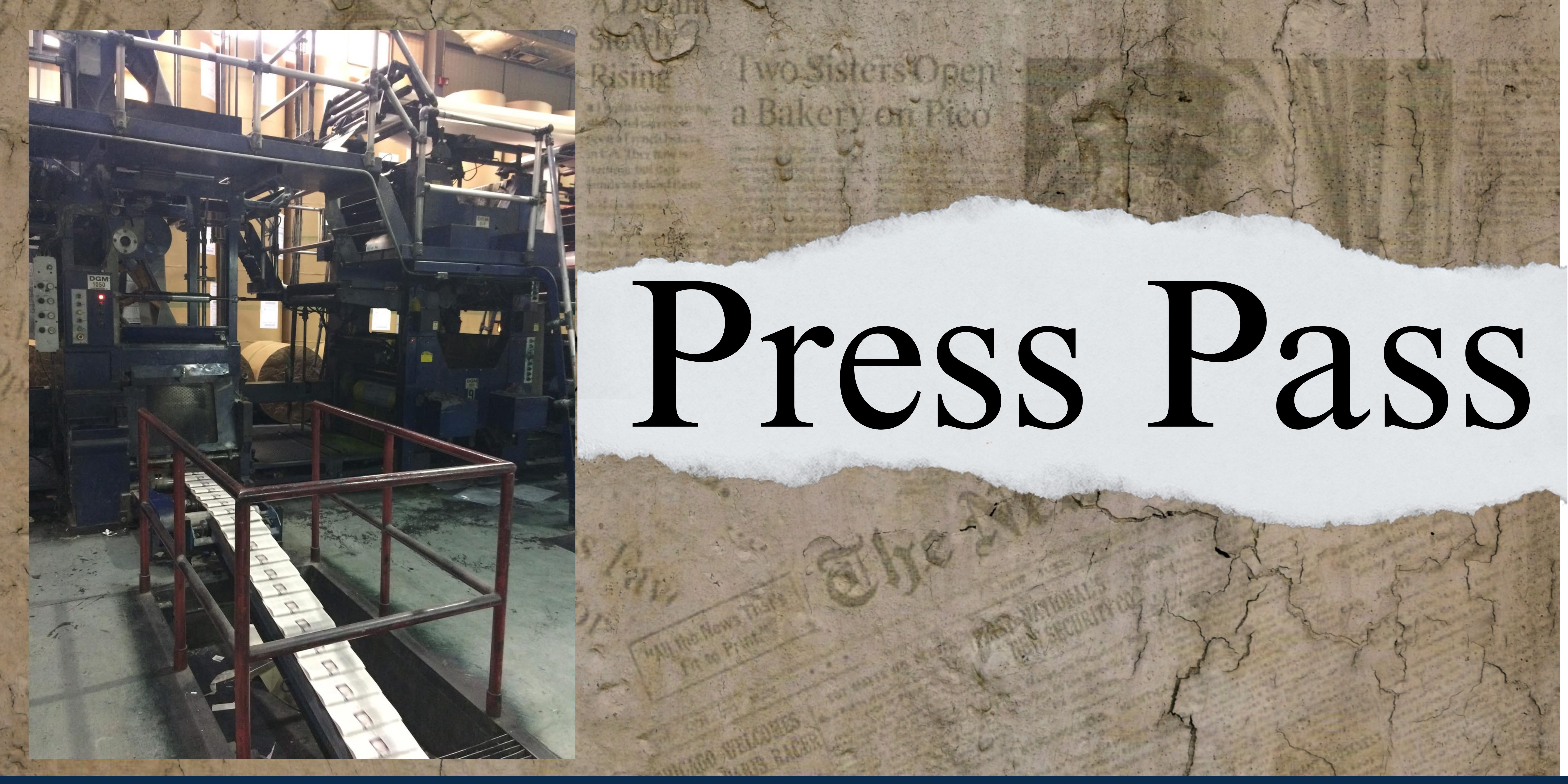
Speaking of printing presses, they are huge machines housed in cavernous spaces. Paper and ink are purchased by the ton. Much of the newsprint comes from Canada rather than domestic production, so paper ain’t as cheap as it used to be when it was produced in the US. Tariffs have made even bulk purchases increasingly expensive.
Fun fact — I’ve spent many hours in these places working with pre-press to coordinate what’s ahead. And like a doctor staying overnight and sleeping on a couch because it was too late to go home, I’ve spent more than a few nights sleeping in a hidden corner of a press room, then splashing down before heading “back into the coal mine” in the ink-stained shower rarely used by the pressmen or perhaps shaving over one of the big sinks that they use to hose down after their shifts end.
The people who work these presses are a dying breed, so newspaper companies are finding it increasingly hard to hire these trademen – who don’t come cheap. Pressman Danny Turner worked for the Athens Messenger for around 40 years – good guy, did a lot of jobs there – RIP.
Training these people takes time, and it’s not like you can take a course at a local community college to learn how to properly operate a multi-million dollar printing press. The work can be hard – the press room is loud, clothes become ink-stained, and if you’re not careful, you can get injured.
And then there’s the stress of printing newspapers on time from across the region – a lot of steps go into that.
Side note – sometimes I’ve seen publishers be unkind to pressmen, even hold them in contempt for working in the bowels of the beast. Publishers like this seldom last very long. When I saw one moron publisher dressing down a pressman who spent his entire life serving that town’s newspaper, I thought – “Leave this poor guy alone – he knows what he’s doing. And if he leaves, we’re all screwed.”
As to editors shouting, “hold the presses!” – I’ve only ever been able to do that once – when a small town police chief resigned in an Appalachian town. The press was nearby, a town over, when making a call and coordinating everything with the publisher and the pressroom was still possible in those days.
Nowadays – even if the mayor shoots a councilman in broad daylight in front of the newspaper office moments before press time, the editor won’t be able to stop the presses because not only would that jeopardize the other newspapers in line to be printed, but it would also cost more money in overtime — a serious no-no that would affect a media executive’s year-end bonus for keeping costs in line with budget figures.
Instead of stopping the presses, the story about the mayor would be posted online, and if it’s behind a paywall, well, it might as well not exist or, worse, is picked up by a news aggregator.
Forget about election coverage the next morning or Friday night football scores being in Saturday’s edition — most papers print long before the last whistle blows.
All that said, cutting printing costs with an eye toward digital without a major investment in editorial staffing is like cutting off arms and legs to lose weight.
Top that off with this: if these media outlets haven’t invested in building and developing an audience for a news product people care about, then your digital strategy won’t matter.
Moreover, by shifting away from print and saying it matters less and less, newspapers are saying ‘screw you’ to current subscribers and advertisers; they should take their business elsewhere, perhaps to digital, which may or may not reach the desired target audience. But what do I know!?
And despite downplaying the print product, don’t you think it is funny how media companies that own community newspapers don’t tell local governments and citizens — who are required to purchase overpriced legal ads — to transition to digital and take their business elsewhere?
Much like coal mining and farming among other industries, newspapers changed after mechanization— that’s not necessarily a good thing, but that’s inevitable.
Having lived in Appalachia or the Coastal Carolina farm belt – I’ve seen how technology has reduced towns to ruins, causing people to move elsewhere to pursue economic opportunity. The days of newspapers as downtown institutions are fading fast.
Newspapers are but another victim of this ongoing trend – a trend that, with the emergence of artificial intelligence, will affect all industries and trades.
Let us know what you think by leaving a comment. Comments are subject to approval.