
Community forum highlights public safety challenges, economic development prospects, school improvements and residents’ concerns
By Nicole Bowman-Layton
WILLIAMSTON — Martin County is spending approximately $75,000 a month to house detainees elsewhere while its regional jail remains closed, even as officials continue working through the regulatory and operational challenges of reopening the former Martin General Hospital.
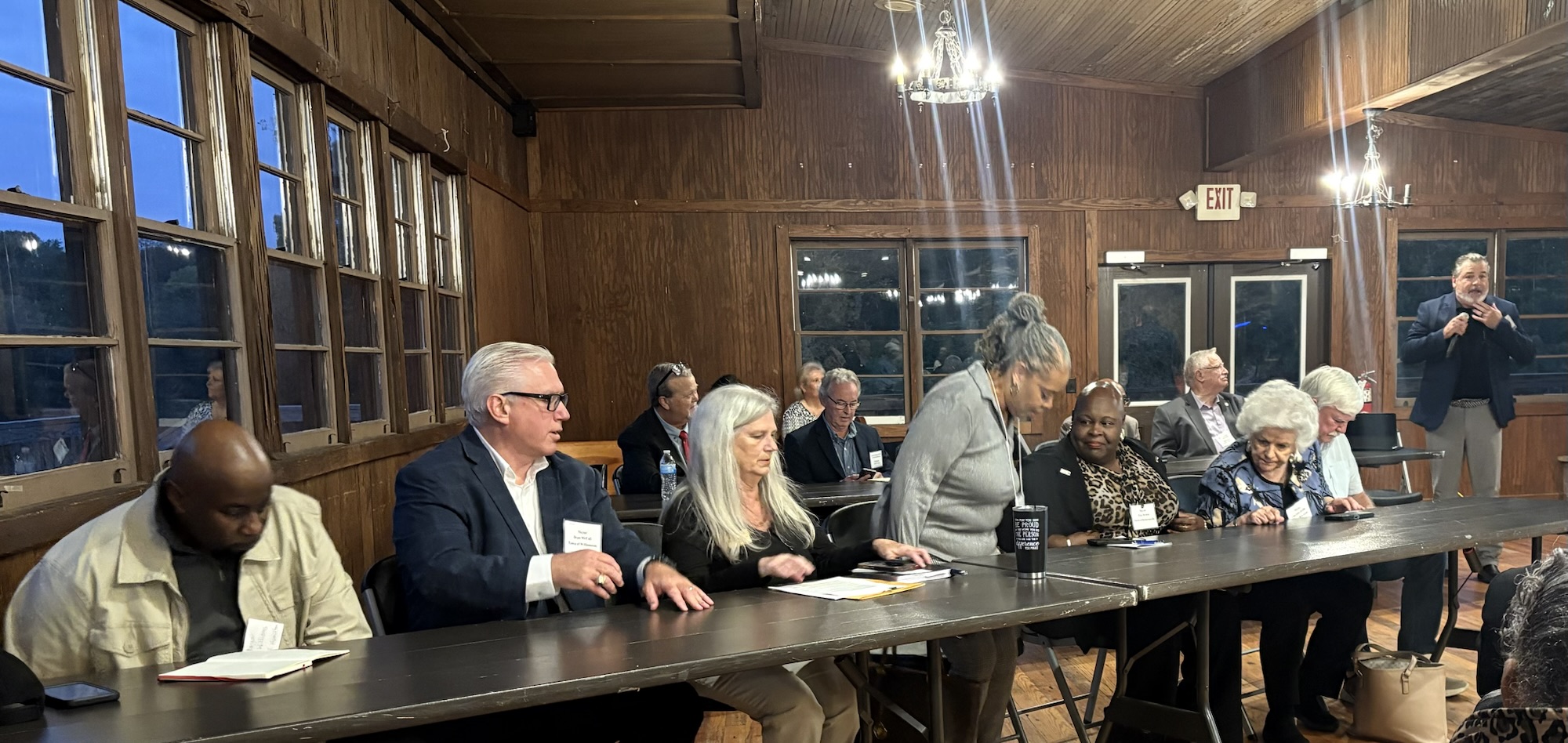
The two issues were among the most pressing concerns discussed during the Oct. 29, 2026, Martin County Community Forum, where commissioners, municipal leaders, school officials and residents gathered to discuss the county’s progress and challenges.
A separate story featuring comments from the town mayors will be published later today.
County Manager Drew Batts said the closure of the Bertie-Martin Regional Jail continues to strain county finances and law enforcement resources. Meanwhile, Commissioner Joe Ayers said efforts to reopen the hospital as a rural emergency hospital are progressing, although officials cannot yet provide a reopening date.

The forum also featured updates on a planned paramedic program, economic development, Interstate 87, changes to federal assistance programs and improvements in Martin County Schools.

Jail closure
The continued closure of the Bertie-Martin Regional Jail has left law enforcement agencies searching for detention space in other counties while Martin County pays approximately $75,000 each month to house detainees elsewhere.

Batts said finding available beds is becoming increasingly difficult because other counties are experiencing similar detention capacity problems.
“Every time we arrest somebody, we’ve got to jump right on it and try to find somewhere to put them,” Batts said.
The county is pursuing several approaches, including repairing part of the existing jail to restore limited intake capacity. The initial goal is to reopen approximately 12 cells where people could be held temporarily while detention arrangements are made.
However, repairs have taken longer than anticipated.
Batts said he recently met with a contractor and was dissatisfied with the projected timeline.
“We have made quite a bit of headway. It’s just a lot of work,” he said.
The county is also exploring another regional jail arrangement that could serve Martin County and neighboring communities.
Meanwhile, Batts is working with court officials to reduce unnecessary detention time for people accused of lower-level offenses and address case backlogs that contribute to longer jail stays.
Those efforts began before the jail closed but have become more urgent because of the costs associated with housing detainees elsewhere.
Hospital reopening
The effort to reopen Martin General Hospital remains another major priority.
Ayers said the county continues working with ECU Health, Criterion Health and state and federal regulators on plans to reopen the facility as a rural emergency hospital.
The hospital’s closure left residents without their former local hospital services, requiring many to travel outside Martin County for hospital-based care.
Ayers said county officials, staff and contractors are communicating regularly with ECU Health as they work through the requirements for reopening.
“It’s going to happen,” Ayers said. “There’s a lot of issues to work through with state, federal agencies before that reopening can occur.”
Legal, regulatory and building-related matters remain under review.
Batts said representatives of the county, ECU Health and Criterion Health were scheduled to meet with the North Carolina Department of Health Service Regulation the following week to better understand the remaining requirements.
“When I tell you it’s going to be a lot of work, it’s going to be a lot of work,” Batts said. “So we’re going to have to have some patience.”
The rural emergency hospital designation would provide a different model of healthcare than the former full-service hospital, focusing on emergency treatment and outpatient services rather than traditional inpatient care.
Officials did not provide a reopening date or final operating plan.
Ayers also discussed the county’s efforts to establish a paramedic program to improve emergency medical response.
The program includes quick-response vehicles, which had been delayed because of purchasing difficulties. Ayers said the official purchase was completed Oct. 18.
Additional equipment, staffing arrangements and contracts are still being developed.
“We don’t have a date for the hospital or the paramedics, but I assure you, it’s coming,” Ayers said.
Economic development and Interstate 87
Batts outlined several prospective economic development projects, including plans for shell buildings at the Martin County Rail and Commerce Park in Everetts.
The county is working with a private developer to construct buildings that could attract new employers and is pursuing grant funding for additional industrial space.
Three projects were identified as potential sources of jobs and investment.
Project Wizard, associated with Robersonville, could create 120 to 150 jobs over three years. Project Piedmont, associated with Williamston, could produce another 120 to 150 jobs over five years.
Project Country View, also associated with Williamston, was described as a potential $40 million investment creating five jobs.
Those figures represent projected outcomes rather than jobs already created or investments completed.
Batts also discussed efforts to encourage housing development for older adults, teachers and young professionals.
Commissioner Dempsey Bond Jr. reflected on the years of advocacy that helped establish Interstate 87 as a planned transportation corridor through eastern North Carolina.
Bond recalled traveling to Washington, D.C., in 2013 to advocate for an interstate route that would better connect northeastern North Carolina with major transportation corridors.
He described meeting with congressional representatives and making the case that the route would benefit communities throughout the region.
Bond also discussed his hopes for additional highway connections, although he did not announce new construction funding or a timetable for completing the interstate.
County improvements
Batts said Martin County has developed a capital improvement plan to guide repairs and maintenance of its aging water system.
The county is also pursuing automated meter-reading technology that would reduce the time employees spend manually collecting usage information, allowing them to focus on maintenance.
A $1 million grant is supporting planning for filtration improvements to address PFAS contamination. Engineering work is underway, with construction planned to begin in 2027.
The county is pursuing another $2.7 million in federal funding for water infrastructure.
Other projects include airport fencing, cybersecurity improvements, emergency preparedness equipment and improvements to county facilities.
At Moratoc Park, officials have applied for Community Development Block Grant funding to help preserve and improve the existing building.
Batts also described changes to county operations, including employee training, policy management, performance evaluations and budgeting.
“We want to use data to drive the budgeting process,” Batts said. “Where do we waste money? Where didn’t we waste money? Where do we need more?”

Medicaid, SNAP
Commissioner Ronnie Smith discussed changes to Medicaid and Supplemental Nutrition Assistance Program benefits, commonly known as food stamps.
Smith expressed particular concern about older residents who may need Medicaid coverage for long-term care after hospitalization.
He urged families to organize financial and eligibility documents before a medical crisis, noting that applications for long-term care Medicaid can involve extensive reviews of income, assets and financial transactions.
Federal changes also affect retroactive Medicaid coverage and introduce additional work or community engagement requirements for certain beneficiaries.
Some SNAP recipients must document at least 80 hours per month of qualifying work or approved activities unless exempt. Expanded SNAP work requirements are already in effect in North Carolina.
New Medicaid work and community engagement requirements are scheduled to begin Jan. 1, 2027, for certain adults, generally involving 80 hours of qualifying activity per month, with exemptions and alternative eligibility provisions.
Those Medicaid requirements primarily affect certain adults covered through Medicaid expansion, not Medicare beneficiaries.
Smith encouraged residents to seek guidance from the Department of Social Services and prepare necessary documentation in advance.

Schools report
Martin County Schools Superintendent Michelle White reported improvements in academic performance, graduation rates and career preparation.
For only the second time in district history, Martin County Schools is no longer designated as low performing by the state.
White said student achievement is at its highest level in a decade, and the district’s graduation rate has surpassed the state average.
Three schools earned B performance grades, with two finishing just one point away from an A.
“We don’t want to just be better than we were post-COVID,” White said. “We want to be the best we’ve ever been in Martin County, and we are getting there in our schools.”
White highlighted the district’s partnership with Martin Community College, which allows students to earn college credits, certificates and degrees while attending high school.
Dual enrollment has increased 257% over the past two years, she said.
The district’s early college program graduated its first class of 23 students last year. Career and technical education programs include welding, culinary arts, health sciences, aviation and cybersecurity.
The district is also moving forward with plans for a new high school supported by approximately $62 million in state funding.
White described universal prekindergarten at no cost to Martin County families as another goal and encouraged residents to volunteer, mentor students and support the district’s Better Together initiative.

Public comment
Residents raised questions about broadband expansion, including why some areas remain without service despite infrastructure work completed years earlier.
Commissioner David “Skip” Gurganus said the county pursued available broadband grants, but the projects were administered primarily through state and federal programs.
He said one contractor initially awarded work in Martin County was unable to complete the project, forcing the state to reassign portions of the service area and contributing to delays.
Batts said county officials spent approximately three months trying to obtain updated broadband coverage maps identifying providers responsible for specific areas.
After contacting the state commerce secretary, he received the maps and invited residents to compare their addresses with the coverage information.
Joanna Rutter, an Oak City resident, suggested making the maps publicly available on the county’s website.
“We’ll get it up there as soon as we can,” Batts said.
Lynn Whitehurst, of the Martin County Soil and Water Conservation District, urged officials to continue seeking funding for drainage and stream maintenance.
He said previous efforts to remove debris and obstructions from waterways helped reduce flooding and improve emergency access, but continued maintenance is necessary.
Rutter also raised concerns about potential data center development.
An intern with the North Carolina Environmental Justice Network, she asked whether county officials were aware of Right Tech LLC, a company she said she had recently heard was approaching Black farmers about a possible artificial intelligence data center project.
Rutter acknowledged that her information was preliminary and encouraged the county to consider regulations governing data centers.
Other residents suggested incorporating living-history educational programs into Moratoc Park improvements, adding a trash receptacle near the Hamilton fishing ramp and expanding opportunities for residents to learn about local government through programs similar to the county’s Citizens Academy.
Cooperation and accountability
Gurganus said the county’s progress has been aided by stronger relationships among commissioners, municipal officials, school leaders and state lawmakers.
He recalled earlier periods when local governments and the school system were less cooperative, making it harder to present a unified case for state assistance.
“We need to come together and be a team,” Gurganus said. “We won’t all have the same project or the same mindset or all believe that we need the same thing. But there’ll be common things among our ideas that we can all get behind.”
He said that cooperation has helped build confidence among state officials considering funding requests.
Gurganus also emphasized transparency and accountability.
“We are human beings. We will stumble. We will make mistakes,” he said. “We’ll have to back up and fix them. We’ll have to say we’re sorry.”
He encouraged residents to speak up when they believe officials have made mistakes while allowing them an opportunity to respond.
“So when we stumble, call us out,” he said. “Give us a chance.”


Let us know what you think by leaving a comment. Comments are subject to approval.