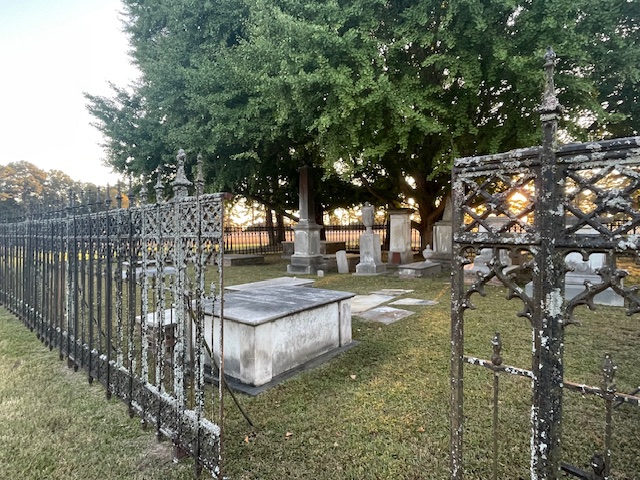
By Samantha Layton
Editor’s NOTE: The author of this ghost story, a cadet at the prestigious Virginia Military Institute, was inspired by Edenton while writing it for one of her classes. We are very proud of Samantha!
Albemarle Observer will be publishing more local ghost stories in the days leading up to Halloween.
Samantha’s story….
In every gift shop there is a postcard of Abbott Manor. The pearly white gates open for all to enter. A brick pathway circles an exotic garden leading to the grand front porch. Vibrant flower petals contrast between the organized white paint and green shutters of the Manor. Two wings encircle the garden, and white columns support the shining copper roof. The main complex is supported by two-story columns that frame an inviting front porch. Wide windows radiate the cozy energy within the Manor’s walls. On top of the Manor is a glass cupola, looking over all of Edenton.
About a century ago, the postcard was correct: before the proud white gate rusted shut, before the plants conquered the garden, before hurricanes claimed shutters and columns, before the north wing collapsed, before the copper roof was coated in a layer of dull green. Before the windows were broken, before the cupola became a bird’s nest, before the ghost of Evalynn Abbott haunted the Manor.
Every Edentonian has their own version of Evalynn’s story. Tourists and ghost hunters know her as the Banshee of Carolina’s Coast. A ghost of a grieving mother who wails the names of her children who never returned from the Civil War. Locals—my mother included—have seen her in her wide-brimmed hat and white gown, silently watching the bay before a major storm. Children would try to scare each other with twisted versions of Evalynn’s story, claiming she murdered her children.
I never believed ghosts were real, but I couldn’t disprove them either. Evalynn was as real as the stories told every October on ghost tours: the 1767 courthouse, Pembroke Hall, or the Cupola House– just stories to keep children up at night, or to play into stereotypes.
I know one thing for certain, is that I, Harper Wood, am connected to the Abbott family, and indirectly Evalynn. I discovered an ancient Bible with the name J. Abbott signed into the front cover while cleaning my late grandparents’ attic. I never knew why or how the book got up there, but it always filled my mind with possibilities. I could be connected to one of the richest families in North Carolina or my ancestors could have conducted a grand heist in this very Manor to steal the Bible. Those questions would all be answered today, a week before renovations start to transform Abbott Manor into the image on the postcard– covering up all the secrets that have been forgotten over the years.
The grand door to the Manor was dark green at one point, now the old paint flakes off the pale door with a gentle breeze. The broken stain glass windows turn the inner floorboards the same color as the door. Courteously, I turn the blue copper doorknob. The lock clicks open, and centuries of dust fill my lungs. Despite the years of neglect, the Manor keeps its elegant charm. A grand staircase divides the men’s and women’s parlor from one another. Two dimly lit hallways disappear into darkness on either side of the foyer. Sunlight outlines rodent footprints on the pale wooden floor.
For a moment, I could imagine Abbott Manor before it was abandoned: the white flowery wall paper, the golden painted railings, the glass chandelier catching sunlight. Evalynn walking gracefully down the stairs to greet guests, or children running through the halls. Moments lost to time, moments no one would witness ever again even with the Manor being restored.
A sound pulls me from my illusion. A slow, methodical scraping noise echoes throughout the empty halls. The gold accents give up the location of the source, a teacup. A rose-patterned teacup slides across a wooden table outside the parlor to the left. Inside the teacup are ancient tea leaves, brewed over a century ago, with additional flavor of dust.
This is so unreal–I feel like I’m in a ghost hunting show. A ghost offering guests a cup of tea is the oldest trick in the book. I am waiting for the cup to fly off the table to tell me I am not welcome here. I pick up the teacup to see if there is anything attached to make it move.
The tea leaves start to mix—as if dancing to a distant memory. Faster, and faster around it turns, changing from brown to black in the sunlight. Two black beady eyes stare draggers into my soul, daring me to justify my presence here. One by one sharp teeth appear.
I fling the teacup out of my hand. Crack, and the porcelain shatters on the floor. A dark mass crawls out of the shards of the teacup. A pink tail and feet form out of the dark mass. Floorboard creaks as the creature retreats to the nearby parlor room, agitating the dust as it scampers away.
I catch my breath. “It’s just a mouse,” I whisper.
“Just a mouse.”
Nothing paranormal about it. No Evalynn extending an invitation. A mouse.
My mind must be playing tricks on me. I’m already on edge because I know the spooky history of this place. My brain expects the supernatural because of the ghost stories I’ve heard about Abbott Manor, so it is more suspectable to supernatural occurrences. But a mouse is just a mouse—nothing otherworldly about that. Besides, mice infestations in an abandoned plantation homes are normal in North Carolina.
“Let it be known that the great Harper Wood is not afraid of a mere mouse,” I boast to an invisible audience.
Silence. Not even a gentle breeze claps in my honor.
I decided to follow the mouse’s dusty trail into the parlor. My grandfather, journalist and part time local historian taught me that every small detail is significant. I wince at the bright sunlight pouring into the room from seemly all directions. The rat trail weaves around an empty table in the center, around the surrounding chairs covered with spider webs, and into a large fireplace. Moldy dark green drapes frame each broken window. Watching over the parlor, is a painting of an older man, and his younger wife.
The sunlight distorts the image in the painting. The man has more winkles than his face should allow, and the pupils in his eyes look unnaturally small. The young woman looks nothing like Evalynn. The woman has small-curly brown snakes forming her hair, a large confident simile with too many teeth, and a nose looking just like mine. Evalynn has long flowing hair, two dark chasms where her eyes used to be, and black tears streaming down her face.
The rusted nail screeches as the painting rotates. The mantel catches the painting, stopping the rotation. The woman and man look like they are in a different-twisted reality. Sunlight reveals a gold painted wooden frame.
“This is normal,” I reassure myself. This is normal. The wind from the nonexistent windows must’ve moved the wire on the back of the painting, causing it to turn. The rusty nail would make it easier to move the wire too. How could a ghost turn a painting anyway?
My instincts tell me otherwise.
“What are you trying to tell me?” I ask the empty Manor.
Silence. The air is still, not even the wind blows.
The silence dares me to do something, to tempt fate. I take the painting off the wall, revealing the preserved bricks underneath. A folded piece of paper falls to the floor. I place the painting down and hold the deteriorating paper up to the sunlight. The yellow paper absorbs sweat from my hands. I feel like my grandfather, uncovering clues of Edenton’s past. The paper leaves a pulpy residue on my hands, but no dust.
Written on the paper is a branch of the Abbott family tree, dated 1882. The root of the tree has the same embellished J and the same meshed together t’s as the Bible in my grandparent’s Attic, spelling the name– J. Abbott. I continue reading, eager to find answers about my family’s heirloom. Two trees stem from J. Abbott’s name, one of the branches is poorly inked out, like someone got caught before completely covering up the names. The paper trembled in my hand as I read the first name of the undamaged tree.
Charolotte Wood.
My last name. The tree explodes after her name, branching in every direction with familiar names. Simple names and dates to represent an entire life on a page. My grandfather told me stories of nearly everyone on this side of the tree. Thomas Wood was a religious lawyer, who would use God in the courtroom. Amelia Wood created the blueberry pie recipe my mother makes every Christmas. The youngest member is my great-grandfather, David Wood, who built the shed that was my fortress as a child.
Charlotte Wood is the oldest story my grandfather told me. She is the one who decided to set down roots in Edenton before the Civil War, transforming the ocean-faring sailor Woods into middle class farmers. Centuries later, my family still has divided opinions about her. The reason she decided to settle down was because of love–her love for a rich but married man, J. Abbott. She ruined an entire marriage, but she got my grandparents’ home and land my family still owns.
Charlotte must have covered up the other branch of the family tree. Aurina Abbott is the only legible part of the family tree, her dates of death, marriage, and birth are blotted out. L, W, A, G are the only legible letters of Aurina’s children. The longer lines underneath the covered-up name reveals that the children died before this family tree was made.
I try to piece together the clues in my mind: J. Abbott, Charlotte Wood, Aurina Abbott, a Bible, and a family tree. Everything leads back to J. Abbott, the wrinkled man in the portrait, with an embellished J concealing his first name. Charlotte, his mistress, won in her mind, she got the big house, a Bible, and her portrait hanged up in the parlor of the Manor. Yet, J. Abbott never married her. Aurina is the biggest mystery. Her entire life is represented by one line; her children erased by Charlotte—names lost to history, but a mother never forgets.
My eyes fill with tears. My grandfather would’ve hated seeing his ancestor covering up history that he loved. If only I could learn more about Aurina, the innocent victim in her husband’s affair.
The wind carries my sadness throughout the halls. A woman’s sobs answer. The crying is soft at first, like someone trying to hide their pain. The crying turns into weeping then a mournful sobbing. “Evalynn,” I whisper.
The sobs echo through the empty halls of the Manor. There is no breath between the sobs, just indistinguishable words. The afternoon clouds roll in to cover up the sun. The wind stops, out of reverence or fear. The overgrown garden retreats into itself– trying to escape the mournful melody. Instead of being scared, I felt sympathetic to Evalynn. I want to find her. I want to comfort her, but the pain is far too deep. “I am sorry,” I said softly. For a moment, the cries are quieter.
Following my grandfather’s advice, I listen to the story in her sobs to trace the origins of them. The Sobbs are loud, and messy, unapologetic. The story of loss and desperation, in every wail. Names fill the breath between sobs– every syllable holding her grief.
L-ogan.
The name of Evalynn’s first son. He gave his life for the Confederate victory at First Manassas. His head never returned home; fragments of his body nourish the battlefield after a cannon claimed it.
W-illiam.
He and his brother Grant stowed away on a cargo ship to join Stonewall’s forces in Virginia. A storm claimed the vessel; the boys never saw the comfort of dry land again.
A-nnarose.
There is no mention of Evalynn ever having a daughter, much less her dying in the Civil War.
G-rant.
Evalynn lost him the same way as William, but her cries felt different for him. I notice guilt and rage in her voice when she cries his name.
No version of Evalynn’s story tell of her life after her children die. The silent grief, and hatred that consumed her from the inside. Evalynn appeared sometime after the Civil War. She materializes before every major storm in her second story bedroom, or by the shoreline– begging for the water to bring her sons home.
The door creaks open to the second story bedroom as I turn the handle. The wailing stops, and silence returns. Clouds block sunlight from entering the dark room. A glass cabinet, glass bottles, a dirty mirror and intact windows reflect the light of my flashlight. Strange shadows are locked inside the glass cabinet. Glass bottles contain foul liquids that trap light. A bird-shaped stain covers the corner of the mirror behind the glass bottles. A shadow in the center of the room looks vaguely like a bed.
The mirror draws me in. Evalynn spends countless hours in front of this mirror, coating her face in makeup to perfect the southern belle look. Or practicing a genuine smile on the day her first son died. She would never want the mirror to be dirty. I try to wipe away the smudge with my fingers, but the smudge remains.
The mirror goes black for a second, looking more like a wall than a mirror. The smell of roses fills my nostrils. I tap the mirror and the image completely changes.
My eyes take a second to adjust to the bright image in the mirror. Sunlight cascades through open windows, reflecting the vibrant hues of the room. Pastel purple bedsheets, snowy-white pillows sit atop a bed that commands the attention of the room. Brightly colored makeup containers change sunrays into pink, red, yellow, green, and purple. Above the elegant bed frame hangs a painting of a beautiful long-haired woman, wearing a large-brimmed hat, and luxurious violet dress with roses embroidered into the silky fabric.
The painting is in the exact same style as the foyer. The realization hit me. Aurina is Evalynn. She lost her husband’s love and her children. No one knows what happened to Aurina after her children died because she was trying to be the woman in this painting—a southern belle. A woman with prefect manners, a bright smile, not tainted by grief, makeup and hair perfectly done. To others, she fit the role perfectly, but to herself, she never lived up to the stereotype. Strands of hair would be out of place, or the sunlight would highlight wrong angles of her.
There is a woman by the window, and I know it’s Aurina. She watches the vibrant world through windows– never able to reveal her true emotions because it would shatter the Southern Belle image. She stands in a corseted white dress with laced sleeves, and a large sunhat in her bony fingers. Makeup covers her natural face, hiding all the imperfections. She looks like a lady, ready for the garden party below. Her body tells a different story, a story of a walking corpse. She hides her bony frame with lace and lipstick. Her eyes have a film over them, as if her soul left with her sons. Her mouth hesitates with the cluster of emotions hidden under the surface.
She floats towards the glass cabinet and starts methodically tapping on the glass. Smudged fingerprints follow her rhythmic tapping.
Tap.
Tap.
Tap.
My brain hears the tapping on the glass, but my ears don’t. Silence fills every part of this room. The only sign of her presence is the pungent smell of roses.
Tap.
Tap.
Tap.
The despair in her eyes matches sobs that echoed in the halls. Yet, she chooses to remain silent, showing her grief through small action of taping on the glass.
Tap.
Tap.
Tap
Inside the glass cabinet is a bayonet, a model ship, a pair of lace gloves, and a broken glass cup. Objects representing lives taken too soon.
Tap.
Tap.
Tap.
Her tapping finger starts bleeding, dots on the glass. Her grief fuels every strike.
Tap.
Tap.
TAP.
She is trying to communicate with anyone. This is her grief. Her pain a consistent….
TAP.
TAP.
TAP.
The woman’s face contorts into a fake smile. A perfect image for the world to see, not the woman underneath. Her bony face won’t allow the smile. Her cheek bones separate the flesh from her jaw. Her lips bleeding crimson red on her yellow teeth. Blood stains her dress.
TAP.
TAP.
TAP.
The glass shatters from the tapping. Evalynn’s grief vanishes and shock takes its place. Aurina never knew she could break the glass between her family and herself. The Southern Belle image consumed her identity that she emotionally isolated herself from the only people that could help her, her family. History could have been different if she spoke up against Charlotte, or begging Logan not to leave for the War. She wouldn’t have deteriorated into a husk of herself if she had the support of her family. Instead, she seeks peace through me, a traveler who dared to listen centuries later.
The mirror returns to reflecting the present state of the Manor. Mold has turned the bright purple sheets into the color of the fallen leaves outside. There is a faded outline of where the painting used to be. Cracked glass distorts the four objects inside the glass case. The woman is gone, and only the afternoon breeze remains.
Silence.
Evalynn’s cries were only heard in silence. She never let anyone see her tears because it wasn’t in character. She was the perfect wife, the person in the painting above her bed. The wife who didn’t complain when her husband was having an affair or violently break down when all her children died.
Someone who was so perfect that no one dared to question her facade. Similar to the planation house, which looked so grand and luxurious in its prime, no one expected it to decay into the husk it is now.
Someone who shouldn’t have become a ghost.
Someone who communicated her emotions through small actions, but they went unnoticed and unheard.
Someone whose story deserves to be told.
And I am ready to listen.
“Tell me your story,” I request.
I open my eyes and ears to the silence of the Manor.
My flashlight turns off. A cheerful violin melody snakes its way through the windows. The sun appears through a gap in the clouds. I could smell the pastries and the exotic tea from the garden party below. Lively conversations passed between faces lost to time, each word sound foreign in my ears.
A white orb of light appears by the window.
First, a white gown appears, then a matching hat. Then a face, hallow from the inside.
A face that haunted my childhood dreams.
The face of Evalynn.
Black lines follow the path of her tears. Tears that trace a skull whose flesh clings to the exposed bone. Her eyes and mouth are gone, rotten away with time, revealing the empty hole underneath. I could see her brain. The same brain that sits inside every human, with complex thoughts and feelings. The brain who consciously changed her name to Evalynn to fit into the prison society created for her.
She examines the invisible garden party below.
Silence rests between us– Neither of us dare to break it.
I try to imagine her life before her husband cheated on her and her children died. She must’ve been a true Belle of southern society. Her hair, dress, and face are carefully planned for every occasion. It must have been lonely and filled with silence.
As time passes, more flesh appears on Evalynn’s face.
Her cheeks fill in and I could see the cake of makeup on her face.
Muscle and skin cover her bones.
Hollow Green eyes appear in her sockets.
The pungent smell of roses nearly masks the putrid smell of alcohol in the room.
For a second, Aurina is nearly human.
Her face is expressionless as she looks at me, then to the invisible garden party below.
“A sad bird still sings,” she whispers. Her quiet voice is louder than the festive music below.
I could see a genuine smile on her face, like a big burden was lifted off her shoulders.
I heard the glass shatter before I saw her jump. For a split second, she was as light as a bird, free of gravity and the pressures of society. Then gravity set in, breaking all the bones in her body. Though I never heard the sound. The joyful violin kept play long after she fell, as if her death didn’t change the status quo.
My legs give out. For a second, I could understand how Aurina felt as she flew. The adrenaline rushes to my skull. The ground closing in but looking so far away. The surreal feeling was gone when I hit the wooden floorboards. My eyes open to a dirty mouse with black bulging eyes staring at me.
The Manor returns to a familiar stillness. Different colors of the sunset stream into the dusty Manor. Spiders carefully weave their webs over the tarnished furniture. Mice scamper throughout the dimly lit halls. The air tastes and smells like dust and mildew, normal for an abandoned building. The silence was different than before, I could hear the sound of birds chirping outside and the waves from the bay.
Slowly, I rise to my feet and slowly walk out of Abbott Manor. A week from now construction will start to restore the Manor and turn it into a museum of the antebellum south, one of many in the southern landscape. Covering up and glorifying the Manor’s past.
The cracked white wallpaper will be replaced. The vines will be removed. In its place will be bandages of paint, and wood–replaced by trees younger than the Manor.
The Manor will look like people expect it too, just like the postcard in gift shops: the white gate isolating the Manor from Edenton, the brick pathway encircling a tame garden, its flowers matching the bony white of the house, two wings ensure visitors can’t escape the Manor, the bright copper roof will be replaced by a cheaper shingles, the hollow and emotionless interior is framed by windows, and the cupola shines its warning to Edenton Bay. No trace of Evalynn, or charlotte, or J. Abbott, or any of the souls that pass through this hall.
When the renovations are complete, the pearly gates will open, the public waiting to hear the fabricated ghost story of Evalynn, ignoring the true story of Aurnia. The woman who lost herself because of a persona she never wanted.
If people knew the truth, they wouldn’t believe it. They wouldn’t believe Aurnia jumped from her bedroom–not out of grief, but because of words unspoken. Unspoken words heard through all eternity by the wails mourning her children, and the faint smell of roses.
Let us know what you think by leaving a comment. Comments are subject to approval.