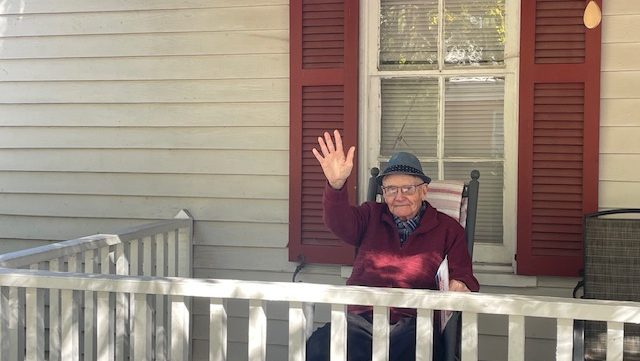
Edd Lee Owens, 80, was born in a front room on Elliott Street and has never left the Cotton Mill District. He still has plenty to say about it.
By Miles Layton
EDENTON – Thursday morning, I walked over to Edd Lee Owens’ house in the Cotton Mill District to talk; pulled up a rocker on his front porch, where you can see the mill and its office.
Owens, 80, has a sharp mind; he remembers Bible verses as well as any pastor. Knows the history of Edenton Cotton Mill and the neighborhood where he grew up. I learned a lot from Edd, not just about local history but also about life and faith. Listening to Owens, I sensed God’s presence as Edd shared his wisdom with me.
I liked this quote best — “Education and salvation, to me, are the two most important things,” Owens says. “You educate your mind, you educate your heart. If your heart’s right, you’re gonna be all right.”
Owens nods toward the room just inside his front door, the one he can see from his porch rocker.
“I was born in this room here,” he says. “Nineteen forty-five.”
Owens, who turns 81 on Nov. 19, is the last person born, raised, worked and retired from the mill who still lives in the Cotton Mill Village. A gallery of photos of the Cotton Mill Village appears at the end of the story.
Ask him about it, and he will tell you he is only the last in the village, not the last anywhere. A few others are scattered around, he says, “one in Florida and two or three around.” But on Elliott Street, in the same house where his mother delivered him, he is the one left to tell it.
And he tells it well.
In 1945, he explains, most babies in Edenton were born at home. The old military hospital was a wartime facility, and the hospital that later served the town was not built until 1952. “Most of the babies were born in house at that time,” he says. His own father, a World War I veteran and a supervisor at the Edenton Cotton Mill, had moved the family back to the village the year before.
His sister, Legion Britton, was born in 1935 and later worked for the Soil Conservation Service. Owens is quick to say how she got that name. “My dad was in the American Legion,” he says. His own name has a story, too. He was named for an uncle, Ed, but his mother added the second D. She lived to be 90, and he never asked her why.
“That’s something else about getting old,” Owens says. “Some one day you’re sitting out here, and something will come to you. You think about something in your life. Wonder why I had two Ds, and to this day I don’t know why.”
‘Not utopia, but it was good’
Owens does not paint the village as a paradise, and he is careful about that. Growing up there, he says, “was fun. It was all right. It’s like anywhere else. It was not utopia, but it was good.”
What held the place together, he says, was church and each other. “Big thing growing up over here was going to church. Majority of the people over here went to church.” There was also baseball. The mill fielded a team, the Spinners, a generation before Owens was old enough to play. On weekends, before most families had cars to carry them off to the city, crowds gathered at the field beside the mill. “They had to rope these streets off,” he says. “People would come see the Spinners play ball right here on the field.”
He played ball himself, just not for the Spinners. As a boy, the games started about nine-thirty or ten in the morning and picked up again in the afternoon, “unless it was hot.” Everybody had a bat and ball. He still has the first baseball bat his mother bought him.
The village in those days was a place of hard-won comforts. When Owens was born, the alleys between the houses held outhouses. He remembers when lumber arrived to build the first indoor bathrooms. He remembers the first television on the street, a 12-inch Westinghouse, and the way the whole village seemed to watch in the dark. “If you go by the house at night, you could see the reflection of the TV,” he says. “I’ve never understood why people looked at TV in the dark.”
Television, he believes, changed Edenton more than people realized. Stores on Main Street once stayed open until eight o’clock on Saturday night. Then people stayed home, or went to the movies, and the shops began closing early.
The village also took care of its own. When a neighbor was out of work for a couple of weeks, someone from the church would go around and “take up a poundin’,” gathering food and money for the family. “You had to do it,” Owens says. “We were a family, to an extent.”
A dollar an hour
Owens went to work at the mill the summer he turned 16, in 1961, along with the other mill village boys who landed summer jobs. He counts himself lucky. The summers before, the boys had painted roofs, and he does not like heights. His summer, they painted porches.
The pay was a dollar an hour. By his memory, a loaf of bread at the A&P that once stood in town cost fifty cents. “So you could buy two loaves of bread for a dollar,” he says. “That was good money for the times.”
The best benefit, he says with a grin, did not show up on a paycheck. “You didn’t have to worry about gas. You just walk.”
After graduating from Edenton High School in 1964, Owens earned a bachelor’s degree in history from East Carolina University. He never taught, though his son, Perry, would go on to be a great coach and teacher for the Aces.
Edd went to work at the mill in 1971. “I liked it over here (at the village),” he says. “It was in my blood, I guess you would say.” When the mill changed hands around 1990, he moved to the lab and stayed until the doors closed in November 1995.
The mill once employed between 300 and 400 people, he says. New machines that did the work of two or three cut that number sharply. “Everything went push button.”
Working conditions, he says, were hard until the mid-1960s, when the mill installed air conditioning. Before that, temperatures on the floor could reach 100 to 120 degrees on a hot day, and men climbed upstairs to open skylights, then raced back up to close them when storms blew in. “That was a lifesaver,” he says. “Like running water and electric lights. That’s some things you people cannot live without today.”
The dust left its mark. Owens has some breathing trouble, a mild case of byssinosis from cotton dust, and he has never smoked. He passes along a warning to anyone who will listen: “Stay away from smoke. That, to me, is death.”
He also remembers the sound of the place. On summer nights, with the windows open, he could hear the men working the night shift.
“You could hear the men talking at night in the summertime,” he says. “Somebody would say something funny, and they’d all laugh.”
Friday was payday. Second- and third-shift workers gathered in front of the mill at ten o’clock for their checks, with his father supervising. As a small boy, Owens would stand and listen. “Everybody talking, and nobody listening,” he says, laughing.
When the mill closed in 1995, Owens landed on his feet. He worked in an office, then for the Joe Lee Company, where he became Edenton’s first FedEx agent. “I enjoyed it,” he says. “Mr. Lee and his family were good people.”
What the village taught him
What Owens misses most is not the mill. It is the people who filled the streets around it.
“People, people, that’s the bottom line,” he says. “These were good, hard-working people. They come over here to a better life, a new way of life.” Many came from sawmills and farms in East Lake, Alligator and Buffalo City, and had to learn to work around machinery. His own grandfather worked in a sawmill and ran a boarding house. The village gave them yards big enough for gardens, and some of the men kept boathouses along the water.
Those neighbors are mostly gone now, moved away or passed on. “You get used to seeing people every day. You give an attachment to them,” he says. “Even if you don’t do nothing but say hello. That’s the main thing. Being able to say hello.”
These days, he says, he speaks to people on the street and gets blank looks. “I feel like a stranger uptown. It’s a generational change. That’s the way it is.”
Owens does not let that sour him. He has watched jobs leave and stores close, and he has come to see it as a pattern.
“Time changes, people change, places change, events change, ideas change, things change,” he says. “Everything runs, I think, in cycles.”
Asked what he would tell young people about work changing again with new technology, he offers a measured answer: progress helps, but “some people is going to be hurt in the process.”
The advice he leans on most comes from his faith.
“Education and salvation, to me, is the two most important things,” Owens says. “You educate your mind, you educate your heart. If your heart’s right, you’re gonna be all right.”
Owens quotes Scripture about words, how out of the abundance of the heart the mouth speaks. “Life or death is in the power of your tongue, and everybody starting with me has said things they regret. But we’re human beings; we’re not spiritual divine.”
He grew up in First Christian Church and sang in the choir. His uncle, the Rev. E.C. Alexander, preached there from 1947, when Owens was 2, until his death at 103 in 2012. “He was a good Christian man, strong-willed,” Owens says. “I guess that’s the thing I admire most about him.”
Life, he says, is a roller coaster. “Pray without ceasing,” he says. “Expect the unexpected. God gave no man a crystal ball. That’s where faith comes in. That’s why you pray. You might not like the answer you get sometimes. But at least you can pray about it and talk to God about it. God will give you not always what you want. Sometimes He will, but sometimes God will give you what you need.”
He believes in listening, too. He once heard a saying on television that stayed with him: Every man is my superior in that I may learn from him. “You have to listen to people,” he says, “because somebody today may tell you something ten years from today may save your life.” He is not shy about admitting what he does not know. “I’ll tell you in a heartbeat, I don’t know. That’s why I ask.”
And he gives gentle advice on getting along. “You got to find the middle ground. You go along to get along. Some things you can’t let bother you.”
Porch time
Owens married Carol in 1983. They have been married 43 years, and he credits “give and take” and a good Christian wife as the secret to a strong marriage. He is also quick to admit his faults. “I’m a pain in the butt because sometimes I talk too much. That’s my biggest weakness, and I like to repeat myself.”
A 17-year-old toy poodle mix named Sugar keeps watch nearby. Carol, 75, does the driving. “My wife drives,” he says. On that note, they are about to buy a new car.
The village, in a way, still stands around him. The former mill office, once home to a museum, is closed temporarily. The district is a protected historic area, which Owens welcomes.
There is a plan for the future, too. If he lives to be 85, he intends to get permission to hold a hamburger and hot dog cookout on the old ball field and invite the whole neighborhood, “even though they may not know me.”
He knows that when the old ones go, the stories go with them. A former co-worker once told him he ought to write a book, and Owens answered that nobody would buy it. “Anybody who would buy it is either moved or dead,” he says. Still, he says, he is proud of where he was raised.
“I’m happy to have been raised on the Cotton Mill Village. Good people, good place to work. Utopian, no. But family atmosphere, yes. From the office right on down to the bottom, everybody got along.”
At Christmas, he recalls, the mill threw parties for each shift in the canteen, with collard greens and old-time food. “I miss that too,” he says.
Asked for a favorite hymn, Owens does not hesitate. It is “Precious Memories,” and he sings the line softly, right there on the porch where he has watched the village change.
“Precious memories, how they linger,” he sings. “How they linger in my soul.”
Then he looks up Elliott Street, past the ball field and the old mill, and smiles.
“All good memories,” Owens says. “Precious.”
Gallery — click to enlarge


Let us know what you think by leaving a comment. Comments are subject to approval.