By Miles Layton
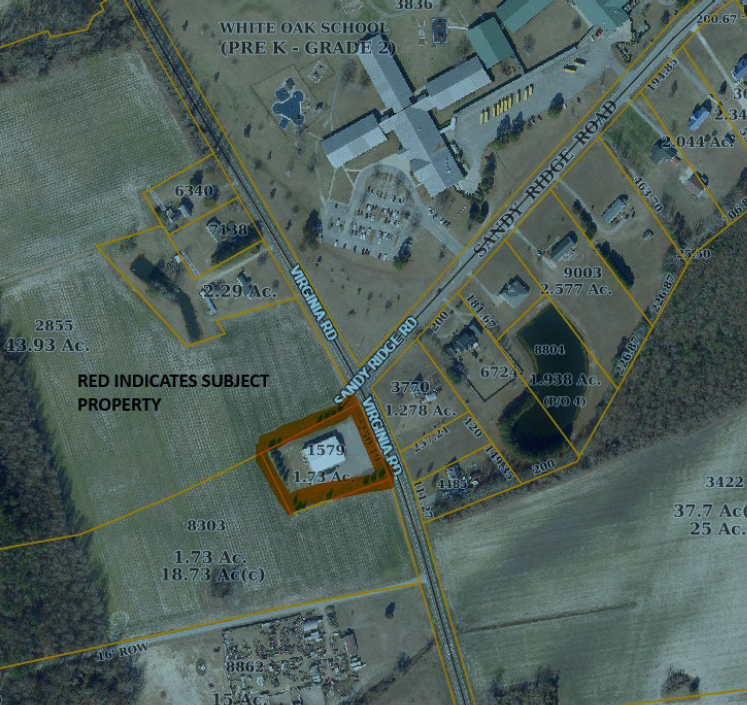
Chowan County commissioners on Monday tabled a decision on whether to rezone the shuttered Family Dollar on Virginia Road for general business use. The case could determine how far commercial development extends along a rural corridor opposite two elementary schools.
The board voted 4-2 to table the request from Deals Edenton LLC to move the 1.73-acre property at 1823 Virginia Road from A-1 agricultural to B-1 general business. Commissioners then voted to have staff meet with the owner and the owner’s real estate agent and to bring back options at the next meeting.
Commissioners Chris Evans, Ellis Lawrence, Tony Shaffer and Larry McLaughlin voted to table the matter, while Commissioners Bob Kirby and Tray Taylor voted against tabling the issue.
I like this quote from Commission Chairman Bob Kirby, who noted the Planning Board had already studied the issue and recommended no zoning changes.
“We got a planning board for a reason, guys,” he said.
Why does this matter? Because you don’t want some business that combines a pig farm with a strip club called Porky’s – an exaggeration – to set up shop at the corner across from White Oak/DF Walker schools.
Superintendent Tammi Ward was the only member of the public outside the applicant’s team to speak. Though Ward took no position on the rezoning, she offered some sound wisdom on the matter.
“For the safety of the school, the community and that surrounding property, I just ask, as the superintendent, that we are very careful,” Ward said. She added that “we never know what’s going to happen in the future.”
On that note, I think it’s safe to say commissioners have to balance present and future land-use zoning with community needs, while tempering them with business concerns. Yes, there was a successful Family Dollar at that location for many years, but it closed when the company shut down at least 350 stores nationwide last year.
That Family Dollar was allowed through a special use permit that most likely died when the store closed its doors.
By changing the zoning to allow more business uses, the property becomes more attractive to would-be buyers or business interests. As it stands now, any would-be developer will have to jump through a bunch of hoops for the permits needed to open certain businesses, such as a Dollar whatever store. Better call Saul because let it be said that government red tape usually adds to the cost of doing business, but sometimes that is a good thing because no one wants a fireworks dealership next to Joe Dirt’s flamethrower farm. I wonder how Los Pollos Hermanos’ chicken farm was zoned in Breaking Bad? Maybe a special permit for dual use…
Not all potential A-1 businesses are subject to zoning restrictions, but here we are.
Whether that location features a future Porky’s or a Dachshund Dan’s puppy-and-vape super store, or something more suitable and realistic for that premier property, the zoning request matters beyond a single empty building. B-1 allows far more uses than A-1, and approving it could invite similar requests from neighboring landowners.
Planning Director Robert Daniel said the only B-1 land in the county is near the airport and parts of the Sandy Point property. The Planning Board has already recommended against the change, 3-1.
Daniel told commissioners the county’s land use plan designates the area as agricultural residential and B-1 does not fit that vision. He also raised the risk of “spot zoning,” in which a small parcel is treated differently from everything around it. It isn’t illegal, he said, but the board must justify it with solid public-policy reasons.
“I empathize with the applicants” trying to find a tenant or buyer, Daniel said, but he recommended against the rezoning. His staff report did list arguments for it: the commercial building already exists, the site sits at the intersection of two major roads, and a planned “rural center” lies less than a mile south.
Owner’s side: ‘What farm field?’
Thomas Wood, an attorney representing the owner, called the hearing another attempt — “a second bit at the apple” — after the Planning Board and disputed the spot-zoning label.
“We’re not looking at a farm field,” Wood said. He pointed to the 8,000-square-foot building, approved under a special use permit in 2014, and to the turn lane in front of it. “What farm field?” he asked.
The store operated for about a decade, Wood said, and the current owner bought it in 2016 for nearly $1.2 million. Family Dollar closed it last fall. He said the property is assessed at $830,000 and has generated more than $65,000 in taxes. He warned of a derelict building across from a school if it can’t be marketed.
Wood said the owner would accept conditions. “I don’t want noxious use there at the school,” he said, noting his own children attended there. He argued the lot is too small for many of B-1’s less desirable uses, such as a truck stop or crematorium.
Alex Rich of the Rich Company, the listing agent, said the asking price has dropped from $795,000 about a year and a half ago to $449,000 after roughly four cuts. Family Dollar had paid $88,000 a year in rent, he said. The owner, Rich said, “wants to find somebody that improves the property value, not deters from it.”
Under current rules, he said, only about ten uses can win approval by special use permit in A-1. Anything else requires a text amendment or rezoning, which can cost thousands of dollars and take months, and few buyers will wait. He said he has sent hundreds of letters to businesses that would be allowed under A-1, including churches, HVAC contractors and landscapers, without success.
County Attorney Lauren Arizaga-Womble clarified that many commercial uses are already allowed by right in A-1, including barbershops, veterinary clinics, garden centers and laundromats. In her legal opinion, she said, the Family Dollar’s special use permit has expired because the building has sat vacant for a year.
Several commissioners asked whether the board could approve B-1 while barring uses it finds objectionable. Arizaga-Womble said it could not. A general rezoning allows everything permitted in B-1, she said, and a conditional rezoning must be tied to a specific project. The board could instead direct staff to draft a text amendment, which would have to go through the Planning Board, or create a new in-between district.
Commissioners press for answers
Commissioner Chris Evans asked whether the turn lane was built for the store or for the schools. Told it was likely for the schools, he asked what limits would apply under B-1. He also noted that a vape shop could open there under current zoning. The attorney said tobacco stores are allowed by right in B-1 but need a special permit in A-1.
Chairman Bob Kirby asked whether anything about the property had changed since the owner bought it. He said he wished an actual buyer stood before the board saying “I want to buy this building” rather than debating hypotheticals. Rich answered that the building no longer produces rent. Kirby replied that the hardship was not created by the county.
Commissioner Larry McLaughlin said a busy intersection at school drop-off and dismissal times “raises a lot of questions.” He added that special use permits and conditions are granted “all the time,” so a legitimate buyer with a legitimate plan would have a path. He could not read the use table projected on the screen and asked for a printed copy.
County Manager Kevin Howard said he favored conditional rezoning but worried “there’s too many things in B-1” that would be allowed. He noted the table lists bars and nightclubs, though state rules limit them near schools.
I guess that means there’ll be no Porky’s.
Commissioner Tony Shaffer, who had asked early on how a rezoning would differ from the special use permit the store once held, spent much of the night looking for a compromise.
“The point we’re trying to do is protect the community and the interest of the school,” Shaffer said. He described the board as “faced with two extremes” and suggested a designation between A-1 and B-1 that would give commissioners authority to restrict certain activities while still allowing reasonable retail. “People will recognize a retail business within certain parameters, within a certain scope, would be good for this location,” he said.
County Attorney said a narrower text amendment moving a few low-impact uses, such as law offices or real estate brokerages, into both districts would move faster than creating a new zoning district, which she said “would take a lot of time and probably wouldn’t be very helpful to the applicant.” She added that the owner could seek conditional rezoning at any time once a specific buyer or tenant emerges.
After closing the public hearing, the board voted 4-2 on McLaughlin’s motion to table the case until members could review the use table on paper. A second motion, which passed, directs staff to meet with the owner and Rich, review the table and report back to commissioners. Staff could later be told to pursue a text amendment.
Leave on this quote — Kirby noted the Planning Board had already studied the issue. “We got a planning board for a reason, guys,” he said.
Let us know what you think by leaving a comment. Comments are subject to approval.