
By Miles Layton
Editor’s NOTE: I’ve wanted to interview Crystal Davis since she made history last November by being elected Plymouth’s first Black female mayor. But more than that, I’m hoping that if people learn more about her — who she is and what she hopes to accomplish — it might go a long way toward improving the tone of discussion on important issues affecting Plymouth. And what an amazing story Davis has to tell – homeless, threatened, a revolutionary with a soft heart but a no-nonsense style, too.
I’ll concede that I don’t always see eye to eye with Mayor Davis, but as I learned more about her through this interview, I discovered that we have a lot in common, same as most folks who care about Plymouth who know that change is needed. A hardworking leader, Davis seeks change by “walking the ward” and uplifting people — all people, no matter where they live — by being their advocate on council.
“Not Too Proud to Do the Small Stuff” — Inside Mayor Crystal Davis’s First Year Leading Plymouth

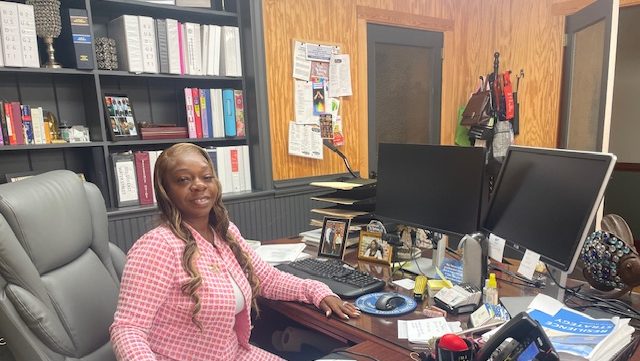
Monday afternoons at Plymouth Town Hall have a rhythm to them now. A few hours before the council gavels in, Mayor Crystal Davis pulls the agenda apart line by line at her desk, with Council Pro Tem Donsenia Teel and Councilwoman Kim Williams leaning in beside her. Nobody’s rushing. They’ve done this enough times to know the meeting won’t go well if they haven’t.
It’s less than a year into the job, and Davis is already the first Black woman to serve as Plymouth’s mayor. Ask her about it, though, and she’ll wave it off before you finish the sentence.

“I don’t feel like the mayor,” she said. “I’m everyday people. I don’t have the big house on the hill. I don’t have the fancy car.”
Everyday people don’t usually run a town the way Davis says she runs one — nights at the office past midnight, phone calls at two in the morning to her council members because she’s “got a policy idea,” a habit of driving straight to a shooting scene before the sun’s even up. But talk to her long enough, and it’s clear she doesn’t see much difference between the two.
What she doesn’t lead with, and what most people in Plymouth never knew until recently, is how she got here at all — a run through homelessness, divorce, death threats and grief that would have knocked plenty of people out of the race entirely. Davis says none of it was optional. It’s just what shaped her into someone who couldn’t stay out of the fight.
Frankfurt to Plymouth
Davis wasn’t born here — she was born on an Army base in Frankfurt, Germany, where her father, William Davis, was a sergeant major, and her mother, Miriam, ran a daycare out of the base before that. Fifth of seven kids. The family bounced from post to post, landing in Rapid City, South Dakota, before Davis’s parents finally brought everyone back to the place they’d started from.
“They were fifteen when they got married, and seventeen back then, and then they moved,” Davis said of her parents, both born and raised in Plymouth. “We would come here two weeks of the summer to visit our grandparents. Even when I lived in Germany, we would come here two weeks of the summer.”
Both her parents are gone now. So is her sister, Nicole, a schoolteacher — she died the same night Davis won her council seat in 2023. Davis went to her first council meeting a couple hours after getting the news.
What most people in town didn’t know, she said, was what else was happening around that same time. She was going through a divorce. And she didn’t have anywhere to live.
“Imagine being on your own since eighteen, and here you go, forty, going through a divorce, and you’re like, where am I gonna go,” Davis said. She slept on friends’ couches for a while before landing on her daughter Deja’s sofa. “How’d I do it all? I don’t know. I’m telling you — my faith.”
How She Got Here
Davis didn’t set out to run for anything. She says the whole thing started with the Pine Forest apartments, where roughly 30 families — older residents, single mothers — were about to be evicted so the complex could supposedly be renovated. Davis, who wasn’t on the council yet, started reading the town’s code and figured there was a way to stop it.
“I asked them to help them,” she said of the council members she pleaded with at the time. “You’re not going to make thirty people, thirty families, homeless.”
The council wasn’t eager to get involved, Davis said — most members seemed content to let the matter play out on its own. She helped file a civil case anyway, and the tenants won. Somewhere in there, she decided she’d run for the seat herself.
Since taking office, Davis and her allies on the council have spent a lot of late nights combing through paperwork nobody had looked at in years — leases that were never signed for town-owned buildings some tenants had occupied rent-free for a quarter century, ordinances untouched since the 1990s, a food truck rule so outdated it effectively banned food trucks.
“Plymouth has gone so long with nothing for most of the people in Plymouth, and that is really disgusting,” Teel said of the backlog they inherited. It hasn’t made Davis popular with everyone. She and Teel were once advised by police to wear bulletproof vests to a council meeting after threats surfaced on Facebook. Neither of them backed down.
“We wish we would,” Davis said, meaning she wasn’t about to let the threats scare her off. “You touch me, I’m gonna touch you back. We weren’t gonna be bullied.”
Teel doesn’t hesitate when asked what she makes of working alongside her.
“Her passion and her compassion — I think she is an awesome, awesome mayor, because she loves the people and wants to see Plymouth grow,” Teel said. “She wants to see us work together in unity to help Plymouth grow, and she wants something for the children, something for the elderly, and something for everybody in between.”
Pushed on whether Davis favors working people over everyone else, Teel didn’t take the easy way out.
“She is definitely a champion for the underclass, the working class,” Teel said. “Even the elite — she doesn’t mind helping them when they’re in need as well. She doesn’t have a set favorite group. She’s for everybody, and we appreciate that. We haven’t always had that.”
Williams, who’s known Davis since before she ever ran for anything, says the mayor’s reputation has softened as more people actually meet her instead of just reading about her online.
“I think the reason is also because more people now are meeting her, so now more people are beginning to know what she stands for,” Williams said. “They now are not just going by what they’re hearing, because they’re being more personable with her.” Williams laughed, adding that she’s also managed to talk the mayor down a notch or two along the way. “I kind of got her to calm down a little bit. You don’t have to be defensive when you’re right — it stands by itself.”
Williams added, “She’s very intelligent, and she knows all the ordinances. I’ve got to look them up. She knows them in her head. With all that intelligence, she doesn’t have to fight anybody — she’s already won.”
Not Too Proud to Do the Small Stuff
Davis says the part of the job nobody sees is the least glamorous — and the part she cares about most. She and her council members don’t just show up for shootings and evictions; they’ll walk a struggling neighborhood block by block, checking on people who are barely hanging on.
“We walked West Avenue recently with code enforcement, because we’re looking at these dilapidated neighborhoods,” Davis said. “People really are poor here. Raise your hand if you almost had your water cut off, too.”
Davis and I raised our hands — sometimes being poor gives you a different outlook on life, certainly makes you stronger as a person.
Davis says she tells council members plainly to walk their own wards and see it for themselves.
That instinct — to do the unglamorous work personally rather than delegate it — is something Williams says she’s watched up close. She recalled a resident whose water had been shut off, panicked and reaching out for help.
“She was like, ‘Could you please just take my bills and just look them over?’” Williams said. “I told her, I will go with Nadine Moore (Utility Billing Supervisor) tomorrow, and I will sit with her, and we’ll go over it. I can’t promise you’re in the right, because all we can do is go over it — but I will find out what’s wrong, whether it’s you or it’s them.” It’s the kind of case, Williams says, that never makes the news but is exactly what Davis pushes her council to prioritize.
Davis puts it more bluntly herself: sometimes she and others may spend their day stuffing tax bills and water notices into envelopes by hand, not because it’s required of them, but because somebody has to make sure working families aren’t blindsided by a bill they can’t pay. “We don’t just do the small stuff,” she said. “Those ladies out there work their butts off, and we’re not too good to go out there and help them.”
The Gentrification Fight
Ask Davis what worries her most about Plymouth’s future, and gentrification comes up fast. She’s watched it happen in Edenton and Elizabeth City, towns not far down the road that have priced out longtime residents in the space of a decade or two, and she’s determined it won’t happen here.
“We’re not allowing that,” she said. “We will fight tooth and nail, whether I’m mayor or not.”
Part of the problem, in her telling, sits with property owners downtown who she says have kept buildings sitting empty rather than rent them out — some, she alleges, going back decades to a time when certain landlords refused to rent to Black tenants at all. It’s a claim Davis has made publicly before, tied to specific buildings on Water Street she says are privately held and largely vacant.
Williams noted, “Why can’t everybody just live together, whether you’re rich, poor, or middle class? It’s not the rich Plymouth or the poor Plymouth. It’s Plymouth.”
And Williams is right!
What Comes After This
Davis is a little over a year from the end of her term, and the question everyone keeps asking — will she run again — doesn’t get a political answer out of her. It gets a spiritual one.
“It’s in God’s hands,” she said. “I may want to run again, and it might not be in God’s will. He may want me to go higher, or he may just want me to be a citizen. I can do a lot more damage — not under the law, not under this reign. That’s how I became mayor in the first place: I listened and let God direct me.”
She says even running for mayor the first time wasn’t really her call. She prayed on it. Called Teel and Williams — “the girls,” she calls them — before she made up her mind.
Those late-night calls haven’t stopped since. “Usually if she calls, or she quotes you the ordinance, you better believe it’s right,” Williams said, laughing about being woken up before dawn with a new policy idea. “Her ideas are great. I just tell her, not two o’clock in the morning — I’ll talk to you tomorrow at nine.”
Embracing her faith — “I thank God for me to run for mayor, and I was like, I’m going to pray some more on it,” Davis said. “If it’s in His will, then I win. If I didn’t win, I would have still been satisfied, because I know I did my work, and it wasn’t about me. It was bigger than me.”
For now, the job looks less like ribbon-cuttings and more like what Davis calls it herself — chasing grant money, walking blighted streets with code enforcement, showing up when someone’s water gets shut off or a driveway floods on a Sunday night. She says the town staff has become something closer to family than coworkers.
“We’re the servants of the people,” Davis said. “That’s what they elected us to do.”
Giving Somebody Her Flowers
For all the attention on Davis being Plymouth’s first Black woman mayor, she’s quick to correct the record. While digging through old town files — the same habit that’s turned up so much else — she and her colleagues found the name of a woman called Journey Bailey, who served as the first female mayor decades ago after being appointed to fill a vacancy left by a resignation.
“We want to give her her flowers,” Davis said. “Even though she wasn’t elected by the people, she was appointed. She counts. She was still the mayor.”
There’s almost nothing written about Bailey that Davis and her team have been able to find. They’ve talked about posting on Facebook, hoping someone — a relative, a neighbor, anybody — might know where she ended up.
By the time the sun started dropping outside the town hall windows Monday, the council chamber was filling up. Davis, Teel and Williams gathered their papers and headed in — three women who, by their own account, don’t plan on slowing down anytime soon, whatever the town decides to do with them next.
What Sticks
Ask Teel and Williams what they actually want people to know about the woman they’ve spent two years in the trenches with, and neither reaches for a soundbite about ordinances or lawsuits. They reach for character.
“I work with her every day,” Teel said. “Her passion and her compassion — I think she is an awesome, awesome mayor, because she loves the people.” It’s not an act, Teel says, and it’s not for show. It’s the same energy whether Davis is standing at a podium or standing in someone’s flooded driveway at eight o’clock on a Sunday night.
Williams describes something similar — a mayor who treats a resident’s shut-off water or a family about to lose their home like it’s happening to somebody she loves. “She’s very intelligent, and she knows all the ordinances,” Williams said. “But more than that, once people meet her for themselves, they see it. She doesn’t have a set favorite group. She’s for everybody.”
That, more than the history-making title or the headlines, seems to be what both women keep coming back to — a mayor who picked fights she didn’t want, absorbed threats she didn’t ask for, and kept showing up anyway, because she says the work was never about her.
Davis herself put it simplest, back at her desk, agenda spread out in front of her, papers everywhere.
“We ride and say we the good guys,” she said. “We are definitely the good guys.”


Let us know what you think by leaving a comment. Comments are subject to approval.