By Miles Layton
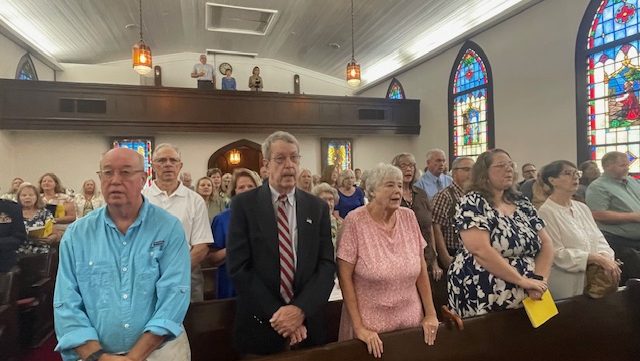
PLYMOUTH — The pews at Plymouth United Methodist Church were fuller than usual on Sunday, packed with members, former pastors and visitors who had come back to the brick building at the corner of Adams and Third streets — some of them stepping through its doors for the first time in decades, others returning to a place they had never really left. Two hundred years after Methodism first took root in Plymouth in 1826, the congregation gathered not just to look back, but to ask what comes next.
Why cover this story?
Answer — because it’s not every day that a church celebrates a bicentennial 200th anniversary. And when you think about that amount of time — that’s a lot of Sunday sermons, weddings, baptisms, funerals and homecomings. For most folks, church is family, home.
For folks who want to read more about Sunday’s celebration, see the next edition of the Roanoke Beacon.

The Reverend Vickie Woolard, the church’s pastor, opened the two-hour service the way she always does, with what she calls her favorite part of any Sunday: sharing joys and concerns. This week, the joys ran deep. Former pastors sat scattered through the congregation, among them the Reverend Dennis Draper Jr. Betty Bedsworth, whose late husband, the Reverend Ellis Jennings Bedsworth, once led the church, was in the pews as well. “I know that Mrs. Bedsworth is a legend in our church, so I’m very glad to finally be able to put a face to you,” Woolard told the congregation. “Welcome, welcome home.”

One by one, members stood to name their own homecomings — a familiar face spotted across the aisle, milestones of 35, 55 and 65 years of membership. There were concerns, too, offered quietly for community members facing illness or the end of life. Woolard’s pastoral prayer wove the two together, giving thanks for the building itself and for the volunteers who had spent weeks preparing the day, while asking for comfort for those in hospitals and those confronting dementia and other diseases that, as she put it, steal identity and steal minds. The congregation recited the Lord’s Prayer together, then rose to sing “How Great Thou Art,” the hymn settling over the sanctuary like something the walls themselves already knew.
Before the sermon came a kind of theater. Neal Brown stepped forward in the voice of what he called “the Ghost of Christmas Past,” a device meant to carry the congregation through two centuries of its own history — the church’s 1826 founding, the Civil War years, a fire in 1864 that could have ended everything, and the long, uneven work of rebuilding and renewal that followed. The history had been researched and written by Beth Price, and Woolard made a point of thanking both of them by name from the pulpit, calling Brown “the spirit of this church in a lot of ways” and praising Price’s history as concise and faithful to the congregation’s story.

Then came the music. Bob Waters, a musician from nearby Tyrrell County, needed no introduction to a room full of longtime members, and Woolard didn’t try to give him one. Waters said he had chosen his songs to conjure memories, and he built toward them slowly, opening with the quiet ache of “Precious Memories” before promising the congregation “a lot of toes tapping” and delivering on it with “Give Me That Old-Time Religion.” Midway through, he stopped to single out a congregant seated in military uniform. “There’s no man in here that knows more about the power in the blood than that man,” Waters said, before closing his set with “There Is Power in the Blood” — played, unexpectedly and to some laughter, on a squeeze-box accordion. It isn’t every day, he joked, that you see one of those in church.

It was into that atmosphere — equal parts memory and music — that the Reverend Gina Miller rose to preach. Miller serves as district superintendent for the Beacon District of the United Methodist Church, and she built her homecoming sermon around a single word: home. She began with a prayer drawn from the United Methodist Book of Worship, giving thanks “for those who established this congregation, for their faith and vision,” and “for all who have preached and taught here.” Then she turned personal, telling the congregation about being eight years old and invited on a beach vacation with a friend’s family, only to wake up the second morning so overwhelmed by homesickness that she couldn’t eat breakfast — “and that was saying something,” she said. It was a radio playing John Denver’s “Take Me Home, Country Roads” that finally broke her resolve. “I stopped and dropped everything and said, ‘I want to go home.’”
That same pull, she told the congregation, is what draws people back to churches like this one, year after year, decade after decade. “Home is a powerful word,” Miller said. “It’s where we know the people and we know the stories. Home is where we know where the good dishes are kept, and it’s where we can walk in without knocking.” For many gathered Sunday, she said, that was exactly what the building had become — a place where they had been baptized, married, taught Scripture, and, in time, mourned the people they loved.
She spent much of the sermon naming the members whose work had quietly held the church together, people who never once stood in the pulpit. She recalled Lawrence McNair, who served as the church’s sexton for as long as seventy years, working, she said, until he was a hundred years old. “Sometimes the people who make the biggest difference in the church are not the ones standing in the pulpit,” Miller said. “They make coffee. They trim tree branches. They tell stories. They make sure there is a place ready for somebody else to come home.”
Miller didn’t gloss over the harder years — the stretches when money ran short and membership shrank. But she pointed to the Reverend Jay Clark and what she called “the faithful few who remained” as proof that a smaller church isn’t a failing one. Their persistence, she said, helped give rise to Carolina Rebuilding Ministry, a housing rehabilitation effort that has since served families across Washington, Bertie and Chowan counties. “When the church got smaller, God did not become smaller,” she said. “When there were fewer people in the pews, God’s mission did not become smaller. When the circumstances changed, God simply opened another door.”

That idea — a church changing shape without losing its purpose — became the heart of her message. “God has never asked a church to go backward. God calls the church forward,” Miller said. “The question isn’t simply, ‘How do we get back to the way things used to be?’ The better question is, God, what are you calling us to do for you now?” Citing Philippians, she reminded the congregation that their citizenship is in heaven, and that the ache many feel for a home they can’t quite name is itself a kind of faith. “God doesn’t simply promise us a home someday, by and by,” she said. “God comes to us, to make a home with us now.”
She closed with three words meant to carry the congregation past the anniversary and into whatever comes next: remember, rejoice and reach. “This church may not look exactly like it did 20, 50, 75, or 200 years ago,” Miller said, “but God is not finished with you. Your story is not over.” Her closing prayer asked God for “eyes to see as far as we can look” and “faith to trust the horizon we cannot yet see.”
As the service ended, Miller offered a final blessing, inviting the congregation to extend their hands and receive it, before members and visitors filed outside for a congregational photograph and a homecoming meal in the fellowship hall. Brown’s narration, echoing the church’s own printed program, had said it best a little earlier that morning: two hundred years, and it’s just the beginning.
Let us know what you think by leaving a comment. Comments are subject to approval.