By Miles Layton
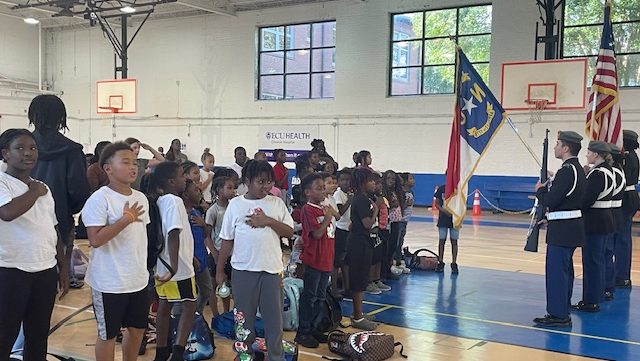
EDENTON — The gymnasium at the Boys and Girls Clubs of the Albemarle filled with the quiet shuffle of children in their Sunday best as the community gathered to mark the 25th anniversary of September 11, 2001. The program, titled “Remember. Honor. Never Forget,” opened with a message organizers hoped would resonate as deeply with students born decades after the attacks as it did with the adults who lived through them.
A small gallery of photos from the event appears at the end of the story.
Subscribe — it’s free!
Emcee Ly’Te’Eire Drew welcomed the crowd before Melvin Tatem, the Edenton-Chowan Chamber of Commerce’s Humanitarian of the Year, stepped forward to lead the opening prayer. Tatem asked God to comfort the families of those who died and those who survived with “life-altering injuries,” and he prayed for a nation he said still shares a bond forged in grief.
“September 12th was met with unity in grief that we all share,” Tatem prayed. “It is still something we share as a people. It reminds us how fragile and precious life truly is.”
Joshua Williams delivered the welcome, and the John A. Holmes High School JROTC led the Pledge of Allegiance. The BGC Chorus lifted the room with a musical selection, their young voices blending in harmony that gave the ceremony an early, moving high point. Teyana Sanderlin performed a dance selection, her expressive, confident moves earning quiet applause from the audience. A group of Boys and Girls Club students — Riley Sikes, Lashawn Wilson, Gage Sullivan, Brycen Squires, Joshua Williams and Troquan Moore — then took turns at the microphone to walk the room through the timeline of events from that Tuesday morning in 2001, their young voices steady as they recounted a history none of them had lived. Sydney Lassiter followed with a sung 9/11 tribute, and Lacey White led a 9/11 questionnaire before the room fell silent for a moment of remembrance for the victims.
Then the program’s guest speaker, George E. Lewis III, chairman of the Edenton-Chowan Board of Education, rose to deliver the address the crowd had come to hear.
Lewis opened by acknowledging how much time had passed and how differently this anniversary lands on a room full of children. “Most of you young people weren’t alive then,” he said. “In fact, some of your parents may have been children themselves. So those of us who remember the day have a responsibility to tell you the story.”
But Lewis said he did not want to dwell only on the horror of that Tuesday. “Today I don’t want to tell you only about what happened on September 11th,” he told the crowd. “I want to tell you about what happened on September 12th, and September 13th, and in the days that followed.”
He reminded listeners of the scale of the loss — “nearly 3,000 people were killed on September 11, 2001,” ranging in age “from two and a half years old to 85” and coming from “more than 90 nations” — before insisting that statistics were never the point. “But those descriptions aren’t who they were,” Lewis said. “They were somebody’s mother, somebody’s father, somebody’s son or daughter, somebody’s neighbor.”
For Lewis, one of those neighbors was personal. He told the story of Mark Whitford, a friend from his days as a young Army officer in the 1990s. “Mark was a husband and the father of twin boys,” Lewis said. “He was a soldier, a champion wrestler, a son, brother, friend.” Lewis recalled Whitford’s stint in his family’s sausage business and his dream of becoming a New York City firefighter — and, to lighten the room, a story about tricking Whitford into eating a mound of wasabi at a Japanese restaurant, warning the students, “never trust grown men when they tell you something’s candy.”
The laughter gave way to grief as Lewis explained what happened next. On September 11, Whitford ran into the South Tower of the World Trade Center to help people he had never met. “He didn’t know their politics. He didn’t know their religion or their beliefs. He didn’t know how much money they made,” Lewis said. “He knew only one thing: they needed help, and Mark helped.” Lewis told the crowd that “at 9:59 that morning, the South Tower collapsed. Mark was 31 years old,” and he noted that the community had raised a flag that very morning in Whitford’s memory.
Lewis then turned his friend’s death into a lesson about what followed — neighbors checking on neighbors, churches opening their doors, strangers giving “food, money, time, prayers, comfort, and sometimes simply a shoulder to cry on.” He argued that unity does not mean sameness. “There is more that unites us than divides us,” Lewis said. “That doesn’t mean everybody simply agrees… Unity does not require agreement. It requires us to remember that disagreement does not make us enemies.”
He challenged the students directly, telling them bravery doesn’t require heroics on the scale of Whitford’s sacrifice. “You don’t have to run through a government building to be brave,” Lewis said, before describing smaller, daily acts — sitting with someone being bullied, welcoming a new classmate, telling someone, simply, “you belong.”
Lewis closed by asking the room to carry the lesson forward without expecting recognition for it. “No camera. No credit. No reward. Just a moment,” he said, before offering a final blessing: “May God bless the memory of Mark Whitford and all those who lost. May God bless the boys and girls playing basketball… May God continue to bless the United States of America.”
As the program ended and the gym slowly emptied, a quiet stillness settled over the room — an echo of the larger message organizers hoped would stick: that remembering isn’t only about looking back, but about what a community chooses to do with that memory going forward.
Gallery — Click to enlarge


Make a one-time donation
Make a monthly donation
Make a yearly donation
Choose an amount
Or enter a custom amount
Your contribution is appreciated.
Your contribution is appreciated.
Your contribution is appreciated.
Let us know what you think by leaving a comment. Comments are subject to approval.