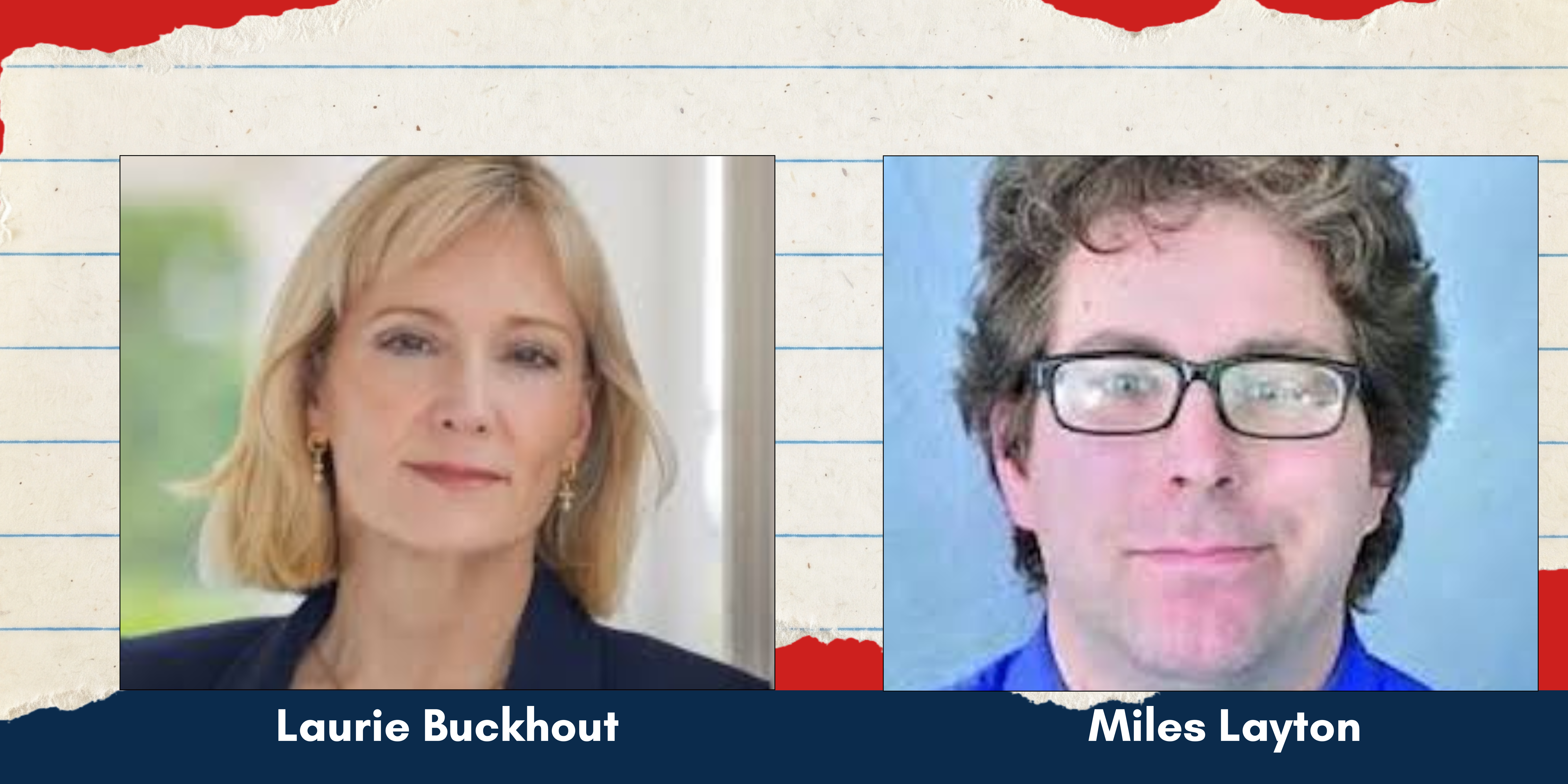
By Miles Layton
Republican Congressional candidate Laurie Buckhout responded to my column about how “silly season” leading up to the November election derails talk of important issues.
Earlier this week, Buckhout made news near and far when she placed bets on her own election – she was banned from the prediction market Kalshi after officials found that she’d placed wagers on the outcome of her own race. See our story.
And here is what I wrote that triggered Laurie, maybe fairly, maybe not.
My thought – Laurie, if you have extra money – maybe less than $1,000 lying around – burning a hole in your pocket so much so that you’re willing to place a stupid bet like this, maybe donate that cash to the local food pantry or buy Chromebook chargers for area students who started school last week.
Laurie, this statement is not aimed at you — you worked hard for your money serving our nation — but I hate rich white people who have no concept of the value of a dollar or of living paycheck to paycheck. Anyone who’s ever traveled through the posh suburbs around DC or Raleigh knows what I’m talking about; places that offer expensive yoga lessons and $5 coffee drinks. I don’t mind folks who are rich, but don’t tell me how you spend your money or how I should spend mine.
Buckhout responded to my column, saying:
Miles. Paul and I literally give thousands to this town. In fact, last year or so there was a drive to buy YOU personally new eyeglasses because you did not have insurance. We contributed. We give thousands to the Boys and Girls Club. We give thousands to the Edenton Steamers. We give to the local historical foundation. We are Gold sponsors for Raine’s Army. We give to the Chowan Arts folks, the hospital, to any Girl Scout or Boy Scout who comes in our Direction with popcorn or cookies. We belong to the Edenton Chamber of Commerce and donate at the highest level (I think?). We donated a bunch of cups for the last Boogie on Broad Street, but rather than put our own name on them, we put the name of the Edenton Steamers. We just about literally never say no when anyone needs anything – to include YOUR glasses. You know my phone number, so why don’t you try that next time?
My turn —
WTF!? — I like you, Laurie, but if you or others want to “cancel me” on social media for writing this column, so be it.
Your response (red flag on so many different levels) means you missed the point of the article – that we need to focus on the bigger issues affecting our nation, not the negative noise associated with political campaigns, whether it’s your betting on the outcome of this congressional race — Pete Rose comes to mind — or Congressman Don Davis’ office’s purchase of $40,000 for furniture and related expenses, although both matters are troubling. Davis’ office spent $27,300 in taxpayer-funded “habitation expenses” during the second quarter of 2023, plus another $13,030 categorized as “office supplies and furniture” — placing him second-highest among all 435 House members in that spending category.
I sense that this congressional race is razor-thin, even though it shouldn’t be in a district gerrymandered to strongly favor Republicans. Means it’s going to get nasty in the days ahead.
First, yes, Laurie, you donated a few dollars, the same as other folks, Democrats and Republicans, many Episcopalians too, to help me purchase some new glasses … Thanks, Laurie, but I’m not beholden to you as if I were a member of Congress who follows orders from their major campaign contributors or votes lockstep with President Trump or Nancy Pelosi’s side of the aisle.
You also mentioned how you donated this or that to various charitable groups; maybe you wrote those charitable contributions off on your taxes, maybe you didn’t; I don’t care. I’m sure you’ve done your tour of duty serving meals in soup kitchens or donating clothes to the needy too. Whatever.
Seven days a week, my wife and I work multiple jobs to make ends meet — just like a lot of other people today in an economy where inflation is baked into the cake no matter who is president or which party is in power because it’s all the same with an economic divide that always is growing.
Laurie and Don, I’m sure you know this – there are two Americas with a widening gap between rich and poor. And for many families, that’s not about cutting out a cup of coffee served at a local cafe or working a second job during a vacation day, but about making hard choices about which bills to pay that month.
Laurie, how you spend your money is your business – I don’t know why you and your husband need to live in a mega mansion with 5 bedrooms, 5.5 baths – 9,256 square feet on a 3.7 acre lot overlooking Edenton Bay that was once listed at $2.9 million – but that’s your money; do what you want with it, you’ve earned it after your service to our nation. The county’s appraisal card for the property is posted at the end of the story. Here’s the Zillow listing.

Laurie, you are not my enemy; bad policies pushed by out-of-touch, greedy government elites are the enemy. Maybe it’s me, but it’s looking more and more like Covid shots were a money grab by big pharma, much like the forever wars in far-flung places. Bad government affects everyone, rich or poor, but especially the poor and middle class.
But back to my point: As for silly season, rather than focusing on Kalshi accounts and other distractions that are sure to come in October, let’s focus on the issues.
This next part is not just aimed at Buckhout but at Congressman Davis too — let’s talk about how the next Congress will need to do some heavy lifting to reform Social Security, help farmers and possibly vote on measures that may bring us into another war overseas.
According to the Social Security Administration — click here to READ THE REPORT — Social Security’s bank account is set to run dry a year earlier than expected.
What are you going to do if elected?
The government agency that oversees Social Security dropped its annual reality check this week, and the numbers keep getting worse. The trust fund that cuts checks to retirees will run out of money in late 2032 — three months sooner than officials predicted just twelve months ago.
That’s not a rounding error. It means the roughly 70 million Americans who rely on Social Security and Medicare are looking at a shorter runway than they thought they had, and the math behind it isn’t especially forgiving.
Here’s what happens when the fund empties out: payroll taxes don’t stop coming in, but they won’t be enough to cover the full bill. Retirees would see their checks shrink to about 78 cents on the dollar, unless Congress finds a fix before then. For someone getting $2,000 a month, that’s a drop to roughly $1,560 — not a footnote, a pay cut.
There’s a silver lining buried in the report, if you go looking for it. The much smaller fund that pays disability benefits is actually doing better than expected. Last year’s report had it running solvent through 2099; this year’s pushes that out to 2100, the edge of what the Trustees even bother projecting. If you combine the two funds on paper — which would take an act of Congress, since they’re legally separate — the pool holds out until mid-2034 and then drops to 83% of promised benefits.
Medicare isn’t faring much better. The fund covering hospital stays is now projected to run dry in early 2033, also earlier than last year’s estimate, dropping to 89% of scheduled payments after that. The Medicare programs covering doctor visits and prescription drugs are a different story — those are set up so premiums and federal money automatically rise to match spending, so they can’t technically go broke. But the report flags that drug costs, especially for specialty medications, are climbing fast enough to keep squeezing both seniors’ premiums and the federal budget.
So why did the picture get worse this year? A few things converged. Demographers are now betting on Americans having fewer kids — the assumed birth rate dropped from 1.90 to 1.75 per woman — and on less immigration than previously assumed, both of which mean fewer future workers paying into the system. On top of that, the tax law signed last July locked in lower income tax rates and a bigger standard deduction, which sounds unrelated until you realize Social Security benefits get taxed, and that tax money is one of the streams that funds the program. Lower taxes on benefits means less money flowing back into the trust fund.
None of this is new territory — Social Security’s finances have been on a slow-motion collision course with reality for years, and this report just moves the crash a little closer. What the Trustees keep saying, year after year, is that lawmakers still have room to fix this without anyone getting hurt too badly — but that room shrinks every year nothing happens. Waiting until the fund is nearly empty means the fixes get more painful, not less.
For now, nothing changes for anyone currently collecting benefits. But 2032 is closer than it sounds — closer than a typical mortgage, closer than most people’s retirement horizon if they’re in their 50s today. The clock the Trustees keep pointing to isn’t abstract anymore.
Rather than waste time hitting me about glasses – why don’t we talk about helping farmers in Eastern NC – see this report.
What are you going to do if elected?
U.S. farmers face mounting financial strain heading into 2027, driven by high production costs, weak commodity prices, and geopolitical instability. Fertilizer and fuel costs, already elevated, have worsened due to the conflict in Iran. American Farm Bureau Federation projects that without federal assistance, farmers growing nine major crops will lose $32 billion in 2027 (up from $31 billion in 2026), with every crop analyzed remaining below breakeven per acre — marking a sixth straight year of negative returns for most row crops.
Specialty crop growers face similar pressure: six representative crops saw over $7 billion in losses in 2025, and the ASCF program covers only 5-28% of those per-acre losses. 2026 data show continued below-breakeven prices, acreage cuts, and weak margins across major fruit, vegetable, and nut sectors, though limited public data make full losses hard to measure.
AFBF argues additional, bipartisan-supported economic assistance is needed to offset trade losses and rising costs, stabilizing the farm economy and rural communities. Longer-term, the group calls for policy fixes including year-round E15 fuel, a modernized five-year farm bill preventing a state-by-state regulatory patchwork, agricultural labor reform, and stronger risk management tools with better data for specialty crop producers.
Last but not least, war may be around the corner.
In June, China’s Coast Guard hailed three ships near eastern Taiwan in international waters, demanding they disclose their origins and destinations—stopping short of intervening, but asserting a right to police the area. Analysts see this as a possible preview of a larger crisis ahead. US intelligence indicates Xi Jinping has directed the PLA to be combat-ready for Taiwan action by 2027, fueling fears of an imminent confrontation. However, some believe the real flashpoint could be January 2028, when Taiwan’s next presidential election occurs—a moment Xi might choose to force a decisive confrontation over the island’s status, according to the American Enterprise Institute.
Candidates – rather than vote the party line, Laurie and Don – how are you going to handle that? As of this writing, we still have military matters in Iran and Ukraine, so Taiwan will certainly be a point of discussion.
Folks may know about betting and furniture purchases, but what about where you stand on the issues?
Elections matter!
Voters want to know where the candidates stand on issues like this – rather than distracting BS – before we cast any votes.


Let us know what you think by leaving a comment. Comments are subject to approval.