By Miles Layton, Editor
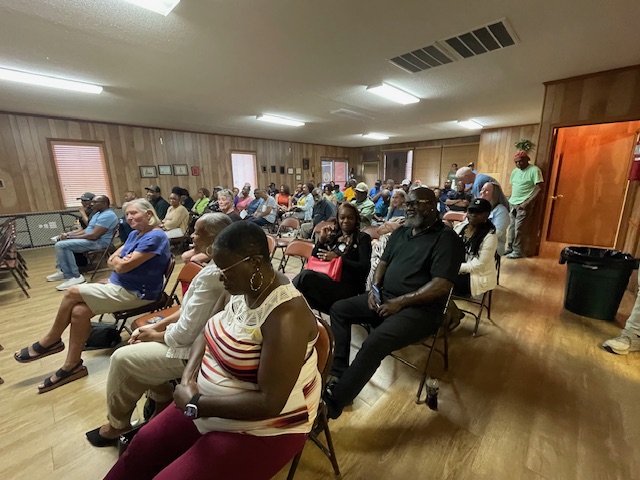
ROPER — Congressman Don Davis, D-District 1, brought his reelection campaign to Mount Eprew Missionary Baptist Church on Saturday, delivering a message aimed squarely at the middle: a defense of rural hospitals, relief for working families, and an appeal to voters across the political spectrum to put Eastern North Carolina first.
Davis shared the evening with Democratic State Senate candidate Roy Surrett, who later urged the crowd to match his own door-to-door campaign push across an eight-county district, as well as a broader slate of local, judicial and legislative candidates that drew a crowd spilling toward the back of the sanctuary.
For more coverage of the campaign rally, see the next edition of the Roanoke Beacon.
The rally drew Washington County Democratic Party secretary Mary Cherry, who opened the program with a call to vote; party activist Wesley Stokes, who broke down three constitutional amendments headed to the November ballot; Sheriff Arlo Norman, who is unopposed but still sought the crowd’s support; Clerk of Superior Court Brian Keith Phelps; District Court Judge Cole Phelps; and Superior Court candidate Regina R. Parker. Civic leaders in attendance included Plymouth Mayor Crystal Davis, Plymouth Council Pro Tem Donsenia Teel and Interim Plymouth Town Manager Dorenda Wallace — underscoring the event’s role as both a campaign stop for Congressman Davis and a broader rallying point for the Washington County Democratic Party.

Davis, who faces Republican challenger Laurie Buckhout of Edenton in the Nov. 3 election, opened not with policy but with roots. “Truly, my name is Don Davis, made in Eastern North Carolina,” he told the crowd, describing his upbringing in Snow Hill under the care of his grandmother. “My grandmother had a vision, and her vision was for her children to go to school, and she felt that college was the key; it was the ticket.”
He credited that grandmother with instilling the values he said still guide him in Washington — faith, education and hard work. “You get it up here. Nobody can take that away from you,” he recalled her telling him, adding another piece of advice that has stuck with him: “There is some good in everybody.” That biography, aides say, is central to Davis’ pitch to a district that includes both reliably Democratic precincts and areas that have trended Republican in recent presidential elections.
A nod to farmers and working families
Davis spoke directly to the region’s agricultural community, many of whom he said are wrestling with how to keep family farms afloat amid rising costs. “Someone’s trying to figure out how to keep the family farm going. Stand with me on this,” he said, recalling how the school calendar itself once bent to the harvest: “If the crops weren’t done, school didn’t start.”
He tied that background to affordability more broadly, describing a recent gas station visit that cost more than expected and empathizing with residents stretching every dollar. “They’re putting that two dollars in to get the kids to practice,” Davis said. “They’re putting that two dollars in to make it to the grocery store… just trying to make it.” He framed support for farmers, rural health care and infrastructure as part of the same fight, repeating a line he returned to throughout the afternoon: “This is about putting Eastern North Carolina first.”
Rural hospitals take center stage
The congressman called rural health care “the center question in this election.” He pointed to the reopening of Martin General Hospital, closed for three years, as a model for the region. “Martin General will be the first fully closed hospital that’s been reopened as a rural emergency hospital in the entire nation,” Davis said, crediting residents who packed county commission meetings to save it. “It was the people that spoke up,” he said. “How the hospital saved their lives, how the hospital saved somebody in their family’s life.”
Davis also cited federal money he said his office helped direct to Washington Regional’s emergency department. “That million dollars for Washington Regional that we took — that was for the emergency department,” he said. “We’re just trying to help save somebody’s life, for crying out loud.”
He criticized federal budget legislation he called “HR one,” saying it pulled more than a trillion dollars from health care programs over a decade, and noted the opposition wasn’t limited to Democrats. “Even Tom Tillis voted against HR one because of these concerns,” Davis said. “It was bipartisan opposition to these cuts to rural health care.”
Pushing back on attacks, offering fixes
Davis used part of his remarks to rebut claims about his record on taxes for tipped workers and Social Security. On the tip-tax provision, he said the criticism misrepresents his position, arguing the income cap written into the law doesn’t reflect the reality of most service workers, and said he has filed his own bill tying that relief to a living wage.
On Social Security, he spent considerably more time. “Oh, oh god! Everybody’s sitting up now!” he said, drawing laughter before turning serious. “I am not against tax relief, those who are eligible that are on Social Security or retired, by the way,” he said. “But I want to talk to you in a real way about Social Security.” Davis warned that continued gridlock in Washington carries real consequences: “If American people allow members of Congress to go up there and continue to all they do is fuss and fight, in 2032, everybody’s benefit is going to begin to decrease by about twenty percent.”
He framed that looming cut as a matter of fairness. “It’s their money they paid into the system,” Davis said. “Let’s be honest. Be honest about ourselves too.” He added that fixing the program for the long term, not just scoring a tax-relief talking point, has been part of his work in Congress.

Keeping young people home
Davis devoted time to what he called one of the region’s most urgent challenges: retaining young people. He recounted a recent visit with early college students, describing them as academically gifted and first-generation college-bound. “I said, ‘How many plan to stay?’” Davis told the Roper crowd. “Put a number in your mind — I’m going to tell you what it was that day: four.”
Rather than treating the moment as discouraging, Davis framed it as a call to action. “We’re fighting for you to have a future right here at home,” he said, “so you can live the American dream right here.” He noted that while North Carolina is rated the nation’s top state for business, “two-thirds of the growth is only occurring in two counties,” leaving much of the rest of the state, including 25 counties in his district, on the outside looking in.
Investments in the district
Davis highlighted federal funding he said was flowing into rural communities under his watch. “A little over $700,000 for Roper, a little over $300,000 coming in for Plymouth,” he said, adding that the emergency department had together received more than $2 million, with roughly $800,000 more in the pipeline. “We’re trying to ease the pressures on property taxes. That’s why we’re doing this, and it’s helping people,” he said.
He also pointed to defense and shipbuilding jobs coming to the region as Newport News Shipyard expands into Eastern North Carolina, and to his support for Seymour Johnson Air Force Base, which he said is set to receive two F-35 squadrons backed by $89 million in the latest defense authorization bill.
Closing appeal: put Eastern North Carolina first
Davis closed by urging supporters to get involved ahead of Election Day. “This district — President Trump won this district by ten and a half percent,” he said. “But guess what? Our polls show us up about four percent. But here is the deal: polls do not vote; people vote.” He also renewed his call for a ban on mid-decade redistricting, saying it sidelined voters when the current map was drawn: “Over 1.4 million Eastern North Carolinians left out of the process. Not even a public hearing in Eastern North Carolina.”
He ended with a direct appeal meant to resonate with loyal Democrats and independent-minded moderates alike: “This is about putting Eastern North Carolina first,” Davis said. “Will you stand with me?” The Nov. 3 election will decide whether Davis wins a third term against Buckhout, a retired Army colonel from Edenton.

Surrett makes his case for the state Senate
Later in the evening, Democratic State Senate candidate Roy Surrett, running in a sprawling District 2 that stretches across eight counties, echoed a similar theme of grassroots, in-person campaigning. Surrett, a Carteret County resident and retired federal law enforcement officer, opened with a joking apology for wearing shorts to a church service before pivoting to his central message. “I’ve been in Martin County today… knocking doors out there today and talking to people and listening to their concerns,” he said. “I think your elected representatives should do that. They should be accountable to you, and they should listen to you and want to get to know you.”
He described the mileage he’s logged criss-crossing the district: “I put about 7,000 miles on our vehicle just in the last month,” framing the effort as a matter of respect for constituents. “You deserve a state senator that works as hard as you do.” Surrett faces Republican state Sen. Norm Sanders, who is seeking reelection, in the race for the District 2 seat.
Surrett argued Eastern North Carolina has been shortchanged in state investment, citing disparities in life expectancy between the region and the rest of the state. “We are not getting our share of the pie out of Raleigh,” he said, pointing to a recent $65 million state expenditure to attract a golf tournament as evidence of misplaced priorities. “What would $65 million do for Eastern North Carolina?” he asked, floating ideas like teacher pay increases, downtown revitalization and support for farmers. “Without farmers we don’t eat,” he said. “It’s as simple as that.”
Surrett also described a food-box distribution effort in Martin County the day before, recalling a struggling family whose car ran out of gas as he handed them supplies, and said the encounter reinforced why he’s running. “I want to be your next North Carolina State Senator,” Surrett said. “I do believe… government does good things for its people. We should be making life better and easier for our citizens.”
Rollin joins the ballot late, vows to compete
Miriam Rollin, the Democratic candidate for NC House District 1, also addressed the crowd, introducing herself as “at heart a policy wonk, a lawyer” who has spent 40 years fighting for disadvantaged kids and families. She explained she entered the race only in early August after the original Democratic candidate dropped out, saying, “I couldn’t imagine Goodwin running unopposed, because that’s not right.” Acknowledging the district’s difficult political lean, Rollin said, “I am not just in this as an exercise in democracy. I am in it to win.” Rollin faces Republican Rep. Ed Goodwin, who is seeking reelection to the NC House District 1 seat.
Rollin then walked through a rapid-fire series of questions meant to draw a contrast with Goodwin, asking whether they wanted a representative who supports “making it harder for folks to vote and easier to challenge votes after the fact,” or one who backs “ridiculous gerrymandering of districts, which means politicians choosing their voters rather than voters choosing their politicians.” She asked whether they wanted a representative who supports “budgets that give tax cuts for the wealthy and inadequate resources for our public schools, and then siphons off some of those resources for private schools,” and one who supports “policies that harm our immigrant neighbors and putting them in concentration camps.” She continued, asking whether the crowd wanted a representative who backs “the weakening of protections for our air, land, and water resources” and “giveaways to energy companies that raise costs for all of us” while accepting “money from those companies.” Finally, she asked whether they wanted a representative who “does nothing, nothing to address the real issues facing all of us: affordability for housing, health care, gas, groceries.” Each time, the crowd answered no.
Rollin then flipped the questions, asking whether they wanted a representative who would “fight for lower utility bills,” fund public schools and “pay our teachers real wages,” make health care “more available and affordable in areas like rural Northeastern North Carolina,” and ensure “the wealthy and big companies pay their fair share” while reducing “the tax burden on low and moderate income folks.” The crowd answered yes each time. “Okay, I’m your gal,” Rollin said.
She argued the stakes come down to a small number of votes in Raleigh, noting the General Assembly, “including Goodwin,” has repeatedly overridden the governor’s vetoes on bills she opposes. “If we turned over a few of these seats like Goodwin’s, and like Roy is running for, we could turn over a few of these seats,” she said, referring to Surrett’s race as well. “That would mean they couldn’t keep passing these bad bills and getting them enacted over the governor’s veto.” Calling herself “the last Democratic candidate to enter this election season,” Rollin asked supporters to volunteer, share her campaign on social media and hand out rack cards to neighbors in the district. “Let’s all be in it to win it this year,” she said.
Make a one-time donation
Make a monthly donation
Make a yearly donation
Choose an amount
Or enter a custom amount
Your contribution is appreciated.
Your contribution is appreciated.
Your contribution is appreciated.