By Miles Layton
ELIZABETH CITY — To transportation planners, the future of northeastern North Carolina can be measured in miles of pavement, wider shoulders, interchanges, passenger trains and billions of dollars in potential investment.
For David Long, it can be measured in houses.
Six of them sit within a few hundred yards of his Pasquotank County home, he estimates. Farther down U.S. 158, between Lynch’s Corner and the swamp near the Gates County line, Long counts roughly 57 homes between US 17 and the swamp along a eight-mile stretch that could be affected by a proposed widening of the highway.
One of the homes that could be threatened belongs to his in-laws, who recently built it.
“It affects us personally,” Long said.
That personal stake has made Long an increasingly concerned observer of transportation proposals that could reshape Pasquotank County and surrounding northeastern North Carolina communities. State and regional transportation planners have considered an array of highway and rail improvements, from upgrading U.S. 17 for future Interstate 87 to transforming U.S. 158 into a four-lane divided expressway with sidewalks and restoring passenger rail service through the region.
Long is not arguing that the roads should remain untouched. He supports safety improvements. He sees a need for wider lanes and shoulders along U.S. 158. He believes an interchange could improve the intersection of U.S. 17 and U.S. 158.
What worries him is the scale of some of the proposals — and whether residents whose homes, farms and businesses could eventually stand in their path understand what is being considered.
“We need to get ahead of this now,” Long said. “So we’re not surprised by it.”
Subscribe — it’s free!
A highway through farm country
The U.S. 158 proposal is particularly significant to Long.
The concept calls for widening the roadway into a four-lane divided expressway with 12-foot lanes, wide paved shoulders, a 46-foot depressed grass median and cable guardrail. The improvements would cover sections around Morgan’s Corner, Sunbury and Easton Crossroads as the highway continues west toward U.S. 13 in Hertford County.
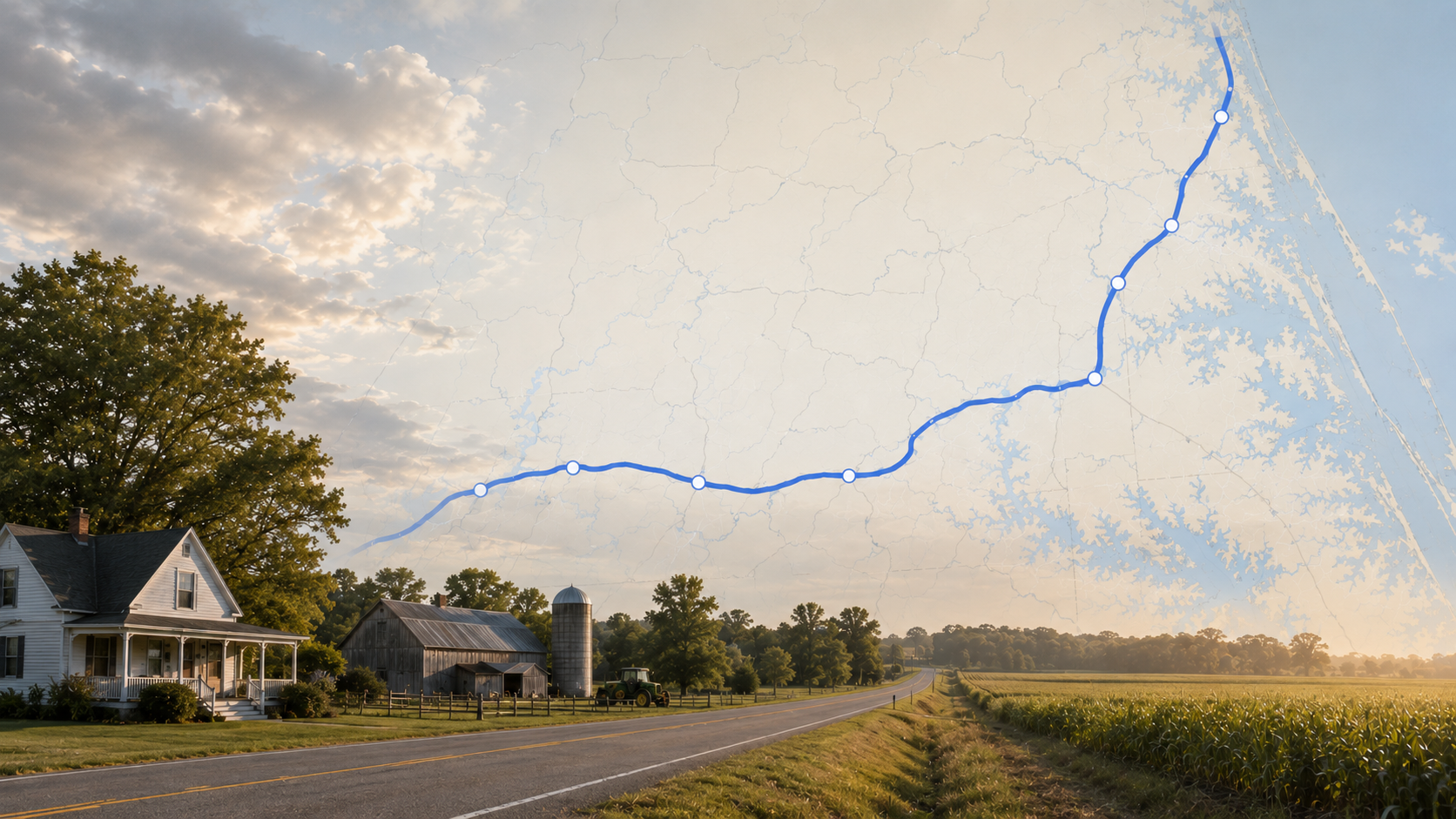
For Long, those engineering specifications look different when superimposed over the landscape he knows.
Much of the area around him is agricultural. Homes line portions of U.S. 158, some occupied by families who have lived there for generations. Farms rely on the highway, and agricultural equipment regularly shares the road with cars and trucks.
Long believes dozens of houses could potentially be affected on the Pasquotank County portion alone if the highway were built as envisioned.
In the small area around his property, he counted what he believes could be six affected homes in a roughly 200- to 300-yard section.
Farther along U.S. 158, he estimated most of roughly 10 houses in one three-mile stretch could face either removal or substantial property loss.
The effects, he said, would reach beyond houses.
Farms could lose land. Businesses along the corridor could face disruptions. Long specifically pointed during the interview to Russell Auto, describing the longtime business as a community staple used by rural residents who often prefer getting tires, oil changes and inspections locally rather than traveling into Elizabeth City.
That is why Long sees the U.S. 158 debate as something larger than a transportation question.
“I am big on preserving our culture and our way of life,” he said. “That’s definitely not preserving our culture or way of life.”
Long sees room for compromise
Long is not opposed to improving U.S. 158.
In fact, some of the existing conditions concern him.
Agricultural equipment can slow traffic, particularly when drivers have few opportunities to safely pass. Near swamp and canal areas, shoulders can be steep or virtually nonexistent. Long said pull-off lanes being constructed in swamp areas are an improvement because they can give farm equipment somewhere to move out of the travel lane.
“I agree with possibly widening the lanes,” he said. “I think that’s a good compromise.”
Wider shoulders could provide another solution, allowing agricultural equipment more room while giving other traffic space to pass.
What Long does not believe the area needs is an urban-style highway cutting through its agricultural landscape.
“We don’t need four lanes and sidewalks,” Long said. “It just doesn’t fit our area.”
Environmental questions could complicate the proposal as well.
Long pointed to the canal near his property, which serves as an important drainage route, as well as swamp areas and nearby federal land. Any major expansion, he said, would have to account for those environmental conditions along with its effects on residents and farms.
U.S. 17 could change, too
U.S. 158 is only part of a much larger transportation picture.
Among the most expensive concepts is an approximately 18.43-mile upgrade of U.S. 17 through Perquimans, Chowan and Pasquotank counties. The proposal would convert the highway into a freeway as part of the long-term development of Interstate 87. The preliminary estimated cost is about $1.19 billion.
Another proposal would upgrade nearly 13 miles of U.S. 17 between the Elizabeth City area and the Virginia line at an estimated $826.5 million.
NCDOT has studied upgrading U.S. 17 around Elizabeth City and farther north as part of the future interstate corridor. Its feasibility materials identify sections around the Elizabeth City bypass and toward the Virginia line for potential upgrades.
The highway proposals could eventually mean higher-speed, interstate-style travel through a region where U.S. 17 is already one of the primary north-south routes.
Then there is the intersection of U.S. 17 and U.S. 158.
Plans contemplate replacing the existing signalized intersection with an interchange. The intersection has a history of crashes, including incidents associated with motorists running the traffic light.
That is one major project where Long sees a clearer benefit.
He suggested an overpass similar to configurations along Interstate 95, allowing through traffic to continue without stopping while ramps maintain local access.
“I think that in general would be okay, because now that’s going to essentially still provide the safety of not having a stoplight there,” Long said. “But also it would ease congestion in that area as well.”
For Long, that distinction is important: improve a demonstrated problem without necessarily remaking miles of surrounding countryside.
Passenger trains could return
The transportation vision extends beyond highways.
One comparatively small rail proposal would improve the crossing at Parsonage Street in Elizabeth City by adding gates to the existing warning system. Planners have cited the crossing’s proximity to a busy intersection and the limited reaction time motorists may have when trains approach.
A far more ambitious proposal would restore passenger rail service between Edenton and the Virginia state line. I’ll believe it when I see it…
The route would pass through Hertford, Elizabeth City and Moyock, with service envisioned at approximately hourly intervals. Stations, passenger equipment and other infrastructure would be required. Advocates believe the service could benefit residents commuting toward Hampton Roads while supporting tourism and economic development.
Long is skeptical.
His objection is similar to his concern about U.S. 158: Development, he believes, should reflect the communities where it occurs rather than import an urban model into a rural region.
“We need to develop smartly on things that fit our culture and our people,” Long said. “If it fits a need for the culture, the people and it preserves our area and our heritage, then by all means we can develop it.”
What could change
Taken together, the proposals present the possibility of substantial transportation changes across northeastern North Carolina:
- U.S. 158 could become a four-lane divided expressway, potentially affecting homes, farms and businesses along the corridor.
- U.S. 17 through portions of Pasquotank, Perquimans and Chowan counties could be upgraded toward interstate standards as part of future I-87.
- U.S. 17 north of Elizabeth City could receive similar freeway improvements toward Virginia.
- The U.S. 17/U.S. 158 traffic light could be replaced with an interchange.
- The Parsonage Street rail crossing in Elizabeth City could receive gates and additional safety improvements.
- Passenger rail could return between Edenton and the Virginia line, including stops in Hertford, Elizabeth City and Moyock.
But the distinction between a proposed project and an imminent construction project is critical.
The transportation prioritization process is used to evaluate projects for inclusion and funding in North Carolina’s long-term transportation program. The 2026-2035 State Transportation Improvement Program was developed through Prioritization 7.0, and NCDOT has since moved into Prioritization 8.0 for development of the next program.
That means residents should not interpret every concept under discussion as a project about to break ground.
Long himself emphasizes that point.
He estimated the U.S. 158 project could be five or even 10 years away. His concern is not that bulldozers are coming tomorrow. It is that waiting until a project is fully designed, funded and moving toward construction could leave residents with less opportunity to shape what happens.
“I’m not trying to scare people out of their shoes, like it’s going to happen tomorrow,” Long said. “But we need to get ahead of this before it does become written in stone.”
Asking for notice
For Long, that starts with something relatively simple: telling people.
He said many residents he has spoken with along U.S. 158 had no idea such a major widening had been contemplated. He wants Pasquotank County to consider mailing notices directly to potentially affected property owners so they can learn about the plans and participate in the process.
The concern is particularly acute for families whose houses sit close to the existing highway.
Long knows transportation infrastructure changes over time. He knows U.S. 17 itself took years to evolve and that northeastern North Carolina is changing as population, development and economic pressures move outward from Elizabeth City and Hampton Roads.
He is not asking planners to ignore those changes.
He is asking what kind of region those changes will create.
For transportation planners, a wider highway can mean increased capacity, safer travel and better regional connections. For the people living beside it, the same project can mean losing part of a farm, watching a longtime business disappear or learning that a family home stands where engineers believe a new lane should go.
That difference in perspective is why Long wants residents involved while the plans are still plans.
Some improvements, he believes, can make life better — safer shoulders for farm equipment, wider lanes, an overpass eliminating a dangerous traffic signal.
But bigger, he argues, is not automatically better.
And as northeastern North Carolina considers transportation investments that could shape the region for decades, Long wants planners to remember what already exists along those lines on a map: farms, businesses, families and communities with histories of their own.
“We need to develop smartly on things that fit our culture and our people,” he said.
Make a one-time donation
Make a monthly donation
Make a yearly donation
Choose an amount
Or enter a custom amount
Your contribution is appreciated.
Your contribution is appreciated.
Your contribution is appreciated.


Let us know what you think by leaving a comment. Comments are subject to approval.