By Miles Layton
ELIZABETH CITY — Land development, and the toll it’s taking on farmland, drainage and rural roads, dominated public comment at Monday night’s Pasquotank County Commission meeting, as four speakers used their three minutes each to push commissioners toward more deliberate planning — and commissioners, in turn, acknowledged the pressure but said their hands are largely tied when it comes to controlling who landowners sell to.
Chairman Lloyd Griffin III opened public comment by recognizing four speakers: Katie Canning, David Long, Sam Reid and Brandon Swain. While Canning’s remarks centered on the county’s need for a year-round indoor pool, she tied her request directly to the county’s pace of growth. The other three speakers — all farmers — focused almost entirely on development’s encroachment on agricultural land.
Canning, who has raised the idea of an indoor aquatic center before, told commissioners she had since learned the concept was recommended a decade ago. She said the county’s 2016 Parks and Recreation Master Plan “identified a new recreation center with an indoor pool was a need,” and that “ten years later, the need remains an outdoor seasonal pool.”
She framed the issue as inseparable from the county’s growth. “We’re watching farmland disappear and land and wetlands cleared for more housing,” Canning said, “but development doesn’t just add rooftops, it adds people. So if we’re transforming our landscape to accommodate growth, what are we building to accommodate the lives that come with it?”
Canning said she wasn’t asking commissioners “to spend millions of dollars and build a pool” that night, but rather to open a conversation with the joint city-county Parks and Recreation Department about whether the decade-old recommendation still applies. “I’m not against development,” she said. “I’m for smart development.”
Because time elapsed, I’m including Canning’s complete remarks at the end of this story.
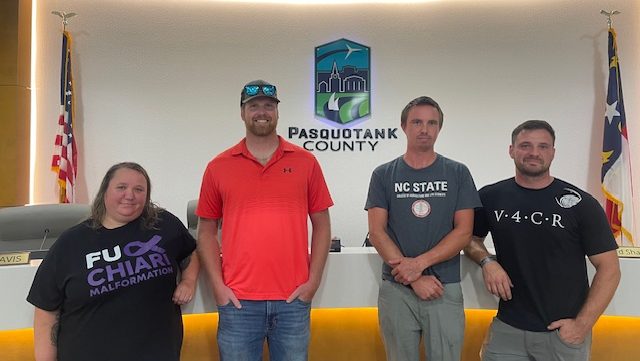
Photo accompanying story shows — David Long, Sam Reid, Brandon Swain and Katie Canning — rural revolutionaries who want Northeast NC to take a closer look at what we have before we become one big faceless suburb, aka Hampton Roads.
Subscribe — it’s free!
Farmers Say They’re Being Priced Out
David Long, a farmer who said he works with the nonprofit Vets for Farming to help veterans get into agriculture, told commissioners the math no longer works for farmers trying to buy or expand.
“Market rate for agricultural lands right now is about $4,700 per acre,” Long said. “A lot of developers are offering upwards of $35,000 per acre.” He said that gap effectively locks out both new and first-generation farmers. “I put a bid in for the land and usually I’m outbid by seven times the amount,” he said.
Long argued the consequences go beyond economics. “They’re destroying our culture and heritage, destroying our lands,” he said, describing how often he now hears people say “do you remember” about the county’s past. “By the time you hear the phrase ‘do you remember,’ usually what that means is whatever we had here at home — our culture, our heritage — is going to die. It’s not coming back.”
He urged commissioners to “tread lightly” as development continues. “Once it’s gone, it’s gone. It’s not coming back,” Long said. “You know, people that move here, they move here to get away from Hampton Roads. They don’t move here to become Hampton Roads.”
Long also asked commissioners whether meetings could be livestreamed, saying he believes most other counties in the region already do so and that people who wanted to watch Monday’s meeting online were unable to.
Traffic, Drainage and “Unfettered” Growth
Sam Reid, who farms in the county as well as in Camden and Currituck counties, told commissioners his entire career has involved “navigating unfettered development encroaching on every aspect of my operation.” He described daily disruptions from heavier traffic that make routine farm operations “take two, three times longer to get done,” and said land costs have climbed beyond what farmers can compete with. “You cannot compete with some of the people that want to come in with outside money,” he said.
Reid also raised road safety, saying he has been involved in multiple collisions with drivers unfamiliar with slow-moving farm equipment on secondary roads with no shoulders. “There’s no DMV training to instruct people what to do when they encounter farm equipment in rural areas,” he said. “It’s a hazard. It’s a real danger. We all just want to go home safe at the end of the day for our families.”
His most detailed concern was drainage. Reid said new developments remove wetlands and fields that once slowed the flow of stormwater, concentrating runoff and worsening flooding elsewhere. “These developments come in, you take away wetlands, you take away fields that used to have a slow percolation of the water,” he said. “It all drains out at once. It increases the peak level of the water during flooding events.”
He pointed specifically to the Queenswood development, which he said “completely reroute[d] the drainage to a different outlet than it ever used to go in,” dumping water on properties upstream and downstream that weren’t built to handle it. “Whoever’s downstream and gets flooded is left holding the bag,” Reid said. “Those people don’t do anything to help the people that designed the development. They don’t care where the water goes, long as it gets off their property.” He said Queenswood’s runoff “backs water all the way up halfway down Blount Road,” and that he has raised the issue with county staff. “Something needs to be done to manage it, to mitigate it,” he said. “It can’t be done feckless and unfettered like it has been.”
Worth noting, Reid is the son of Wade Reid, a prominent farmer whose roots go back generations in Pasquotank County — see our story here.
A Farmer’s Perspective
Brandon Swain, who grew up in the county and now runs a farm with his wife that provides therapeutic animal services for children with disabilities, described watching the same pattern play out among farmers he knows. What began as five acres for his own animals has grown to fifty, he said, even as he keeps a full-time job.
“You’re constantly talking to people — small world out there — and talking to farmers that are getting out of it,” Swain said. “You kind of see everybody’s selling the land as a whole versus dividing it up where people trying to get into agriculture can purchase it.” He echoed Long’s point on pricing: “We’re just being outpriced. And that comes down to development. You can’t blame the farmers that are getting out of it, or their kids, but at the same time you just got to be smart about it.”
Swain also described drainage problems on Newland Road, where he lives. “We have canal ditches that just cannot hold the water back,” he said. “We get downpours of several inches within a few hours, and we just can’t hold it back.” Like Canning and Long, Swain closed by clarifying he isn’t opposed to growth outright: “I’m not against development.”
Commissioners Respond
Before we get into this section, let me state that commissioners, generally speaking, don’t answer questions or concerns — go back and forth with the public during meetings. This is not like Prime Minister’s Question Time in the British Parliament or a town council deep in the Appalachian Mountains.
That said, sometimes, commissioners do answer questions — later in the meeting, Chairman Griffin returned to the topic, telling the audience he had tried to explain to Canning how land moves “from raw land to developed land to lots,” and encouraged residents to call the county’s planning staff for more detail. He also addressed Reid’s drainage concerns directly, saying the county has “a drainage engineer that does look at the site plans, pre and post, type of drainage” and that subdivisions are reviewed by a stormwater engineer before approval. “We try to do the best we can on getting it right,” Griffin said.
On the question of farmland sales, Griffin said the county has little legal authority to intervene once a landowner decides to sell. “As for the farmland, I don’t think we have any control over land unless someone else is selling for it,” he said.
County Manager Sparty Hammett added that because of the level of public interest, staff plans to give commissioners — and the public — a fuller explanation of how planning and zoning work at the board’s Sept. 14 meeting, including a review of areas already zoned for residential growth.
Commissioner Barry Overman spoke at length about the pressures facing farming families, drawing on his own background. He recalled that his grandfather owned the land Overman now farms, and that when his grandfather chose to sell, “he could sell it to anybody, and the county couldn’t vote him” out of it. Overman said many heirs to farmland today aren’t interested in holding onto it. “The heirs of many properties aren’t interested in just getting four thousand dollars for farmland,” he said. “They’re going to sell it to the highest bidder because they just want money, and that’s sad.” He said his own commute has stretched from nine minutes to roughly 25 because of development between his home and town.
Overman said the county is limited in what it can do. “The commissioner can’t tell somebody you can’t sell your land to just [someone who wants] to farm it — that would put us in a bad place,” he said. “We try to stay out of that. But we are an agricultural community, and we want to try to protect it.” He added that the board reviews the issue “every time a project comes before us,” but must be careful not to overstep what’s legally permissible. “We’re just real careful with that,” he said. “Thanks for coming and sharing your thoughts with us. It’s really helpful to us.”
Commissioner Sam Davis followed up on Overman’s comments, saying he had recently spoken with a farmer struggling with rising costs. “I just had a farmer tell me that because of his increase in fertilizer, his increase in diesel and his increase in gas, he said, ‘Sam, I can’t pay my bills,’” Davis said, calling it “a sad thing to hear a farmer say.” He said the farmer had begun asking about selling his property. “Sometimes you got to sell,” Davis said. “It’s just the way of life now.”
No formal action on land-use policy was taken Monday. The board’s next meeting is scheduled for Sept. 13, with a planning-focused work session on the county’s Unified Development Ordinance set for Thursday and a public explainer on planning and zoning planned for Sept. 14.
Canning’s full remarks
Sometimes you run out of time, but you still got stuff to say that’s important. However, Commission meetings near and far across Northeast NC allow three minutes, give or take, for folks to say their peace. Posted below are Katie Canning’s full remarks.
Good evening, Commissioners.
The last time I spoke, I brought up the idea of a year-round indoor aquatic center. I’ve also spoken with Parks and Recreation Director Stacy Williams about it as an idea.
Since then, I did more research and discovered that apparently I was about ten years late.
During the 2016 Parks and Recreation planning process, expanding Meads Pool or considering another location within the county was discussed. The final 2016–2026 Parks and Recreation Master Plan identified a new recreation center with an indoor pool.
Ten years later, Meads remains an outdoor, seasonal pool.
So I think it’s fair to ask:
What happened, and does that need still exist today?
This is personal for me.
More than 30 years ago, I learned to swim at Riverwind. Later, I joined Camden’s swim team. We practiced at ECSU and held meets at the Coast Guard base.
I wasn’t a basketball or volleyball kid.
Swimming was where I belonged.
Now I’m looking at this as a parent.
My son Carter loves water, but he cannot swim. For families like mine, adaptive swimming and water safety aren’t simply recreation.
They’re safety.
Carter also received aquatic therapy through Sentara at the YMCA, where available therapy time slots were limited.
But this conversation is bigger than a pool.
Dream Hunt & Fishing Program provides hunting and fishing experiences for people with special needs. Carter participated last year, so I’ve personally seen the difference inclusive opportunities can make.
Kin’Folk is creating opportunities through teen nights. I’ve invited City Council to attend, and I extend that invitation to you. Go meet these teenagers and ask what they believe our community is missing.
We also have PAL providing sports and youth opportunities.
These programs reach different people, and that’s important.
Sometimes a child finds their place hunting or fishing. Sometimes it’s a football field. Sometimes it’s a teen night.
For me, it was a swimming pool.
And this connects to something I’ve said repeatedly:
I’m not against development. I’m for smart development.
We’re watching farmland disappear and land and wetlands cleared for more housing.
But development doesn’t just add rooftops.
It adds people.
So if we’re transforming our landscape to accommodate growth, what are we building to accommodate the lives that come with it?
I’m not asking the County tonight to spend millions of dollars and build a pool.
I’m asking the County to have a conversation with our joint Parks and Recreation department.
What happened to this recommendation? Does Parks and Recreation believe the need still exists? And if it does, what do they need from the County and City to explore it?
Maybe the County’s role isn’t building a pool.
Maybe its role is helping bring Parks and Recreation, the City, our schools, ECSU, healthcare providers, nonprofits and private partners to the same table and asking:
What could we build together that none of us could build alone?
I’ve emailed you research showing how other communities have done exactly that through different partnerships and funding models.
Because houses alone don’t make a community.
People do.
And our community shouldn’t simply grow around its residents.
It should grow for them.
Thank you.
Make a one-time donation
Make a monthly donation
Make a yearly donation
Choose an amount
Or enter a custom amount
Your contribution is appreciated.
Your contribution is appreciated.
Your contribution is appreciated.


Let us know what you think by leaving a comment. Comments are subject to approval.