By Miles Layton
CAMDEN — Text came in from one of our readers telling me that the Camden County Board of Commissioners voted Monday night unanimously to impose a temporary, five-month moratorium on data centers and cryptocurrency mining operations, capping a meeting that drew an unusually large crowd and produced more than a dozen public comments on both sides of the issue.
Before we jump through hoops with this article — ask yourself, would you rather live next to an industrial-scale hog farm or have a data center in your backyard? Most people who spoke at last night’s meeting might answer — none of the above. That’s why counties across Northeast NC have placed moratoriums on data centers — Pasquotank, Gates, Perquimans, to name a few. Wouldn’t it be cool if the billionaires and corporations pushing these data centers built them in their gated communities!? Probably plenty of room on the golf course next to that random out-of-place manmade lake that has a sprinkler for effect. WTF…
Commission’s vote came after commissioners considered two competing drafts of the ordinance — one that would have paused new development applications for a full year, and a shorter version, ultimately adopted, that freezes applications for five months while county staff moves to formally classify data centers and cryptocurrency mining as prohibited uses under the county’s development rules.
Lot of things are going on these days in Northeast NC, from a billion-dollar proposal to transform a section of US 158 to four lanes, accompanied by sidewalks in the middle of farm country in Pasquotank County, to massive property developments poised for rural areas.
More news to come — subscribe, it’s free!
What the moratorium does
County Manager Erin Burke explained that the moratorium is in place from August 3, 2026, to January 3, 2027, or until the county adopts formal zoning rules for these uses — whichever happens first.
The moratorium halts the county’s acceptance and processing of any development applications for data centers, data processing facilities, cryptocurrency mining operations, or related infrastructure such as power generators, cooling systems and utility substations. It applies to all unincorporated areas of Camden County. The ordinance defines a data center broadly, covering uses such as cryptocurrency mining, artificial intelligence computing, cloud storage and streaming services, but it carves out an exception for server rooms or data processing equipment that are merely incidental to another permitted use — for example, a bank’s or hospital’s internal computer systems — as long as that capacity isn’t offered as a service to outside customers.
Burke explained that the shorter, five-month version differs from the year-long draft in what it asks staff to do. Rather than spending months studying environmental and infrastructure impacts before deciding whether to regulate or ban the uses, the five-month moratorium is meant to buy just enough time for staff to write formal language into the county’s list of prohibited uses — essentially making explicit what county officials argue is already true under current rules. “The conundrum we find ourselves in is the use is not currently outright prohibited in the ordinance, nor is it defined, nor are there any use guidance set up for that,” Burke told the board, adding that without a moratorium in place, the county could receive an application it has no clear legal ability to deny.
County Attorney Lauren Arizaga-Womble said the ordinance’s practical effect is to close a “gray area” in the county’s development rules. “There is no use in our ordinance that gives — that is substantially similar to any one of those uses that have been presented,” she said, adding that a moratorium was the least restrictive option available to the board while it sorts out how, or whether, to allow the uses at all. She said the board could later direct staff to study development standards and consider allowing data centers under specific zoning conditions, but that step would come after the prohibited-use language is adopted, not before.
Commissioner Randy Krainiak urged caution, arguing the moratorium’s wording pre-judged data centers as harmful before the facts were in. Krainiak noted reports that small data centers can generate $1 million to $5 million in local tax revenue and use closed-loop cooling systems that recycle water rather than consume it, and he likened the situation to the county’s past reviews of solar and wind projects, where officials gathered facts before deciding.
“I am not looking for a prohibited use; I want to know the facts before I tell them no or yes,” he said.
Later, Krainiak joined the rest of the board in voting for the five-month moratorium.
Burke responded that the industry has changed rapidly even in her own 22-year career in local government.
“If you’d asked me what a data center was and how we should regulate it ten years ago, I would have asked you what a data center was,” she said. “If you were to ask me today, and my friends and neighbors that live in the Northern Virginia area, I would say that they are detrimental to the life and livelihood of those that live adjacent to them.” She argued a short pause allows staff to study the issue “before we get backed into a corner.”
Board Chair Jason Banks summed up the board’s uncertainty with an analogy. “I kind of imagine three farmers in nineteen hundred or early nineteen hundreds,” he said. “Two of them have teams and mules and one of them’s got a tractor. One team, one guy with his team of mules is like, ‘Man, I need one of those,’ and the other one’s like, ‘Man, I never want to own one of those in my whole life.’ I feel like we’re at that stage of development with AI and data centers.”
Public hearing draws mixed reaction
The public hearing portion of the meeting produced the evening’s most extensive testimony, with speakers offering sharply different views on whether data centers should be welcomed, regulated or kept out of the county entirely.
Robert Wright, who said he spent 25 years working with data infrastructure for the Navy, urged the board to reject the moratorium altogether in favor of targeted regulation. “This seems to be a very specific solution to an undefined problem that exists,” he said, arguing that noise, water and emissions impacts can all be managed through zoning conditions. “I would much rather have multiple data centers than a thousand townhouses,” he said, adding that data centers could bring jobs and tax revenue with less added traffic than residential development. “I’m against the moratorium, I’m for the data centers.”
Darryl Wickens took the opposite position, citing concerns about strain on local aquifers. “They can use upwards of five million gallons of water a day,” he said, urging commissioners to look at how neighboring counties are responding and referencing a state bill, House Bill 1189, that he said would end tax exemptions for data centers and impose a two-year statewide moratorium on new permits. “I don’t think our aquifers could handle that,” he said.
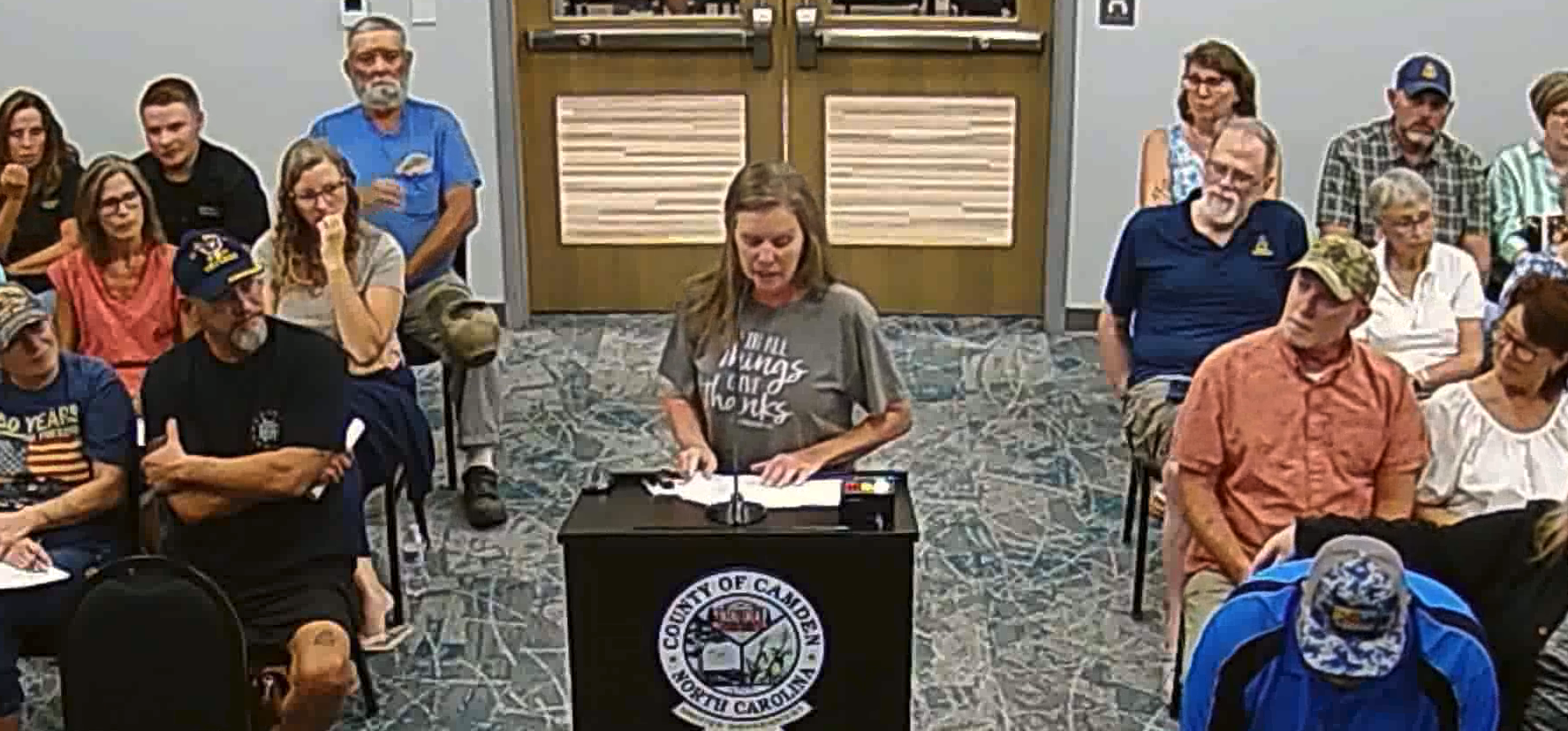
Samantha Nadj made a passionate, fact-filled speech asking commissioners to think about the tradeoffs rural communities face. That’s a photo of her accompanying this story.
“I stand before y’all tonight because I believe small rural communities deserve to have their voices heard before massive data centers are approved, and I hope that you will vote in favor of the moratorium. These facilities are often promoted as engines of economic growth, but for many rural towns the costs can outweigh the benefits. Data centers require enormous amounts of electricity and water. Resources that our communities rely on every day,” she said.
Citing Congressional Research Service estimates, Nadj said a single 100-megawatt data center can use as much water as roughly 2,600 households, and that rising data center electricity demand in the regional PJM grid — which serves Camden — has already been linked to higher capacity costs. “Rural communities often receive surprisingly few permanent jobs once construction is complete,” she said. “Growth should benefit the people who already live here, not come at their expense.”
Joshua Penick, who said he lives in Pasquotank County but visits Camden often, welcomed the pause. “The natural beauty of Camden is a reason I love to visit here and spend a lot of time here,” he said, adding that industrial development could push away the “peace” and “quiet” that draw people to the area.
Dana Smith, who described herself as a litigation paralegal with access to materials from ongoing data-center lawsuits in Texas, raised concerns about noise and possible effects on livestock near existing facilities elsewhere. “These data centers can put off eighty decibels of sound,” she said, comparing it to a dishwasher running continuously, and said sound from larger facilities can reportedly be heard for miles. She offered to share litigation materials with the board.
Martin Hare and Jerry Legaux urged the board to adopt the longer, 12-month version instead of the five-month draft, arguing that more time was needed to gather outside expertise before deciding the county’s long-term approach. “The shorter period of time that you give yourself to consider facts and to look up data, the heavier burden you put upon yourself,” Hare said.
Others, including Virginia Albertson and Francisco Salmeron, said they were open to data centers under the right conditions but supported taking time to study the issue first. “We set the rules,” Salmeron said. “We need to study the entire facts, not just yes, no.”
Board opts for the shorter timeline
After more than a dozen speakers addressed the board, Banks closed the public hearing and asked commissioners whether they preferred the 12-month or five-month version. Burke told the board that five months was enough time to draft language formally listing the uses as prohibited, noting that staff had already begun that work and that nothing would prevent continued study afterward. She also flagged legal exposure tied to moratoriums generally. “When you are under a moratorium, you are always subject to legal consequences should that be challenged,” she said, adding that the county has not seen local moratorium challenges yet but that state lawmakers “have not been so friendly to local government decisions in the last few years.”
After an informal poll showed support for the shorter option, commissioners voted to adopt the ordinance with the five-month term, running from August 3, 2026, through January 3, 2027, or until a permanent zoning amendment is adopted, whichever comes first. The motion carried without opposition.
County officials emphasized that no company has yet applied to build a data center or cryptocurrency mining operation in Camden County. The moratorium is intended as a preventive measure while the county drafts formal zoning language, with the board free to direct further study of infrastructure standards, noise limits or other conditions once that language is in place.
Make a one-time donation
Make a monthly donation
Make a yearly donation
Choose an amount
Or enter a custom amount
Your contribution is appreciated.
Your contribution is appreciated.
Your contribution is appreciated.