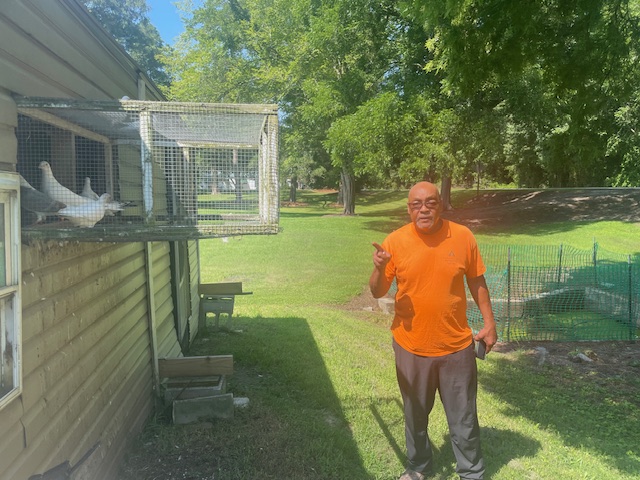
These birds can travel very fast over great distances, but prefer their home in Washington County
By Miles Layton
ROPER — Thomas Davenport feeds his birds and his dog before he feeds himself. Every day, without exception. It’s a small ritual, but it says almost everything about the 65-year-old Roper man and the eighty or ninety pigeons he keeps in a coop behind his house.
“My birds eat and my dog eats before I eat every single day,” Davenport said. “You know, every single day they come first.”
That kind of devotion doesn’t come from nowhere. It was built over nearly six decades, starting on a rooftop in New York and carrying all the way to a quiet lot in Roper, where Davenport now spends his days as one of the region’s most dedicated keepers of homing pigeons — a man who talks about his birds less like livestock and more like old friends who happen to have wings.
If you have a story to tell — everyone has a story to tell — my email address is mileslayton1969@gmail.com
The story was originally published in the Roanoke Beacon.
A Boyhood That Never Really Ended
Davenport grew up splitting his time between two worlds — Roper in the warmer months with his grandmother, New York with his mother and father’s side of the family the rest of the year. It gave him, as he put it, “both sides (North and South).” But it was on the rooftops of his New York block, somewhere around age nine or ten, that the thing that would define his life took hold of him.
“The whole block, all the little boys and stuff, they called the neighborhood coop,” Davenport recalled. He and the other kids on the block built lofts out of old wooden milk crates hauled up to a rooftop, nailed together, patched where the wire had worn through. None of them had money for real pigeons, so they earned it the only way they could.
“We were all kids, we didn’t have any money,” he said. They’d carry groceries to cars outside a local store for whatever change people would spare — a nickel here, a dime there, a quarter on a good day” until he was able to afford a bird.
Those first birds were what Davenport calls “flights” — not true homing pigeons yet, just young birds penned up for a few weeks and released to circle the block before drifting back down. It wasn’t sophisticated. It didn’t need to be. “We just sat there, fascinated watching them flying,” he said, and something about that image — a boy on a rooftop, watching birds circle against a city sky — never left him.
When he came to stay with his grandmother in Roper, Davenport found a local pigeon keeper named Mike Griffin and attached himself to him completely, chasing down wild birds in every abandoned barn he could find.
A Man Who Knows His Birds, and Is Known by Them
Ask Davenport what makes pigeons special and he doesn’t start with statistics — he starts with recognition. His birds know him, and he knows them, in a way that took years of quiet, repeated presence to build.
“My birds know me very well,” he said. “I walk back there, they’re all over the place. You walk back there, they get scattered because they don’t know you. See, they feel no threat from me because I’m there for them every day, you know?”
That trust, he says, is earned through nothing more glamorous than showing up. Davenport can teach a bird its name simply by pairing the sound with food, over and over, until the association sticks.
“If I constantly go to that bird and I say Pete… and I am giving him something out of my hand to eat or something. Then when he hears Pete, he is looking for something to eat,” Davenport explained. “So it’s repetition.” Given enough time, he says the bond becomes almost physical — he can stand in his backyard, raise his arms, and watch birds come land on him. He can send his flock spinning right or left in the sky with nothing but a gesture, calling them higher, then bringing them back down, standing in his yard like a conductor.
“How did you learn how to do this?” he was asked. “No, no, it’s just being around things and watching and learning,” he said.
There is real tenderness in how he describes handling them, too — never rough, never forced unless it has to be. “You go to your birds and pick them up gently,” he said.
Pride, Worry, and the Long Way Home
Nothing captures what these birds mean to Davenport quite like the way he talks about watching them leave — and waiting, sometimes for days, to see whether they’ll come back.
He remembers vividly the morning his son released four birds near Beacon, New York, hundreds of miles from Roper. The call came at 5:30 in the morning. “He said, ‘Pops, the birds are in the air,’” Davenport recalled. Then came the waiting — the not-knowing, the doubt creeping in. “I’m sitting back and I’m like, ‘these guys are never gonna make it back. Oh, I wondered if I had lost my birds or what?’” That afternoon, one bird finally appeared, dropping out of the sky “with wings tucked back coming in like a bullet.” The next morning, two more were waiting in the yard. Only one didn’t make it. “Three out of four made it back and I was proud of that,” he said — pride, not disappointment, even with the loss folded into it.
He’s watched birds find their way home from Camden, South Carolina, and Marietta, Georgia, too, carried there himself on family trips and released to test what they could do. He couldn’t always time exactly how long the return trip took, since he was traveling himself, but the birds were always waiting for him when he got back. He talks about wanting to push the birds even further — maybe down to Texas, where his brother lives, just to see. “That’d be a bit much,” he was told. His answer was to bring up a bird released in Africa that made it home to England, over seven thousand miles, in fifty-five days. Next to that, he says, Texas would be nothing.
Ask him how the birds actually navigate and he’ll wave off the textbook explanations. “Some says, well, they go by smell. Then some say they go by landmarks. But see, I can’t agree with — I don’t agree with them,” he said, “because landmarks, how can it go by landmarks and I never took that bird to that place before to learn a landmark?” His own theory, arrived at from decades of watching birds circle before straightening out toward home, is that they orient themselves by the sun and the Earth’s magnetic field, the same way a person might read a compass. It’s not something he read in a book. It’s something he’s watched happen, over and over, in the sky above his own yard.
The Cost of Caring
None of this comes without worry or without loss. Hawks are Davenport’s most persistent fear — a threat he takes seriously enough to have reinforced the trap doors on his coop after hawks broke in and killed birds during lean winter months. He describes the terror in his flock afterward not with detachment, but with real sympathy for what the birds go through. “It’s like me and you going into a room and there is a lion in there and he’s a hungry lion,” he said. “I think to myself after seeing that lion, oh my god, what am what are we gonna do? That’s what the birds would think when seeing hawk in their coop.”
He manages his flock’s growth carefully, too, using dummy eggs so hens won’t overbreed — and even there, his reasoning is protective rather than purely practical. Simply removing a bird’s eggs, he explained, causes real distress. “Like any mother, they’re gonna get stressed out.”
Every bird in his coop wears a permanent leg band through the International Federation, a system Davenport clearly takes pride in maintaining — not for the paperwork, but because it means a lost or hurt bird can always find its way back to him. “Thomas Davenport, Roper,” he said, describing what someone would hear if they called the number on one of his bands. “Indeed my phone number. So I become a rescuer to them, you know.”
Still Fascinated, After All This Time
For all he’s learned in nearly sixty years around pigeons — the racing circuits, the six-hundred-mile competitions, the hundreds of books he’s collected — Davenport still talks about his birds the way a boy on a New York rooftop once did: with wonder that hasn’t worn off. “I could go forever with these birds,” he said. “I wish I could tell myself a little better than this, but… that’s my hobby. And I look forward to taking care of them as well. I take care of myself.”
It’s a quiet kind of devotion, built one repeated visit, one gentle handling, one anxious wait for a returning bird at a time. And for Thomas Davenport, it’s never once let go of him.


Subscribe — it’s free!


Let us know what you think by leaving a comment. Comments are subject to approval.