By Miles Layton
This is no ordinary book review, but a story from an interview about a book and a mother’s grief and transformation as a Christian.
To set the stage, before meeting Michele Lewis, author of “The Day the Doorbell Rang,” I was leaving a meeting with a friend – which turned into a long talk that offered a bird’s eye view of another story I’d written about a man we knew whose fortunes had changed and are changing, maybe not for the better. Right or wrong, thinking about that story brought forth feelings of guilt, which morphed into flashbacks of traumatic things I’ve written about as I walked up Broad Street to meet Michele to learn more about her grief, the loss of her son.
As a reporter, I’ve covered all sorts of stories over the years, some leaving a mark so much so that now, I’m beginning to see my past as regularly as a soldier leaving the battlefield after years of combat. I’ve covered many fatal car accidents, much like what happened to the Lewis family, talked to a wife who lost her husband – a soldier killed overseas – and been there the moment a mother’s hopes turned to grief when she realized her son was not coming home – a search/rescue operation was now a recovery mission to find his drowned body, killed in an unfortunate accident after slipping into a fast moving river.
That’s why this interview with Michele hits a little closer to home at a moment I needed to hear what she had to say the most.
I didn’t know what she was going to say – all I knew was that her book dealt with grief – her son’s death. This story is not a book review.
I’m not good with grief — never have been. Nobody really is, but I have a strange relationship with death. I can write about death and dying without emotion. I can watch a man die — years later come the flashbacks. As with all of us who’ve lost a loved one, there is the guilt and shame for not being a better son or a friend — a better person all around.
I want to believe that God was listening, so He made this interview happen. I learned a lot by listening to Michele, how she handled the loss of her son, how she transformed as a Christian and how she is healing as a parent.
I love this quote — “My greatest therapist is the Lord God,” Michele said. “He knows everything, and He’s heard it all.” She rejects the popular notion of neat, sequential stages of grief, calling it instead “this ugly, nasty bundle” in which anger, shame and guilt never fully disappear — they simply have to be laid, as she puts it, “at the foot of the cross.”
Michele, as with your stories about the small things that people do, that hidden hand that changes folks’ lives – a word, a deed – thanks for the interview – your words rang true.
Maybe someone can gain solace and truth from your book about your experiences.
‘I couldn’t leave the spot where my child had died’
Lewis will tell you plainly that she used to be a “mediocre vanilla Christian.” The kind who stayed under the radar, who avoided the big sins, who never expected God to speak to her directly. That changed on a drizzling Thanksgiving morning in 2015, on a two-lane road outside Frederick, Maryland, when Lewis lay down in the mud where her son’s truck had come to rest and told God she was never getting up.
“I told God that I wasn’t going to leave that spot, that I couldn’t leave the spot where my child had died,” Lewis said in a recent interview about her new book, The Day the Doorbell Rang.
It is the first time Lewis has been interviewed about the book, and she said she was nervous and excited going into it. What followed was one of the most searing conversations this reporter has conducted — an hour that moved from military postings and Chesapeake Bay retrievers to a mother’s vision of her dead son walking away with a stranger, laughing.
Who She Is
Lewis describes herself first and foremost as “a woman of faith.” She has been married to her husband, George, for 37 years, a union that began at Fort Bragg, where she landed after a childhood spent following her own father, an Army soldier of 23 years, from posting to posting. Lewis was born in Okinawa; her brother was born in France. By the time her father retired at Fort Bragg, the family had moved constantly — and Lewis simply continued the pattern with George.
George Lewis’s own military story is a long and layered one. He enlisted, became a French linguist, and joined a Green Beret team in 5th Group and 3rd Group before earning a Green-to-Gold scholarship that commissioned him as an officer in military intelligence. He later moved into Joint Special Operations Command work that Michele says she still knows almost nothing about — “that’s when I don’t know where he went and I don’t know what he did,” she said — before commanding a Special Troops Battalion through deployments to Iraq and Afghanistan. He finished his 30-year career at the Pentagon, managing military intelligence budgets, and now serves on the local school board, a role Michele says he approaches “like it’s a military mission.”
The couple raised two children: a daughter, Lexie, who married a service member and has given the Lewises three grandchildren, and a son, Kristopher, who graduated from Bradwell Institute in Fort Stewart, Georgia, and played soccer at Methodist University in Fayetteville — the same school and the same position his father once played.
The Lewises found their way to the Northeast NC almost by accident, drawn first to the area by a real estate agent, Ann Perry, who then asked a simple question — what did they actually want in a community — and drove them to Edenton. They visited for two years before Kristopher was killed, pausing everything, and eventually bought the one house in town that Kristopher himself had walked through with them.
Subscribe — it’s free!
The Night Everything Changed
Kristopher Lewis was killed instantly in a collision with a tractor-trailer the night before Thanksgiving in 2015, driving his father’s F-350 home from visiting his girlfriend. Michele wasn’t notified until seven o’clock the next morning — hours during which, she said, she had gone about an ordinary morning, checking her computer, talking to a co-worker, “not knowing my son had been killed.” That gap has haunted her ever since.
“There was this overwhelming guilt,” she said. “Which, by the way, I have learned is nothing but the evil one. Guilt and shame are two of Satan’s strongest weapons. If he can make you feel guilty, and if he can make you feel shameful, he can take whatever situation you’re in and destroy you — because you’ll be your own worst enemy. Then he doesn’t have to do anything.”
The day after the crash, Lewis went to the site with George and lay down in the mud where the truck had rested. That is when, she says, she heard a voice — stern, unmistakable — tell her to get up.
“Now, when I tell you this, you are probably going to think I lost my mind too,” Lewis said, “because I never was that Christian who says, ‘I am a prophet,’ or ‘I hear this,’ or ‘I dream that.’ My goal was to stay under the radar.”
She stood, walked several paces away, and turned back toward the site. What she describes next reads like a vision: her son stepping out of the wrecked truck to face a man she never saw clearly from the front — long dirty-blond hair, a sand-colored tunic, a strong back. The man told Kristopher, “Dude, come on. We got things to do.” Kristopher protested that he couldn’t leave his family. “I’ve got your family covered,” the man answered, and Kristopher’s face relaxed. As they walked away together, Kristopher asked, “Dude, where were you?” The man answered, “I was in the bathroom” — and the two of them laughed.
Lewis was stunned. It wasn’t until 2:30 that morning, digging through a childhood memory box for Kristopher’s baby book, that she understood why the exchange felt so familiar. Years earlier, driving five-year-old Kristopher to kindergarten in Arizona, she had pointed to beams of sunlight breaking through storm clouds over the mountains and asked what he thought they were. “Those are all the angels coming down for who they’re going to be with today,” he told her — and when she teased him, asking where his guardian angel had been the night before when a friend accidentally struck him in the eye with a hockey stick, he answered without hesitation: “He was in the bathroom.”
“It was that moment I knew my son did not leave here alone,” Lewis said. “God gave me just enough knowledge to say, ‘I got him covered. You got things to do and you don’t need to worry about him.’ … And that’s when I did become the Isaiah 6:8 ‘send me, Lord.’”
Faith as the Only Way Through
Lewis is careful to say she is “no theologian.” But her faith has become the architecture of how she has survived the ten years since — years, she says, that included many nights face-down on the floor, sobbing.
She describes grief as standing at an inescapable crossroad. “I don’t care if you are an atheist, I don’t care if you are agnostic,” she said. “There is something in you that wonders, is there something bigger than me? … There’s no middle ground in that kind of grief.”
Her advice to anyone suffering loss is simple and unwavering: talk to God, and give yourself grace. “My greatest therapist is the Lord God,” she said. “He knows everything, and He’s heard it all.” She rejects the popular notion of neat, sequential stages of grief, calling it instead “this ugly, nasty bundle” in which anger, shame and guilt never fully disappear — they simply have to be laid, as she puts it, “at the foot of the cross.”
Lewis also credits her marriage’s survival to a promise she made to George the evening they were notified of Kristopher’s death.
“We have to hang on to each other because this is going to destroy our family,” she remembers telling him. “We have to stay so close to each other, and we cannot let this destroy us.” She has watched grief divide other families and was determined it would not divide hers — even as she and George grieve in starkly different ways. She speaks Kristopher’s name daily; George, she said, cannot say it without tears instantly falling.
Writing as Ministry
The Day the Doorbell Rang grew out of what began as informal Facebook posts, small reflections Lewis wrote as she noticed herself seeing the world differently after Kristopher’s death — more compassion for the bitter, the homeless, the broken. Readers began telling her the posts had helped them. That response, she said, revealed something larger: “There is grief everywhere, and people don’t know how to handle it.”
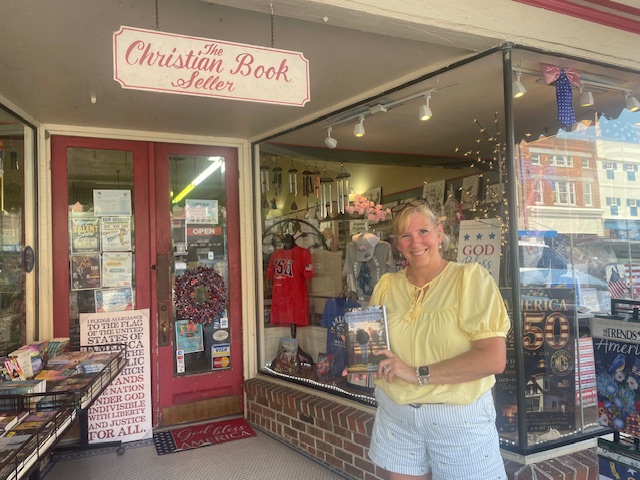
Lewis takes no profit from the book. Buy the book at the Christian Book Seller in downtown Edenton – please shop local – or do the whole Amazon order thing to support a billionaire. Or you can reach out to Lewis directly and she’ll sell you a book.
Every dollar from book sales goes to the Kristopher Fielding Lewis Foundation, which funds scholarships at John A. Holmes High School.
“We present scholarships in Kris’ name each year to John H Holmes students,” she said. “Those scholarships are based on character — kids who may have good or average grades but absolutely have quality character — trustworthy, manners, and who others see as doers and givers.”
Michele believes she will see her son again, and that belief, she said, is what keeps her from wasting the years in between. “If I truly believe I’ll see my loved one again,” she said, “why would I waste the life I have?”
Make a one-time donation
Make a monthly donation
Make a yearly donation
Choose an amount
Or enter a custom amount
Your contribution is appreciated.
Your contribution is appreciated.
Your contribution is appreciated.


Let us know what you think by leaving a comment. Comments are subject to approval.