By Miles Layton
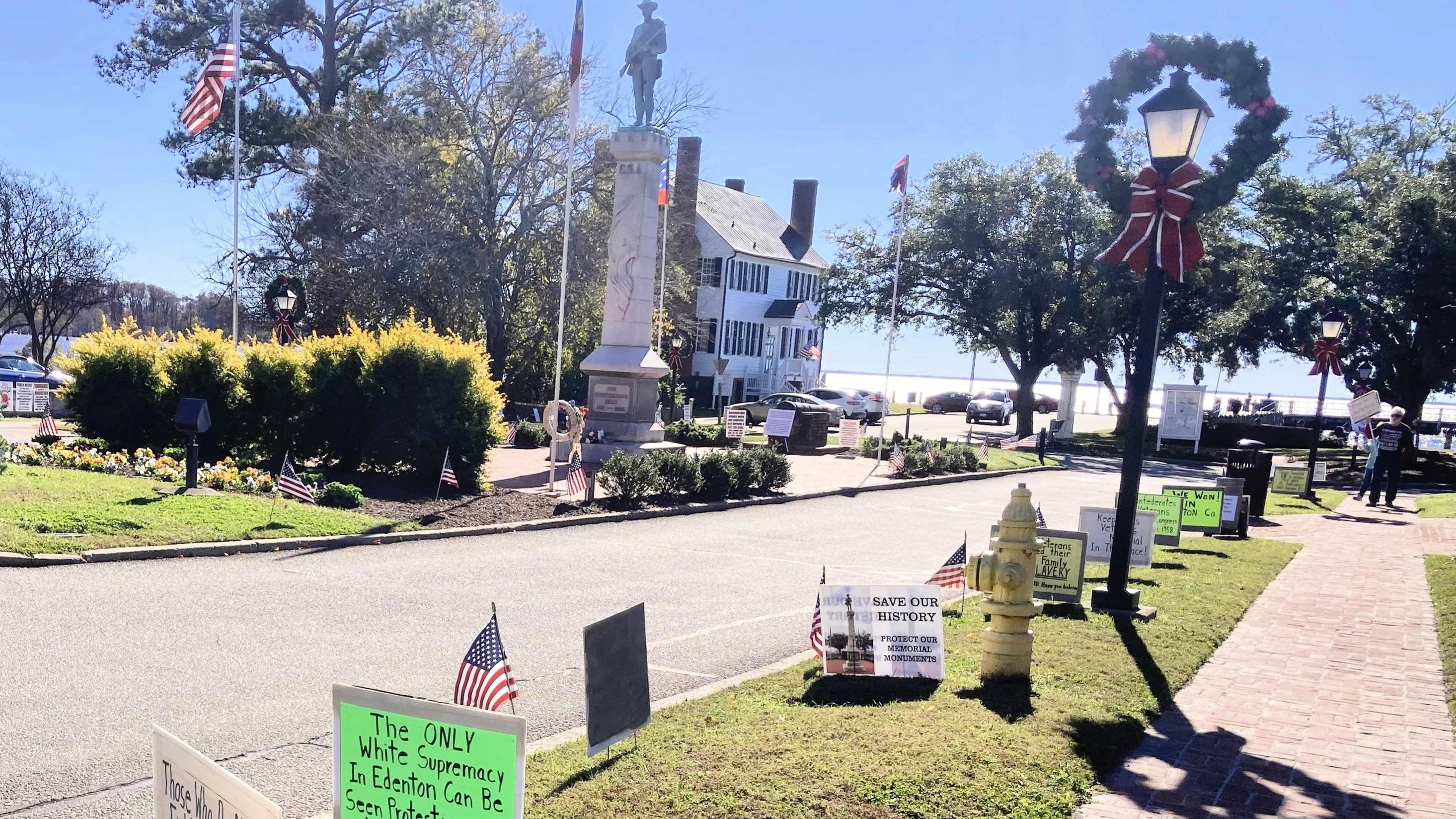
EDENTON — A legal battle over the fate of a Confederate memorial that once stood on Edenton’s waterfront is heading deeper into the courts, as heritage groups push back against efforts by the town to have their lawsuit thrown out altogether.
Since Tyrrell County’s case appears to be settled, I figured I’d do an update on Chowan County’s memorial. Long-story-short, regarding the monument’s future, we’re still in a holding pattern in the court system.
Unless the statue has been moved during the dark of night from the Chowan County Detention Center, it’s still collecting dust there after being moved around midnight on Labor Day weekend in 2025.
That said, I’m waiting to see if the Town, affected parties and heritage groups can come together, maybe work out their differences and place the monument somewhere – Veterans Park or maybe by the hospital, possibly even on the Courthouse Green, although I’m not going to hold my breath on that location.
If folks are OK with erecting a former plantation house — Martinique — by the waterfront downtown, ironically near where the Confederate statue once stood, then I guess anything is possible.
I just hope the statue doesn’t end up permanently in a closet somewhere, as Silent Sam did and as some of the others from Raleigh or Greenville did.
And yes, that is a file photo from 2024 accompanying this story. Also, I’m studying a detailed history of Martinique for a follow-up story that I’ll write when I get a spare moment.
Subscribe — it’s free!
As folks know, the case pits the United Daughters of the Confederacy, the North Carolina Division of the Sons of Confederate Veterans, and a local chapter, the Colonel William F. Martin Camp 1521, against the Town of Edenton and then Mayor Jimmy Stallings. At its heart is a simple but consequential question: do these groups even have the legal right to challenge the town’s decision to move the memorial from its longtime spot on the waterfront?
The case now sits with the North Carolina Court of Appeals, which will decide whether the lawsuit can move forward — a ruling that could determine whether the underlying fight over the memorial’s relocation ever gets argued on its merits at all.
In a reply brief filed in May with the North Carolina Court of Appeals, attorneys for the heritage organizations argue forcefully that they do — and that the town’s lawyers have twisted the law to suggest otherwise.
“Defendant’s response brief seeks to divert the Court’s attention from the specific facts of this case by misconstruing controlling case law,” the brief states, accusing the town of leaning on legal precedent that doesn’t actually apply here.
The plaintiffs say they have the right to sue for several reasons. As taxpayers, they argue, they’re entitled to challenge how the county spends public money — and moving the memorial, they say, cost tax dollars in a way that violated state law. They also argue the town committed what’s known in legal terms as an “ultra vires” act — essentially, exceeding its authority — and that the move ran afoul of a state law commonly called the Monument Protection Act, which restricts when and how historical monuments can be relocated.
The brief points to a string of older North Carolina court rulings backing up the idea that ordinary taxpayers have long had standing to sue when they believe local governments have misspent public funds or broken the law. One case cited goes all the way back to 1940, when the state’s high court ruled that Madison County residents could challenge a board of commissioners simply by virtue of being taxpayers — no special personal stake required.
Much of the brief is spent rebutting the town’s reliance on two more recent cases involving Confederate monuments elsewhere in the state, in which similar heritage groups lost their standing to sue because of gaps in how their lawsuits were written. The Edenton case, the plaintiffs argue, doesn’t have those same problems. “The complaint in the present case contains none of the defects that proved fatal to the plaintiffs” in those earlier cases, the brief states.
The plaintiffs also draw a comparison to a case out of Alamance County, where a different set of plaintiffs — the NAACP — successfully sued under the same Monument Protection Act to challenge the presence of a Confederate monument outside that county’s courthouse. The Edenton groups argue that if those plaintiffs had standing to sue under the law to get a monument removed, then heritage groups should have just as much standing to sue under the same law to stop one from being removed.
“The parallels between Alamance and the present case are undeniable,” the brief argues, noting that both sets of plaintiffs are nonprofit groups engaged in educational and historical work suing on behalf of their members. “Either the plaintiffs in Alamance and those in the present case all have standing or none of them do.”
The brief leans on a similar argument involving a more recent appellate ruling out of Gaston County, where plaintiffs likewise prevailed in a fight over a Confederate monument’s place on courthouse grounds.
Beyond the taxpayer and procedural arguments, the heritage groups also assert a constitutional right to sue, pointing to a section of the North Carolina Constitution that allows residents to challenge government actions even before any harm has actually occurred — so long as there’s a credible threat of injury. They reject the town’s characterization of an earlier ruling involving the UDC, arguing the court in that case never actually ruled against the group’s constitutional standing — it simply found the group hadn’t raised that particular argument at the time.
The brief closes with a broader appeal about accountability, arguing that towns and counties don’t get to sidestep state law just because it’s politically convenient to do so. “Local governments cannot ignore the state Constitution and laws passed by the Legislature for any reason, especially for political expediency,” the filing states, warning that shutting the door on the lawsuit “would be a profound dereliction of the rule of law.”
The brief was filed by Winston-Salem attorney James Barrett Wilson Jr. on behalf of the heritage groups. The Town of Edenton is represented by attorneys M.H. Hood Ellis and Zachary M. Robeson of the Elizabeth City firm Hornthal Riley Ellis & Maland, along with attorney Henry Edward Phillips III.
One response to “Confederate Heritage Groups Fight to Keep Monument Case Alive in Court”
It should have been left alone. They wanted it removed for greedy money for the waterfront. How come we the people of Chowan didn’t have a vote on the issue? What gives the town and the trouble makers or outside the control. I want our heritage restored to its location on the green state property. How can the town tell me that my ancestors lives meant nothing and given no respect. Just toss aside into storage to never be seen.It’s hurting to know my great-grandfather Boswell’s death meant nothing to Edenton. Also, my husband’s family, great-grandfather and great-uncle were in the Edenton Bell Battery. Where is the respect for their lives?