A local team of volunteer divers answers the call when tragedy strikes the county’s waterways
By Miles Layton
When I was getting gas Tuesday at the best Exxon station in Northeast NC, I talked to the station’s owner, Steve Taylor, who is a member of the dive and rescue team. I’ve always been fascinated by what the dive team can do and it’s important mission — a group of volunteers that serve all across our region.
By pure coincidence, Sheriff Basnight was getting gas too, so I pulled out my tape recorder, or rather pushed a button on my tiny phone, and talked to both of them, then ran into Chief Deputy McArthur, who was working across the street at the courthouse, for one more interview. There was a training exercise Tuesday evening at a local pond — they were to pull a vehicle out of the muddy water.
EDENTON — The water in Chowan County is everywhere — the river, the sound, the ponds tucked behind shopping centers and along rural roads. And in almost all of it, you can’t see your hand in front of your face.
That darkness is exactly where Steve Taylor, Sheriff Scooter Basnight, Chief Deputy John McArthur, and about seven other members of the Chowan County Sheriff’s Office Dive Team do their work — searching by touch and feel for bodies, weapons, and evidence when no one else can get there fast enough.
The team has been operating for roughly a dozen years, born out of a drowning tragedy that exposed a critical gap in the region’s emergency response capacity.
“We started the dive team up after a drowning out at the Chowan River bridge, and it took 24 hours for a dive team to get here,” Taylor recalled. “We felt like if we had a team here locally, we wouldn’t have to wait 24 hours to get somebody here to help cover a body or something like that — in case, you know, closure for a family. You know, the longer you wait for a family closure, the longer it takes.”
Basnight echoed that founding mission.
“It started as a way to give to our county because we had had a death that it took them so long to get a dive team there,” said Basnight. “So, once we started the dive teams, it was a way to get that family closure quicker. Now, if we know it’s someone that just gone down, we can be there hour, hour and a half and start giving that family closure. It’s all about giving that family closure. Finding that person because they need to know. They don’t want to sit there and have false hope that, well, maybe they’re — they need to know so they can start the process of grieving and get the closure.”
In the years since, the team has been called not just within Chowan County but across the region — Bertie County, Washington County, Tyrrell County, Martin County, Pasquotank County, and Gates County, among others — recovering bodies, vehicles, and criminal evidence.
A gallery of photos from the dive team appears at the end of this story.
Subscribe — it’s free!
A Science Experiment at 90 MPH
One of the team’s most striking recoveries came after a shooting in Edenton led to a high-speed chase across the Chowan River Bridge a few years ago. During the flight, someone in the suspect’s vehicle threw a handgun over the bridge railing and into the water below.
“Edenton Police Department called the sheriff’s office and asked, ‘Could we go dive that location?’” McArthur recounted. “The officer at that time made a mental note of where that incident happened. They were able to make an arrest in Bertie County when the vehicle wrecked.”
The team deployed and began methodical arc searches around the area the officer had marked on the bridge. For hours, two divers worked intersecting circles along the riverbed — in roughly twenty feet of pitch-black water — and found nothing.
“We don’t know where it is, but we know where it is not,” McArthur said, describing the team’s approach when a search comes up empty. “So it was not in that area.”
What came next was equal parts ingenuity and science. The team loaded a brick into a vehicle and drove it across the bridge at approximately 90 miles per hour, throwing the brick from the window at the same point the gun had been tossed. Divers on the water watched the brick sail over the railing.
“It skipped on the water, just like you skip a rock on the water. It skipped and then it sank, and we marked where that brick sank,” McArthur said. “And ten minutes later, we had found a gun — extremely close to where that brick had sunk.”
Black Water Training
The team trains through ERDI — Emergency Response Dive International — a rigorous program that takes divers well beyond recreational certification.
“Steve and I, when we started it, we took it all the way to become dive masters. And that took us from basic scuba divers to advanced scuba divers, to working through to getting our divemaster,” Basnight explained. “And just because that certification gives us more comfort in the water, helps us know what type of people to look for to join the team — because everybody says, ‘I’m a scuba diver, can I do it?’ Not necessarily, if you don’t have the right mentality.”
The training is intensive — three solid days of classroom instruction, surface exercises, and time in the water learning search patterns tailored to different objectives and environments. But the signature skill the team develops is something that goes against every instinct: learning to operate completely blind.
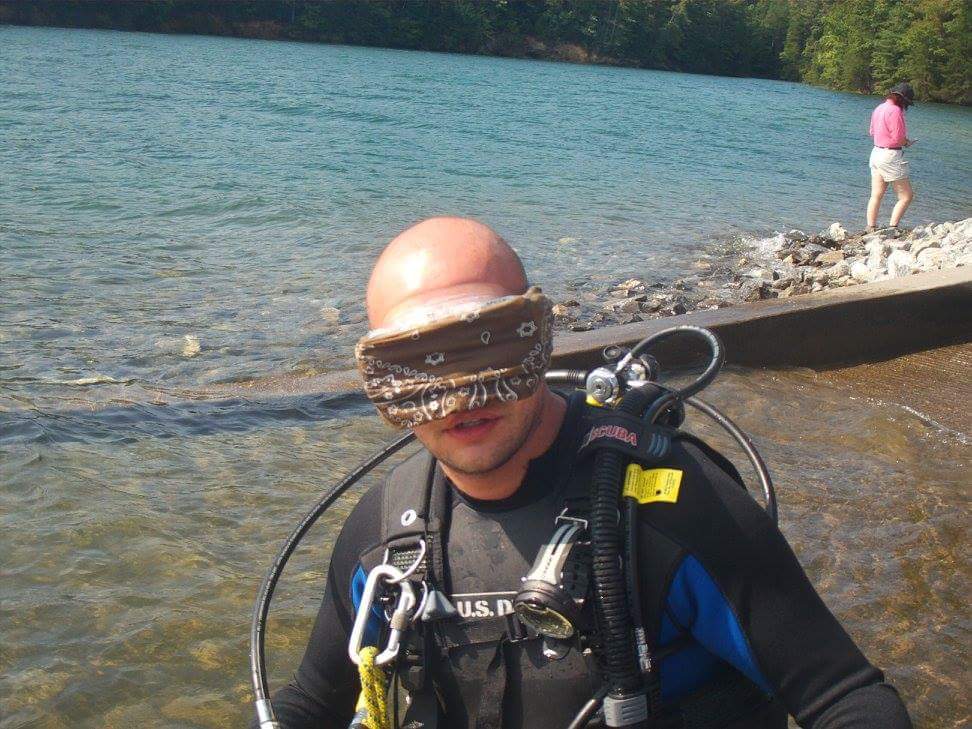
“We are a dive team that focuses on training in black water,” McArthur said. “We actually put blindfolds on in some of the water that we train in because not all water is dark like ours. We went to the mountains and dove there, and there the water is very clean and clear. But so we put blindfolds on so that we could know what it feels like to be diving and not have any use of your sight, and you’ve got to search for something underwater that you can’t see. You just use your hands.”
The system relies on a tender line — a rope connecting a surface handler to the diver via a harness — and a methodical arc-pattern search. The type of item determines how tightly the arcs are spaced.
“If it’s a body, it’s more distance that you let somebody out. If it’s something small like a firearm, you might want to let out two feet,” McArthur explained.
Taylor made the distinction plainly: “A regular diver can’t do what we do. What we do in the training is so much more intense — to be able to know how we do what we do compared to just normal diving. A normal diver couldn’t do what we do.”
The Human Cost — and the Relief
The team’s work is not merely technical. It carries an emotional weight that never entirely goes away.
“When you’re raising a body up out of the water, you do not want to look him in the face,” Taylor said quietly. “Because if he’s staring at you, you’re gonna remember that.”
But for Basnight, looking at the face has become part of the job.
“I do look at the face for identification,” the sheriff said. “But there’s a peacefulness on their face when we get them on the boat. When you find them and you deliver that message to the family, there’s — of course families grieve in different ways and they break down crying. But there’s always somebody in that family who comes up and thanks us for what we did, for how — that they now have the information they need to continue living.”
Basnight recalls how he drove to Elizabeth City one morning to personally deliver word to a family after the team recovered a man who had jumped from the sound bridge overnight.
“It’s hard, but you get to see relief,” he said. “The relief on their face, because it’s nice to be able to tell them your loved one was found.”
McArthur offered one unexpected bright spot from the team’s work — a stolen pickup truck he had investigated years earlier, discovered on the bottom of the Roanoke River during a separate search.
“That was a happy ending for me for closure on an investigation,” he said. “When you have that body, that’s something to provide closure for the folks that love that individual.”
Known Dangers in Unknown Water
The hazards the team faces go beyond the darkness. Entanglement, wildlife, and powerful currents all present real threats.
“Snapping turtles are a big concern,” McArthur said. “If I rub my hand across a snapping turtle and it scares them, he could literally bite my finger off. And then you have entrapment concerns — trees that have fallen from shore into the water. If my line gets entangled in those branches and I can’t break free, eventually I run out of air underwater.”
The Roanoke River carries an additional danger: current.
“Water is a powerful, powerful element that can move — can literally move mountains and boulders,” McArthur said, recalling a swift water rescue mission in Pitt County following Hurricane Ivan. “There was a whitewater river, and those rapids would never be the same, because those boulders had all been moved. When you are in the Roanoke River, there is rocks, there is trees, there is vehicles that are being moved around and present dangers to our team members.”
Back home, even the Chowan presents challenges that surprise the uninitiated.
“Right near in front of the Barker house, that water right there is as black as any water you’ve ever wanted to see, especially at the bottom where we work at,” Basnight said. “There’s a layer, probably a foot and a half or so, of silt and everything down there that when we lay our lines in it, they disappear. So you’re down there and you’re feeling and you realize you’re up to gunk. You put the gauge right to your mouth. Still can’t see it. It’s just pitch black.”
Running on Donations
Despite their reach and record, the team operates almost entirely on donated funds. The county once provided a budget line item, but it barely covered equipment maintenance and insurance. The team’s biggest financial boost came from a family whose loved one they helped find.
“Most of it’s donations,” Basnight said. “The biggest donation came from a citizen whose family member we found, or we were associated with finding. That was really the jumpstart to get our team going.”
The team is intentionally local by design. McArthur explained that while the team could register as a statewide deployable asset with North Carolina, Sheriff Basnight has chosen to keep the focus close to home.
“The citizens of Chowan County pay taxes for those resources to be here, and our office is not so large that we can afford for three to four members of our sheriff’s office to go somewhere else in the state to participate in a recovery when we need those resources here in Chowan,” McArthur said. “We are surrounded by water on three sides. We want to be available here, and hopefully we never get used — but if we are needed, we want to be able to provide that service to our people that pay taxes.”
The team is currently exploring new technology that would reduce the need to put divers in the water at all, including an underwater radar system that can locate submerged objects from the surface. McArthur said he strongly supports any advancement that reduces risk.
“Any time that we can use a piece of technology and keep a human being out of that dangerous situation, I’d recommend doing that,” he said.
Those wishing to support the Chowan County Sheriff’s Office Dive Team can write a check to the Chowan County Sheriff’s Office — noting “Dive Team” in the memo line — and mail it to P.O. Box 78, Edenton, NC 27932, or deliver it in person to the sheriff’s office.
“Always need donations,” Basnight said simply.
Click image to make the photo larger.


Let us know what you think by leaving a comment. Comments are subject to approval.