By Miles Layton
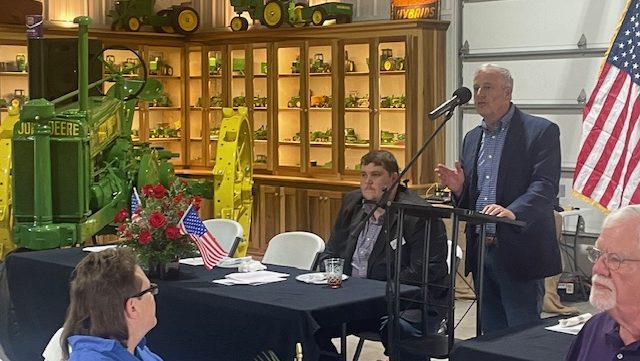
WASHINGTON COUNTY — The setting for Saturday night’s “Salute to Service” Memorial Day fundraiser said everything about what the Republican Party was trying to celebrate.
Harris Farm — all 1,700 owned acres of it, with thousands more under cultivation — belongs to Mike Harris, a man who started with nothing and built one of the most formidable agricultural operations in eastern North Carolina through sheer will and relentless work. Harris did it on one leg, but if the loss slowed him down, the farm doesn’t show it. Row after row, field after field — Harris Farm stands as a living monument to what the conservative faithful call the American dream: the idea that if you work hard enough, long enough, and refuse to quit, you can build something from nothing in this country.
It was on that ground, and in that spirit, that the Washington County Republican Party brought together candidates, veterans, and conservative faithful Saturday evening for an event that served equal parts patriotism and political fire.
The gathering drew a slate of Republican candidates from across eastern North Carolina, all united by a common message: the 2026 elections represent the last, best line of defense for President Donald Trump’s agenda — and for the soul of the state.

Why cover this story? Because it’s not every day that US Senate candidate visits our neck of the woods and that party standard bearers pay a visit to Washington County, so I thought it would be a good idea to hear what they had to say up close in person rather than trust soundbites filtered by the mainstream media that hates Republicans and rural America.
Featured photo shows Republican US Senate candidate Michael Whatley making his pitch to Eastern North Carolina voters.
More to come from this event. Also see the Roanoke Beacon, the emerging voice of Eastern North Carolina.
Subscribe — it’s free!
Watley: ‘Her Blood Is on Roy Cooper’s Hands’
The night’s marquee speaker was Michael Whatley, the Republican nominee for U.S. Senate and former state party chairman, who wasted little time pivoting from solemn tributes to veterans into a blistering indictment of his Democratic opponent, former Governor Roy Cooper.
Whatley opened on a note of reverence. “Almost ten percent of all the armed forces around the country are based here,” he told the crowd. “We have seven hundred twenty thousand veterans. They call North Carolina home more than any other state in the country. And we owe those veterans more than just our thanks. We owe them a duty. We have a responsibility to be there for them because they were there for us.”
But reverence quickly gave way to combat.
On the economy, Whatley was unsparing. “Roy Cooper raised your taxes when he was a legislator,” he said. “This is a guy who vetoed tax cuts six times when he was the governor. When he announced he was running for Senate, he said, ‘I would have voted against the one big beautiful bill.’ Why? Because he wanted every one of you and every household across this state to pay $5,700 more in taxes than you just did on April 15th. He wants you to pay taxes on tips. He wants you to pay taxes on overtime, and he wants you to pay taxes on social security. This man has never seen a dollar he didn’t want to tax and spend. I’ve never seen a tax I didn’t want to cut.”
Whatley’s sharpest accusations, however, concerned the release of thousands of inmates from North Carolina prisons under Cooper’s watch. “Roy Cooper let him out because he didn’t want them to get sniffles in a cold while they were in prison,” Whatley said. He described the now-unsealed list of released offenders as proof that Cooper “lied to you. He lied to this state. There were hundreds of people on that list: aggravated assault, assault with a deadly weapon, sexual assault, murder — seventy of them committed murder. Fifty-three of them were serving life sentences.”
One case drew particular emotion from the Senate candidate. He described how a man named Carlos Brown Jr., released by Cooper, was re-arrested and released thirteen more times in Charlotte before boarding a light rail car and killing a Ukrainian refugee named Iryna Zarutska. “Iryna Zarutska should be alive today,” Whatley said, his voice hardening. “That monster should have never been on the street. That monster should have never been on that light rail car. She should be alive today, and her blood is on Roy Cooper’s hands.”
Whatley also rebuked Cooper’s response to the summer 2020 riots. “Back in 2020 when BLM and Antifa were burning down our cities and burning down Raleigh — did he call in the National Guard to put down those riots? He did not. He went out and marched with them.”
Turning to what he described as the stakes of the race, Whatley framed the contest in sweeping terms. “It comes down to one vote in the United States Senate. It’s a vote for common sense. It’s a vote for North Carolina first. It’s a vote for America first. Or it’s a vote for New York and California and Chicago values, special interests, and a woke radical mob.”
The race, Whatley predicted, will be the most expensive Senate contest in history, with between $600 million and $800 million expected to flood North Carolina. His answer to that torrent of outside money: “I got you. The only thing that cuts through that clutter, that cuts through that noise is a five-minute conversation that you have with someone who knows you and someone who trusts you.”
A native of Blowing Rock, a Blue Ridge mountain town of 534 people, Whatley described a life of hard work — washing dishes at 14, paying his own way through college, law school, and eventually serving as chief of staff to Senator Elizabeth Dole. He called his Senate candidacy an extension of that story, one he wants replicated for every family in the state. “That’s the American dream: get an education, get a job, get married, buy a house, raise your kids in a safe and secure environment and see them go do better things than you do.”

Sanderson: Cooper Vetoed More Legislation Than All Other Governors Combined
State Senator Norm Sanderson, the District 2 Republican running for re-election, offered the crowd a legislative reckoning with Cooper’s record before turning to a warning about what comes next.
“Roy Cooper vetoed more of our legislation than all the other governors in the history of North Carolina combined,” Sanderson declared. He described the satisfaction legislators felt overriding those vetoes. “We love to override Roy Cooper’s vetoes. I’ll tell you what, it made our day when we could go in and bring a couple up and vote on them and override his vetoes and send them back to him.”
Sanderson also drew a direct line from Cooper’s COVID-era governance to economic harm. “The one year that we did not have a revenue surplus was the year that Roy Cooper shut the state of North Carolina down during COVID,” he said. “One year out of ten. He took that opportunity away from us by shutting all the businesses down, shutting everything down including our churches. I often wondered why Walmart stayed open and ABC stores stayed open, but we had to close our churches.”
By contrast, Sanderson described a decade of Republican stewardship that has made North Carolina a national model. “We’ve been cutting taxes, we’ve been reducing regulations, and we’ve been making the business environment attractive to outside businesses. North Carolina is growing in the top five in the nation as fastest-growing states. We’re again this year ranked number one in the United States for business.”
On the urgency of the 2026 cycle, Sanderson issued three direct challenges to every voter in the room: support candidates financially, pray daily for elected officials, and personally escort at least two people to the polls. “The last thing we want to do is to put Don Davis back in office,” he said. “Or to see Roy Cooper go to Washington, D.C. to represent us. We have got to send help for Donald Trump to Washington, D.C., because he needs our help, he needs your prayers, and he needs people that will go up there and stand with him.”

Buckhout: ‘I’ll Crawl Through Broken Glass for Every Single One of You’
Laurie Buckhout, the Republican candidate taking on incumbent Democratic Congressman Don Davis in North Carolina’s 1st Congressional District, delivered one of the night’s most impassioned addresses — part military memoir, part frontal assault on her opponent’s record.
Buckhout, whose father was an Army colonel who served in World War II, Korea, and Vietnam — shot down three times in Vietnam, held as a POW in Germany — called her family’s military legacy the foundation of everything she believes. “I grew up with a legacy of hard work,” she said, describing a childhood of stacking hay bales and climbing ropes in rural Virginia’s Shenandoah Valley. She went on to serve in the U.S. Army herself, including a deployment to Iraq where she commanded troops in situations she described with quiet understatement as moments when “I really thought I was going to die.”
She reserved her sharpest words for Davis. “I’m going to hit him on throwing those ethics away that he should still have in his heart,” she said, describing the ethics of military service — selflessness, integrity, responsibility — that she argued Davis has abandoned after nearly three decades in elected office. “He’s been a career politician for about twenty-nine years: mayor, serving in the state house, serving in the state senate, going to Congress. That’s all he’s ever done.”
On Davis’s congressional record — one bill… — Buckhout was blunt. “You know what that bill is for his five years in Congress? To rename a post office.” She accused Davis of falsely claiming credit for federal defense spending secured by Republican appropriators. “He did not get that money,” she said. “That came out of appropriations. It came out of Republican lawmakers in Texas and Florida who brought that up. When it finally got to the floor of the House, he miraculously woke up and said, ‘I guess I’ll vote for that,’ and went back to sleep again.”
She also took Davis to task for voting against the One Big Beautiful Bill while endorsing Kamala Harris for president — the same candidate who served as what Buckhout called “the border czar.” “He talks out the side of his mouth, does one thing, says another.”
Buckhout framed the race in existential terms. “If we lose this fight, Trump’s agenda is gone,” she said. “House Bill One is going to be to impeach Donald Trump.”
Buckhout closed with a soldier’s vow. “I am not Don Davis. I am not going to say one thing and do another. I’ve got a lifetime of integrity, of hard work, of putting others before myself. And I’ll throw myself on that grenade for every single one of you.”

Sawyer: Service Is ‘the Alarm at Two in the Morning’
Jonathan Sawyer, Washington County GOP chair as well as a civic leader and a candidate for Washington County Commission, offered perhaps the evening’s most personal remarks.
“This day belongs to the ones who did not come home, the ones whose service cost them everything,” Sawyer said. “Somewhere tonight there is an empty chair at a family’s table. There has been for years. A mother, a father, a husband, a wife, a child who learned that freedom is not free. Because they paid for it in the hardest currency there is.”
A captain at Roper Volunteer Fire Department with about a decade in the fire service, Sawyer grounded his candidacy not in policy platforms but in a code of conduct. “The firehouse taught me what service really is,” he said. “It isn’t a title, it isn’t applause, it’s the alarm at two in the morning and you get up anyway.”
He pledged straightforward, accountable governance if elected. “I’ll treat every dollar the county spends like it came off your kitchen table, because it did. I’ll read every line of every budget. I’ll work to hold the line on property taxes, so the people who built this county can afford to stay in it.”
Washington County Commission Chairman John Spruill, who introduced Sawyer, vouched for him without reservation. “He’s a good young man,” Spruill said. “Anything that you guys can do to support him, I am sure he would appreciate it and I know that Washington County would too.”

The evening also featured remarks from Darren Armstrong, the Republican state House District 79 candidate who urged the crowd not to be discouraged by the perceived scale of the opposition — referencing a story about Ulysses S. Grant learning on the frontier that enemies always seem more numerous before they are counted. Former judge Jerry Tillet, the Republican candidate for state Senate District 1, offered brief and heartfelt thanks to those who serve. And Robert Burns, mayor of Monroe and a potential 2028 gubernatorial candidate, energized the crowd with a preview of his emerging campaign message: taking conservative governance to Raleigh and defending Trump’s national agenda from what he called relentless Democratic attacks.
Throughout the evening, one theme sounded again and again from every lectern: the 2026 elections in North Carolina are not merely about candidates or seats. They are, as Sanderson put it, “the most important one in our lifetime.” With Roy Cooper seeking a Senate seat and Don Davis defending his congressional district, the conservative faithful of Washington County left Harris Farm with both a charge and a challenge — to have the five-minute conversations, to find the neighbors who don’t usually vote, and to show up.
As Buckhout put it: “The big challenge this time is going to be get out the vote. We have enough Republicans in this district to win.”
Make a one-time donation
Make a monthly donation
Make a yearly donation
Choose an amount
Or enter a custom amount
Your contribution is appreciated.
Your contribution is appreciated.
Your contribution is appreciated.


Let us know what you think by leaving a comment. Comments are subject to approval.