
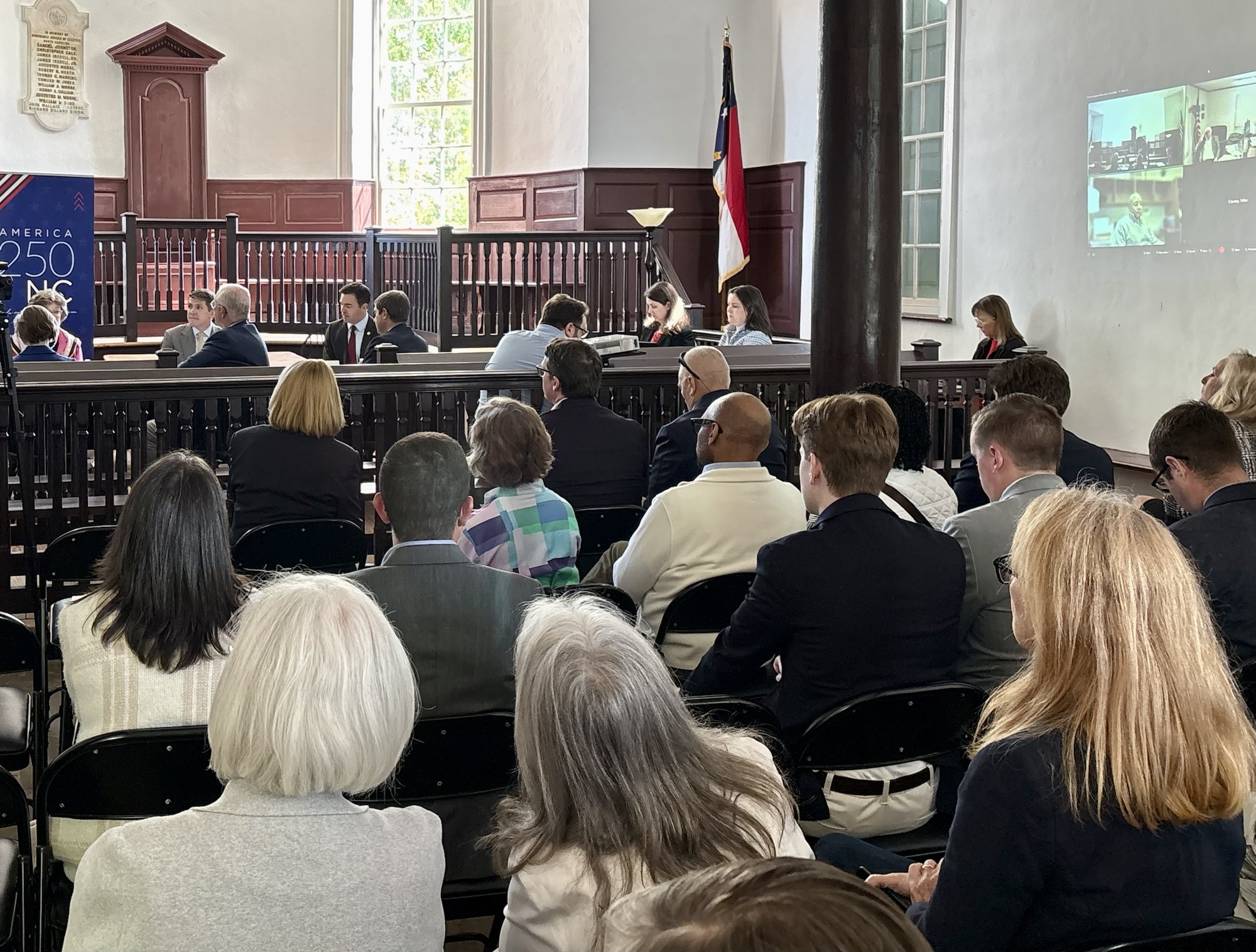
Gov. Josh Stein and members of the North Carolina Council of State brought their America 250 tour to Edenton on May 12, holding a cabinet-style meeting inside the historic 1767 Chowan County Courthouse while highlighting North Carolina history, economic development and statewide policy initiatives.
The meeting was part of the Council of State’s effort to travel across North Carolina during the nation’s semiquincentennial commemoration. The council previously met in Halifax and is scheduled to continue the tour later this year with meetings planned in Currie and New Bern, according to the Office of State Budget and Management. The traveling meetings are designed to connect state government with communities that played major roles in North Carolina and American history.
Stein opened the meeting by noting the significance of holding the session in one of the oldest courthouses in the state, calling it “a wonderful opportunity for us all.”
Edenton Mayor Hackney High, who arrived after the meeting began because of what he jokingly called “scheduling snafus,” apologized to the governor and council members before welcoming them to town.
“I am certainly grateful and have a heart full of gratitude that I live in the great state of North Carolina,” High said. “And I’m also as equally proud of being a resident and the mayor of this fine town, Edenton.”

High said the town was honored to host the governor and his leadership team and expressed hope the visit would not be their last.

“We’re so excited you guys are here,” High said. “We hope you have a good enough time that this will not be the last time.”


History highlighted
Throughout the meeting, council members repeatedly referenced Edenton’s colonial and Revolutionary-era history.
North Carolina Secretary of State Elaine Marshall highlighted the Edenton Tea Party of 1774, in which 51 women led by Penelope Barker signed a declaration boycotting British tea in protest of British taxation policies. North Carolina Secretary of State Elaine Marshall, who wore a Penelope Barker commemorative scarf during the meeting, described the protest as one of the earliest women-led political actions in American history. Marshall noted that unlike the anonymous participants in the Boston Tea Party, the Edenton women boldly signed their names to the declaration, which was later published in London.
Stein also reflected on Edenton’s role in the founding of the nation, mentioning signer Joseph Hewes, who later became the first secretary of the Navy, and Supreme Court Justice James Iredell. He described the town as “the center hub of activity that really helped create this nation.”
State Auditor Dave Boliek also highlighted Edenton’s historical ties to government accountability and financial oversight. Boliek spoke about Thomas Benbury, an Edenton native who served as sheriff, a Revolutionary War militia leader and later a customs and revenue official appointed by President George Washington. Boliek said Benbury helped establish early traditions of recordkeeping and financial accountability in the colonies and the young United States, calling him an important figure in the foundations of modern auditing practices.

Modern impact on NC
Several officials used the meeting to spotlight Edenton’s historical and modern-day contributions to North Carolina.
Labor Commissioner Luke Farley introduced Joan Maxwell of Regulator Marine, praising the Edenton-based boat manufacturer for its commitment to workplace safety. Farley noted that Regulator Marine became the first boat manufacturer in North Carolina to receive Carolina Star certification, the state’s highest workplace safety designation. He said only 144 employers statewide currently hold the voluntary certification. Farley also recognized Maxwell’s recent honor as North Carolina’s Marine Conservationist of the Year.
Boliek also noted several audits his agency has conducted. He noted that the state’s auditor of the Division of Motor Vehicles earned his agency a national auditor of the year award. He noted that the audit was a result of a statewide collaborative effort.

Statewide issues
Much of the meeting focused on statewide issues ranging from business growth and public safety to healthcare and agriculture.
Marshall noted North Carolina continues to experience record business creation. She reported the state set consecutive monthly records with 18,146 new businesses formed in March and 19,754 in April, surpassing the previous high set in 2021.
Marshall also noted that North Carolina set consecutive monthly records for new business creation during March and April 2026.
Recently, Marshall visited Moldova, North Carolina’s long-running partner. The relationship with the Eastern European nation began about 30 years ago through the North Carolina National Guard’s State Partnership Program, which paired the North Carolina Guard with Moldova’s military after the breakup of the Soviet Union. Over time, the military relationship expanded into a broader civilian partnership involving education, agriculture, economic development and government cooperation.
During the Edenton meeting, Marshall reported on a recent delegation trip to Moldova that included representatives from N.C. State University and other North Carolinians. She said one of the primary focuses of the partnership is agriculture, particularly helping Moldova develop agricultural extension services modeled after North Carolina Cooperative Extension. Extension has a statewide economic impact of $2.1 billion, Marshall noted.
Marshall said the partnership has helped support:
- agricultural research collaborations,
- development of rural extension offices,
- plans for Moldova’s first soil-testing laboratory,
- and broader economic and civic development efforts as Moldova works toward possible European Union membership.
She described the program as “people-to-people diplomacy at its best” and emphasized that much of the work is funded through federal grants and private partnerships rather than direct state appropriations.
Stein also touted North Carolina’s economic standing following his participation in the SelectUSA Investment Summit in Washington, D.C., where he promoted the state to international businesses.
“We’re the number one state for business for the third time in the last four years,” Stein said, while also noting North Carolina had more job announcements last year than at any time in state history.
Healthcare and Medicaid funding were also major topics. Stein praised lawmakers for passing legislation that fully funds Medicaid expansion, protecting healthcare coverage for approximately 745,000 North Carolinians, particularly residents in rural communities.
Attorney General Jeff Jackson discussed several major legal settlements, including an $11 million share for North Carolina from a nationwide settlement involving anti-competitive pricing practices related to EpiPens. He also described a multistate antitrust case targeting alleged price coordination practices in the meat industry that affected chicken, pork and turkey prices nationwide.
Agriculture Commissioner Steve Troxler promoted the upcoming Got to Be NC Festival and reminded residents to remain cautious about wildfire risks despite recent improvements in drought conditions. Troxler said nearly all wildfires in North Carolina are caused by human activity.
Labor Commissioner Luke Farley highlighted workplace safety initiatives, including ending what he called the “death discount,” a previous policy that reduced certain workplace fatality penalties based on employer size.
Insurance Commissioner Mike Causey urged residents to prepare for hurricane season, reminding North Carolinians that standard homeowners insurance policies do not cover flood damage and encouraging residents to review their coverage before the June 1 start of hurricane season.
State Treasurer Brad Briner said the agency plans to launch financial literacy clubs in schools and other organizations across North Carolina beginning this fall as part of a broader effort to improve financial education.
Briner said the clubs will use the department’s existing “Finance Fridays” program — a monthly newsletter focused on personal finance education — as a foundation for teaching students and communities about money management and financial planning.
He also announced a new internship initiative tied to the program. High school students participating in the internships will help work on Finance Fridays content and will also partner with Fidelity Investments to gain exposure to the private finance sector. At the end of the internship program, participating students will receive $100 scholarships.
Briner said the effort is aimed at expanding financial literacy opportunities statewide and creating more direct engagement with students both during the school year and over the summer.
The meeting also included updates on education, workforce development and childcare initiatives, with officials emphasizing the importance of strengthening North Carolina’s labor force and supporting working families.
Stein closed the meeting by thanking Edenton officials and residents for hosting the council in one of North Carolina’s most historically significant communities.
“It is such a pleasure to be here,” Stein said. “Thank you all for participating in our process today.”
What is the North Carolina Council of State?
The Council of State is made up of North Carolina’s statewide elected executive officials, including the governor, lieutenant governor and heads of major state agencies such as the departments of agriculture, labor, insurance and justice. The body meets regularly to approve state property transactions, hear agency reports and discuss statewide issues.
As part of North Carolina’s America 250 commemoration leading up to the nation’s 250th anniversary in 2026, Gov. Josh Stein and the Council of State are holding meetings in historic communities across North Carolina that played key roles in colonial and Revolutionary War history.
Council of State schedule
- April 7, 2026 — Halifax
Held in Halifax, a major Revolutionary-era site where North Carolina patriots adopted the Halifax Resolves in 1776. - May 12, 2026 — Edenton
Hosted inside the historic 1767 Chowan County Courthouse, one of the oldest courthouses in North Carolina and home of the Edenton Tea Party. - Sept. 1, 2026 — Currie (scheduled)
Meeting planned at Moores Creek National Battlefield, site of the 1776 Battle of Moores Creek Bridge. - Nov. 3, 2026 — New Bern (scheduled)
Meeting planned in one of colonial North Carolina’s earliest capitals and a center of Revolutionary history.


