By Miles Layton
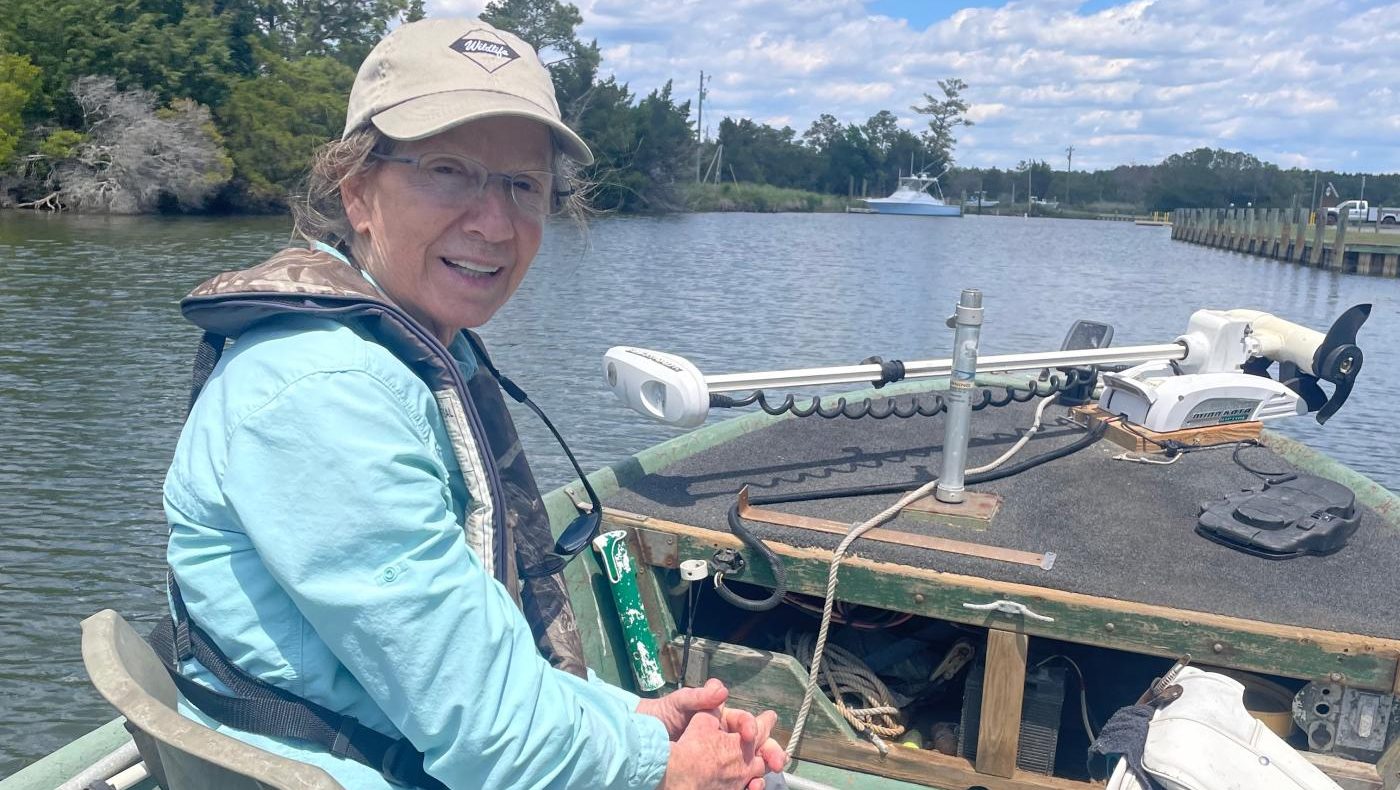
When I saw the news about Kelly Davis of Hyde County, I thought I would reach out to her – I’ll credit God with inspiring me to write a story about her life. Davis sees what many of us see and embrace – life in the country, rural living, small-town values, and deep roots in the land.
SWAN QUARTER — Kelly Davis came to Hyde County for a temporary job. More than four decades later, the county has put her name on the map.
The Swan Quarter Boating Access Area in Hyde County has been renamed the Kelly N. Davis Boating Access Area at Swan Quarter, honoring the former North Carolina Wildlife Resources Commission commissioner who represented District 1 from 2019 to 2025. For Davis, the recognition carries meaning that runs far deeper than a nameplate on a boat ramp.
“I am grateful for the opportunity to have served on the Wildlife Resources Commission and to continue working alongside them,” Davis said. “I hope this recognition reflects the importance of caring for our public resources and keeping them accessible for everyone.”
Subscribe — it’s free!
A Fresh Graduate and a One-Way Trip
The story begins in March 1980, when a young woman fresh off a wildlife management degree from Ohio State University packed up and headed to the Carolina coast — not for a career, not for a relationship, but for a temporary technician position at Mattamuskeet National Wildlife Refuge.
“Immediately after graduating from Ohio State in wildlife management in March 1980, I moved to Hyde County to work as a temporary employee at Mattamuskeet National Wildlife Refuge,” Davis recalled. “Not long afterward, the position became permanent, and I served as a biological technician and later a biologist for Mattamuskeet, Swanquarter, and Cedar Island National Wildlife Refuges.”
What she found in Hyde County was something she hadn’t expected: a community that took her in immediately.
“Hyde County’s welcoming people made me feel at home from the start, and it did not take long for me to build a life here surrounded by Hyde’s beauty and elbow room,” she said.
That life deepened when she married a Hyde County farmer who shared her passion for wildlife and the outdoors. Together they raised a daughter and a son in the county, both of whom, Davis says, carry a strong appreciation for Hyde’s outdoor life and enjoy bringing friends back to experience it.
Farming, Land, and Water
The Davis family operation — she refers to it simply as Davis Farms — spans multiple tracts across Hyde County rather than a single home place. By local standards, Davis describes it as a mid-sized operation. The land is worked in partnership with other local farmers, with the primary crops being corn, soybeans, and snapbeans.
Her role goes beyond passive ownership. Davis works closely with the farmers on land-use and water-management decisions covering both cropland and forested areas — a hands-on engagement that reflects the same stewardship ethic she brought to her years of federal wildlife work and later to the Wildlife Resources Commission.
Her late husband Calvin Blythe Davis came from one of Hyde County’s established families. His father, George Thomas Davis, was a Hyde County attorney. His brother Tom Davis also practiced law in the county and is now retired; Tom’s wife Kathy worked both in the law office and with Hyde County Schools. Calvin’s mother, Alma Lee Cathey Davis, arrived in Hyde County from the North Carolina mountains as an Extension agent, later joined the family law office, and became a fixture in the Swan Quarter community. Calvin’s uncle and aunt, Coleman and Ruth Davis, farmed near Lake Landing and built friendships across North Carolina during Hyde County’s celebrated goose hunting era of the 1950s and ’60s.
Life With Room to Breathe
Ask Kelly Davis what makes Hyde County special and she doesn’t reach for a single answer — she offers a world.
“Daily life in Hyde is still connected to the natural world,” she said. “I am surrounded by wildlife, big water, fresh air, and room to breathe. I can photograph birds and insects, explore my yard, or walk field paths and woods trails without ever getting in the truck.”
And when she does get in the truck, or take the boat, the rewards are immediate.
“Within minutes I can reach WRC game lands, national wildlife refuges, or the open waters of Pamlico Sound, with very little traffic and plenty of wildlife to enjoy along the way,” she said. “Every season offers something different: birding, fishing, hunting, walking, and photography.”
Davis has a particular fondness for photographing insects and reptiles — a niche enthusiasm that speaks to her eye for the overlooked details of the natural world.
Water draws her in multiple directions. She counts Swan Quarter Bay and Juniper Bay among her favorite spots, particularly for watching the sun set over Marsh Island. She explores the creeks along the Pungo River, kayaks the Lake Mattamuskeet bays near Lake Landing and Waupoppin Canals, and fishes while simultaneously birdwatching, identifying aquatic vegetation, and poking around islands and shorelines.
“I have too many favorites to choose just one,” she said.
The People Are the Place
If the landscape defines Hyde County’s character, its people define its soul — at least in Davis’s telling.
“Hyde County people are unique because many still live close to the realities of land and water,” she said. “Hyde people have practical knowledge of weather, soils, wildlife, seasons, markets, and how to adapt when conditions change.”
That practical wisdom has been tested repeatedly. Hurricanes, nor’easters, and economic downturns have all left their marks on a county that by any measure operates on thin margins. But Davis has watched Hyde County absorb those blows and keep moving.
“People here continue to work hard, help one another, and move forward,” she said. “What impressed me most when I first moved to Hyde County was the generosity of its people. They opened their doors and hearts to me from the beginning.”
That generosity is not abstract. It shows up in neighbors who appear when something breaks down, and who are just as quick to show up with fish, squash, cabbage, or sweet corn. It shows up in school programs, 4-H clubs, churches, and volunteer fire departments.
“Hyde County has a strong tradition of neighborliness, service, and pride in community,” Davis said. “There is a generosity and groundedness here that makes everyday life rich.”
On Being ‘Forgotten’
Hyde County is sometimes described as one of North Carolina’s forgotten places — a remote, sparsely populated county that can slip through the cracks when decisions are made in Raleigh or Washington. Davis understands where that perception comes from, even as she pushes back on it.
“Rural counties with small populations can sometimes be overlooked when decisions are made or resources are distributed,” she said. “But Hyde County is far from forgotten to the people who know it well. It is a place of extraordinary natural resources, deep history, strong families, and a resilient community.”
Changing that perception, in her view, isn’t about marketing or advocacy campaigns — it’s about recognition and support for what already exists.
“Its character and way of life are exactly what make it worth valuing and preserving,” she said.
A Name on a Boat Ramp
The renaming of the Swan Quarter Boating Access Area in her honor caps a six-year tenure on the Wildlife Resources Commission that itself grew out of a lifetime spent in Hyde County’s fields, waters, and communities. The access area sits at the edge of Swan Quarter Bay — one of the very spots Davis counts among her favorites, a place she has watched the sun go down over Marsh Island more times than she can count.
It is, in its way, a fitting location for a tribute. The boat ramp is a working piece of public infrastructure, not a monument — the kind of resource Davis has spent her career arguing for and protecting. People back their trailers down it, launch aluminum johnboats and kayaks, and head out onto the same waters she has navigated for 45 years.
Hyde County Shaped Her
When asked how Hyde County has shaped her, Davis pauses before answering in a way that suggests she has thought about it often.
“Living in a place so closely tied to land and water has taught me to value stewardship, patience, and paying attention to the natural world,” she said. “The rhythms of weather, seasons, wildlife, farming, and community life are reminders that what matters cannot be rushed and often depends on working with nature.”
The people, she says, shaped her just as much as the place.
“This is a community that knows how to appreciate nature, help neighbors, and carry on without fanfare,” she said. “Those qualities have influenced how I try to live my own life.”
She came to Hyde County in 1980 with a freshly printed degree and a temporary appointment. She stayed for a farmer, a family, a career, and a life woven into the fabric of one of North Carolina’s most distinctive places.
“Hyde County gave me a family, lasting friendships, and a deep sense of gratitude,” Davis said. “I came here for a job and it became home.“
Make a one-time donation
Make a monthly donation
Make a yearly donation
Choose an amount
Or enter a custom amount
Your contribution is appreciated.
Your contribution is appreciated.
Your contribution is appreciated.